


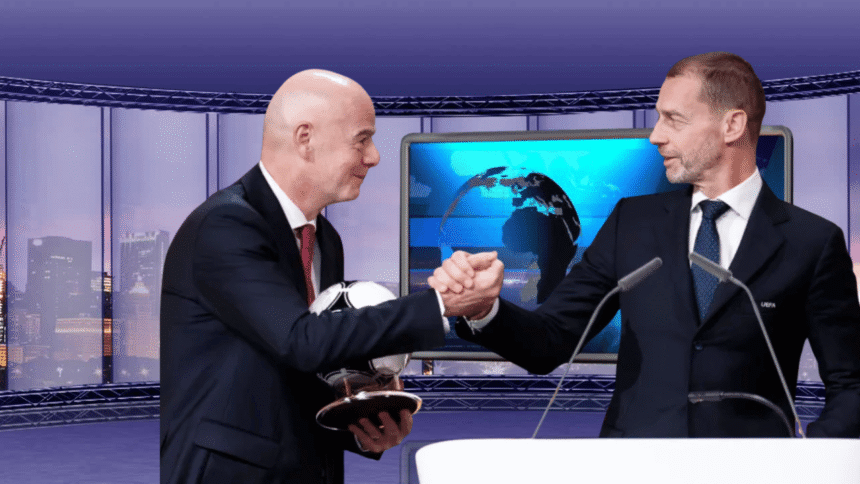
The decision came out of an emergency virtual meeting called after FIFA revealed on Tuesday that it intends to spin off its commercial operations into a new entity, valued at roughly $20 billion, with about 20 percent sold to outside investors. More than 40 UEFA representatives spoke during Thursday’s call, and the final vote was unanimous across all 55 member federations.
UEFA said afterward that it and its national associations will not participate in FIFA competitions while the plan remains on the table. The federation added that no UEFA national teams will take part in any FIFA competition for as long as the proposal is alive, unless it is fully withdrawn and FIFA guarantees it will never again open its governance or competitions to private ownership.
What Happened
FIFA’s proposal centers on a new commercial subsidiary, reported as the FIFA Forward Enterprise. The plan would sell a minority, non-controlling stake to outside investors, led by a New York investment firm founded by Joshua Kushner, brother of Jared Kushner. FIFA is seeking to raise up to $4.2 billion in an initial round.
Every one of FIFA’s 211 member federations has been given until September 19 to accept a one-time payment of $20 million tied to approving the plan. Infantino has framed the structure as a way to boost development funding across the global game, arguing it would eventually lift annual payouts to member federations well above current levels.
UEFA’s response was immediate and coordinated. Within 48 hours of FIFA’s announcement, Europe’s governing body had convened all 55 members and secured a unanimous boycott vote, a level of unity rarely achieved on contentious FIFA matters.
The proposal landed just weeks after a financially record-breaking men’s World Cup in North America, which pushed FIFA’s income over the last four-year cycle past $12 billion. That windfall is part of why the private equity plan drew such a sharp reaction from UEFA: officials at Thursday’s meeting repeatedly asked why FIFA’s own reserves, swollen by that tournament, could not fund development programs without outside investors.
Spain, the reigning World Cup champions, along with semifinalists France and England, are among the teams that would be affected if a boycott of the 2030 tournament actually goes ahead. That edition is set to mark the World Cup’s 100th anniversary with matches spread across six countries and three continents, including games in South America.
The more immediate flashpoint is smaller but symbolically significant: the Women’s Under-20 World Cup, hosted by Poland from September 5, is the next FIFA competition on the calendar and the first test of whether UEFA’s boycott threat holds in practice.
Why This Matters
FIFA has backed down from confrontations with UEFA before. In 2021, the governing body abandoned a plan to hold the men’s World Cup every two years after facing the same kind of organized opposition from Europe. That history is shaping how seriously this threat is being taken across the sport.
The dispute is fundamentally about control. UEFA’s objection is not only financial but about who is allowed to own a piece of international football’s biggest asset. UEFA argued that once outside investors acquire ownership stakes in FIFA competitions, the sport changes permanently, with commercial return becoming a fixed obligation and investor expectations turning into constant pressure.
For Infantino, the stakes go beyond this one proposal. A prolonged standoff with Europe, which combined with Asia represents close to half of FIFA’s global membership, would weaken his authority heading into a World Cup cycle built around expansion into new markets and new revenue streams.
Reactions and Expert Views
FIFA has defended the plan as a development tool rather than a sell-off. Infantino said the initiative is about the democratization of football worldwide, and FIFA has said the funds raised would be reinvested into the sport rather than distributed to shareholders.
Opposition is not confined to Europe. CONCACAF, which includes the United States, Mexico and Canada, said it was troubled by the lack of consultation before the plan was made public. The Asian Football Confederation went further, with president Sheikh Salman bin Ibrahim Al Khalifa warning that FIFA’s unilateral actions appear to undermine the foundations of continental football.
Notably, Sheikh Salman lost the 2016 FIFA presidential election to Infantino and has generally been considered an ally since. His public criticism signals that discomfort with the plan extends well beyond UEFA’s usual sphere of influence.
What Happens Next
FIFA’s September 19 deadline for member federations to accept the $20 million payment now sits at the center of the standoff. Whether Infantino adjusts or withdraws the proposal before then will likely determine if the boycott threat is tested in practice.
The Women’s Under-20 World Cup in Poland, starting September 5, arrives before that deadline and will be the first real signal of how far UEFA is willing to go. A full boycott of the senior World Cup would not become a live issue until closer to 2030, but the coalition being built now, spanning Europe, parts of Asia and CONCACAF’s early objections, will shape how much leverage FIFA’s presidency has for the rest of this cycle.