- Football formations explained: how to read the numbers
- Football formations explained: the 4-4-2, two banks of four
- Football formations explained: the 4-3-3, width and pressing
- The 4-2-3-1: balance in the middle
- The 3-5-2: wing-backs and midfield numbers
- Football formations explained: the 5-3-2
- The 3-4-3: three forwards and width
- Football formations explained: comparing the six
- Football formations explained: how to choose a formation
- Football formations explained: frequently asked questions
- What is the most common formation in football?
- What do the numbers in a formation mean?
- Can a team change formation during a match?
- Which formation is best for defending a lead?
- What is a wing-back?
- Conclusion
Football formations explained begins with a simple idea: a formation is a set of numbers that shows where a team’s ten outfield players stand on the pitch. When a television graphic shows 4-4-2 or 4-3-3 before kick-off, it tells you the shape of the team.
Last updated: November 2026
Quick Answer
- Football formations explained in one line: the numbers show how the ten outfield players spread across the pitch, read from back to front.
- 4-4-2 means four defenders, four midfielders and two forwards; 4-3-3 means four defenders, three midfielders and three forwards.
- The goalkeeper is not counted in the numbers.
- A formation is only a starting point — teams change shape during a match.
- No single formation is the best one; each suits a different kind of team.
Football formations explained: how to read the numbers
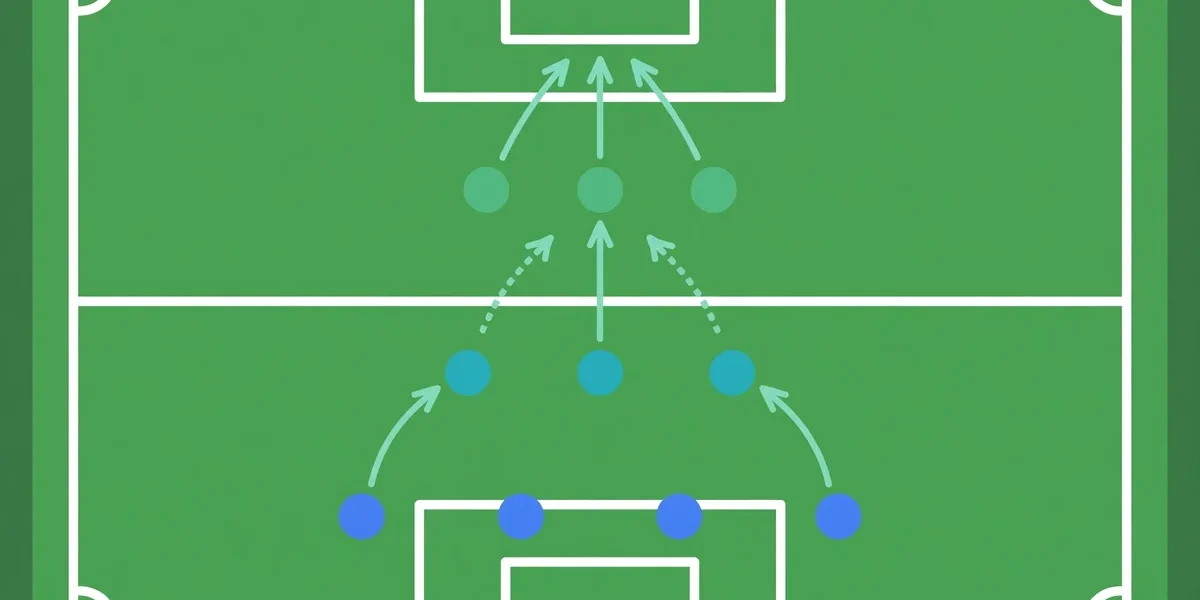
Read the numbers from back to front. First, the opening number gives the defenders. After that, the second number gives the midfielders, and the last number gives the forwards. For example, 4-4-2 means four defenders, four midfielders and two forwards, while 3-5-2 means three centre-backs, five midfielders and two strikers. In short, football formations explained means reading the numbers from back to front. The goalkeeper does not appear in the numbers, because every team has one.
However, a formation is only a starting point. Teams rarely hold one shape for ninety minutes: full-backs push forward and wingers drop back, so a team that defends in a 4-4-2 can attack in a 4-3-3. For that reason, the numbers show the plan at kick-off, not the shape at every moment. To learn what each player does inside the shape, read our guide on football positions explained.
Football formations explained: the 4-4-2, two banks of four
In a 4-4-2, two banks of four sit behind two strikers: four defenders, four midfielders and two forwards. It is the simplest shape in football.
First, the two banks of four make the team very compact in defence, so opponents find little space between the lines. Second, the shape is easy to coach, so players settle into it fast. Third, the two strikers form a natural partnership, with one holding the ball up and the other running in behind. Finally, the compact shape suits quick counter-attacks.
However, the 4-4-2 has real weaknesses. Its two central midfielders can face three opponents in the middle, so the team can lose control of the game. In addition, the build-up can turn predictable, and the wide midfielders must track back a long way.
Arrigo Sacchi’s AC Milan of the late 1980s made the 4-4-2 famous. Sacchi kept the lines compact and pressed as a unit, and his Milan side showed that a simple shape, played with discipline, can beat more complex systems.
Football formations explained: the 4-3-3, width and pressing
A 4-3-3 uses four defenders, three midfielders and a front three of two wingers and a centre forward. It is the shape of teams that want the ball and want to attack with width.
For example, the wingers give the team natural width, so the attack can stretch the pitch. In addition, three midfielders help the team keep the ball, and the three forwards give the team a strong pressing shape.
On the other hand, the 4-3-3 has weaknesses. Its lone centre forward can end up isolated against several defenders. Full-backs push high, so space opens up behind them, and wingers must track back, or the full-backs face two attackers on their own.
Pep Guardiola’s Barcelona played a 4-3-3 built on possession and passing. His team kept the ball, pressed hard when it lost the ball, and used the wingers to stretch the pitch.
The 4-2-3-1: balance in the middle
In a 4-2-3-1, four defenders sit behind two holding midfielders, three attacking midfielders and one striker. The two holding midfielders form a double pivot, and a number 10 links the play to the striker.
For example, the double pivot protects the defence, so the back four rarely face attacks on their own. The number 10 links the midfield to the striker, and three attacking midfielders give the team width around the box.
However, the 4-2-3-1 has two main weaknesses. Its lone striker can end up isolated, with little support when the ball goes long. The shape also relies on a creative number 10, so the attack can stall when that player has a quiet game.
The 3-5-2: wing-backs and midfield numbers
A 3-5-2 uses three centre-backs, five midfielders including two wing-backs, and two strikers. Wing-backs play the full length of the flank, defending like full-backs and attacking like wingers.
For example, the team overloads central midfield, so it can dominate possession and win second balls. Three centre-backs give the team great defensive stability. In addition, wing-backs stretch the field, so the attack has width without wingers. Finally, two strikers give the team a partnership up front, just like the 4-4-2.
On the other hand, the 3-5-2 has clear weaknesses. Wing-backs need extreme fitness, because they run the whole flank for the full match. When wing-backs push high, space opens up behind them, so opponents can attack the wide areas.
Football formations explained: the 5-3-2
The 5-3-2 is the defensive version of the 3-5-2. It uses five at the back, three centre-backs plus two wing-backs, with three midfielders and two strikers. Wing-backs sit deeper, so the shape turns into a back five when the team defends.
First, five defenders crowd the penalty area, so opponents find few gaps to play through. As a result, the shape suits a team that wants to protect a lead, and two strikers still give the team an outlet on the break.
However, the 5-3-2 has clear weaknesses. A team can turn too defensive, so it creates few chances of its own. Its midfield three can face more opponents in the middle. In addition, the team can sit too deep, so the strikers end up far from the goal and isolated.
The 3-4-3: three forwards and width
A 3-4-3 uses three centre-backs, four midfielders including two wing-backs, and three forwards. It is an attacking shape with width and three players high up the pitch.
For example, three forwards give the team numbers high up the pitch, so it can press hard and create chances. Wing-backs stretch the field, so the attack has width on both flanks. In addition, three centre-backs give the team cover behind the attack.
However, the 3-4-3 has one main weakness. It uses only two central midfielders, so a team with three in the middle can overrun the centre. Wing-backs must also work very hard, because they defend the flanks and join the attack.
Antonio Conte’s Chelsea won the league in 2016-17 playing 3-4-3, after Conte switched to the shape following a poor start.
Football formations explained: comparing the six
The table below compares the six formations at a glance. It shows trade-offs, not a ranking.
| Formation | Shape | Best at | Watch out for |
|---|---|---|---|
| 4-4-2 | Two banks of four, two strikers | Compact defence, counter-attacks | Midfield outnumbered |
| 4-3-3 | Four defenders, front three | Keeping the ball, pressing | Lone striker isolated |
| 4-2-3-1 | Double pivot, number 10 | Balance in defence and attack | Needs a creative number 10 |
| 3-5-2 | Three centre-backs, wing-backs | Controlling central midfield | Wing-backs caught high |
| 5-3-2 | Back five, two strikers | Protecting a lead | Sits too deep |
| 3-4-3 | Three centre-backs, front three | Attacking width, pressing | Two central midfielders only |
Football formations explained: how to choose a formation
A coach picks a formation to fit the players. For example, a team with two good strikers suits a 4-4-2 or a 3-5-2, while a team with strong wingers suits a 4-3-3 or a 3-4-3. In addition, a team with a creative number 10 suits a 4-2-3-1.
The opponent matters too. A coach may pick a 5-3-2 against a stronger team to stay compact, or a 4-3-3 against a weaker team to attack with width. The game state matters as well: a team that chases a goal needs more attackers, while a team that protects a lead needs more defenders.
Form also plays a part. A team in good form may keep the same shape week after week. To judge whether a team is in good shape before a match, read our guide on how to analyse football form.
Football formations explained: frequently asked questions
In short, these are the questions fans ask most about football formations explained.
What is the most common formation in football?
In fact, the 4-3-3 and the 4-2-3-1 are the most common shapes at the top level, because they balance defence and attack well.
What do the numbers in a formation mean?
Read the numbers from back to front: defenders, midfielders, forwards. The goalkeeper is not counted.
Can a team change formation during a match?
Yes. A team can change shape with a substitution, or the coach can move players into new roles. For example, a team that starts in a 4-4-2 can finish in a 3-4-3.
Which formation is best for defending a lead?
In fact, the 5-3-2 suits protecting a lead, because five defenders crowd the penalty area. The risk is that the team sits too deep and invites pressure.
What is a wing-back?
A wing-back plays the full length of the flank, defending like a full-back and attacking like a winger. Wing-backs need great fitness.
Conclusion
Football formations explained comes down to a simple idea: the numbers show where the ten outfield players stand, and each shape trades one strength for one weakness. The 4-4-2 gives compactness, the 4-3-3 gives width, the 4-2-3-1 gives balance, the 3-5-2 gives midfield numbers, the 5-3-2 gives defensive strength, and the 3-4-3 gives attacking power. No single formation is the best one. For more football stories, visit our Sports News page. Follow the next matches on our free live scores page, and see ideas for upcoming matches on our free football predictions page.