
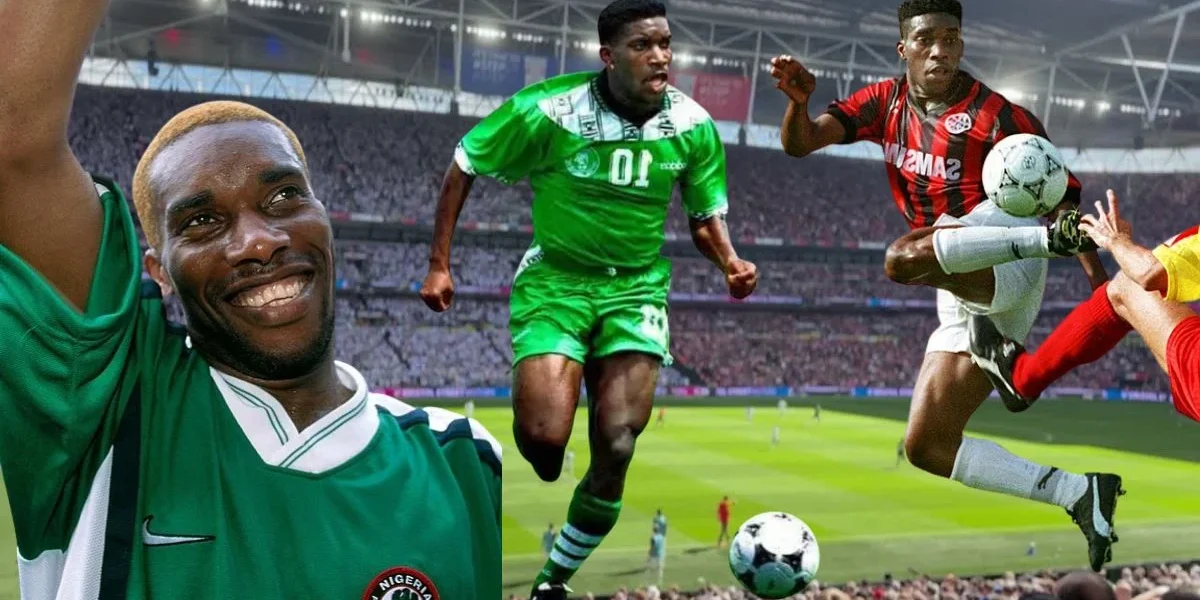
Nigeria has produced many great footballers, but few are remembered with as much affection as Augustine Azuka “Jay-Jay” Okocha. Fans still talk about his stepovers, flicks and long-range goals, and many younger Nigerian players grew up trying to copy them.
So, how did Jay-Jay Okocha influence Nigerian football? His impact came in several ways: he helped deliver the country’s greatest titles, gave the Super Eagles a creative identity, changed how European clubs valued African players and inspired a new generation. This article looks at each of these areas, from his playing career to his work after retirement.
Who Is Jay-Jay Okocha?
Okocha was born in Enugu on 14 August 1973. An attacking midfielder, he played in Germany for Eintracht Frankfurt, in Turkey for Fenerbahçe, in France for Paris Saint-Germain and in England for Bolton Wanderers and Hull City. For Nigeria, he won 73 caps and scored 14 goals between 1993 and 2006, playing at three World Cups.
He first became famous in 1993 with a Bundesliga goal for Frankfurt against Karlsruhe, when he dribbled past several defenders and goalkeeper Oliver Kahn before scoring. It was voted Germany’s Goal of the Year and introduced European audiences to his remarkable close control.
A Key Part of Nigeria’s Golden Generation
Okocha made his Nigeria debut in May 1993 in a World Cup qualifier against Ivory Coast. Within a year, he was part of the team that won the 1994 Africa Cup of Nations in Tunisia and then played at Nigeria’s first-ever World Cup in the United States, where the Super Eagles reached the round of 16.
His biggest international success came at the 1996 Olympic Games in Atlanta. Nigeria came back from 3-1 down to beat Brazil in the semi-final and from 2-0 down to beat Argentina 3-2 in the final. It was the first time an African nation had won the men’s Olympic football tournament, and Okocha was one of the team’s main creative players.
Later, as captain in the mid-2000s, he kept Nigeria competitive in Africa. At the 2004 Africa Cup of Nations, he was joint top scorer with four goals and was named the tournament’s best player, helping Nigeria finish third. Nigeria also reached the final in 2000 and finished third in 2002 and 2006 during his time in the team.
Giving Nigerian Football a Creative Identity
Before Okocha, Nigerian teams were often praised mainly for their pace and physical power. Okocha showed that a Nigerian player could also be the most technical player on the pitch. His version of the stepover became known as the “Okocha stepover”, and his mix of tricks, free kicks and passing made entertainment part of the Super Eagles’ style.
This influence is still visible today. Nigerian fans continue to value flair in their attacking midfielders, and Okocha is often the standard against which new playmakers are judged.
Changing How Europe Valued African Players
In 1998, Paris Saint-Germain paid around £14 million to sign Okocha from Fenerbahçe, making him the most expensive African player at the time. The fee sent a clear message that an African playmaker could be the centrepiece of a major European club. He played 84 games for PSG and scored 12 goals.
At PSG, he also spent the 2001-02 season alongside a young Ronaldinho, who has often spoken of his admiration for Okocha. Okocha himself has been modest about this, telling Pulse Sports in 2023 that Ronaldinho “picked one or two things from me” but did not need to be taught.
At Bolton, where he joined on a free transfer in 2002, he became captain and a fan favourite, inspiring the chant “so good they named him twice”. He helped Bolton reach the 2004 League Cup final and qualify for the UEFA Cup for the first time in the club’s history. He was also named BBC African Footballer of the Year in 2003 and 2004.
Inspiring the Next Generation
Okocha’s influence is especially clear in his own family. His nephew, Alex Iwobi, played youth football for England before choosing to represent Nigeria, and he has described his uncle as his biggest inspiration. Iwobi has since become an important player for the Super Eagles.
Away from the pitch, Okocha has stayed involved in Nigerian football. In February 2015, he was elected chairman of the Delta State Football Association, and he has also worked as a television pundit for SuperSport.
A Legacy Beyond Trophies
Okocha never won the CAF African Footballer of the Year award, finishing second in 1998, and Nigeria never went beyond the World Cup round of 16 during his career. Yet in 2004, Pelé named him in the FIFA 100 list of the greatest living players. His real influence on Nigerian football was not only in medals, but in the belief that Nigerian players could compete with the best while playing with freedom and joy.