
- The Short Answer: Where You Can Bet in October 2026
- Sportsbooks vs. online casinos at a glance
- What Is a Sportsbook?
- What Is an Online Casino?
- Why Sports Betting Spread So Much Faster
- The 2018 Supreme Court ruling
- Online casinos never had that moment
- Follow the Money: How the Two Markets Compare
- The World Cup Effect
- The Grey Zones: Prediction Markets and Sweepstakes Casinos
- Prediction markets
- Sweepstakes casinos
- Taxes: A New Rule for 2026
- Which One Is Right for You?
- What to Watch in 2027
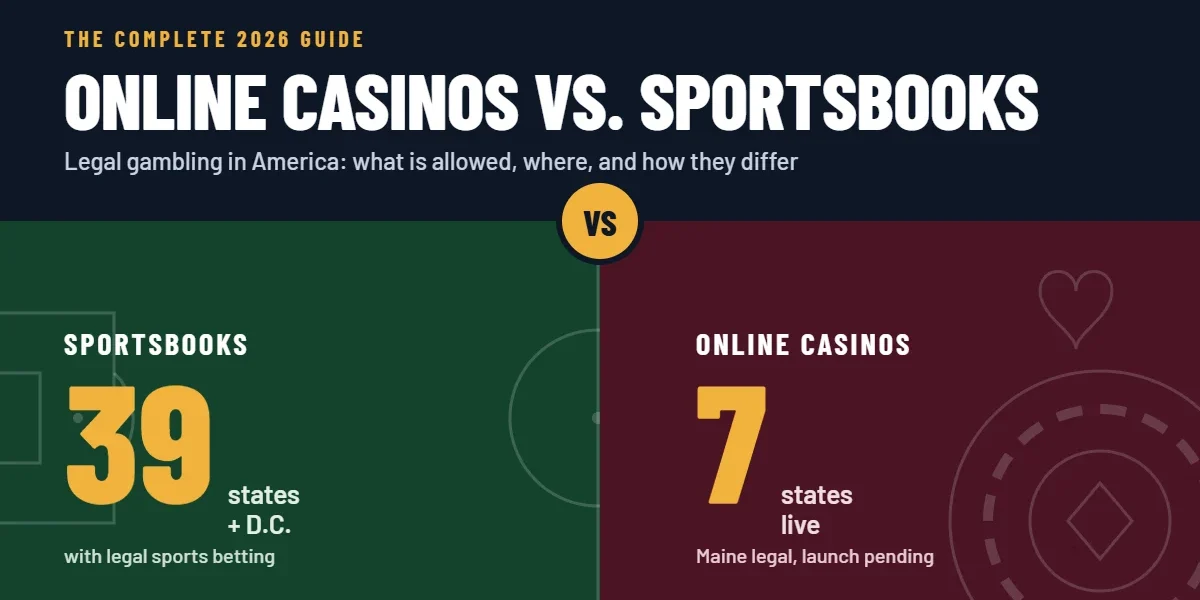
Sports betting is legal in 39 states. Real-money online casinos are live in just seven. Here is exactly what is allowed where, how the two products really differ, and the court battles and tax changes that could reshape American gambling in 2027.
The 2026 World Cup turned millions of Americans into football bettors. Spain’s 1-0 win over Argentina in the final became the most-bet soccer match ever at BetMGM, Caesars Sportsbook and DraftKings, and DraftKings alone took 2 million bets on that one game. Yet a fan watching the final in New Jersey could also open a real-money casino app that night. A fan in Ohio could not.
That difference explains a lot about gambling in the United States. Sportsbooks and online casinos are often treated as one industry, but legally they are separate products with separate laws, regulators and tax rates. Each state decides for itself what to allow, and the result is a patchwork that confuses locals and visitors alike.
This guide explains what separates a sportsbook from an online casino, shows where each is legal as of October 2026, compares how the money and the odds work, and looks at the three issues that will shape the next year: prediction markets, sweepstakes casinos and a new federal tax rule.
The Short Answer: Where You Can Bet in October 2026
Sports betting is legal in some form in 39 states, plus Washington, D.C., and Puerto Rico. Roughly 30 of those states, plus D.C., offer statewide online betting through licensed apps. Eight others, including Mississippi, Montana, Nebraska and Washington, limit betting to retail venues, kiosks or tribal casinos.
Real-money online casinos are much rarer. They are live in only seven states: New Jersey, Pennsylvania, Michigan, West Virginia, Delaware, Connecticut and Rhode Island. Maine became the eighth state to legalize them in January 2026, with licences reserved for its four Wabanaki Nations, but its rules were still in draft at the end of September and no site has launched. Nevada allows online poker only.
Eleven states still have no legal sports betting at all: Alabama, Alaska, California, Georgia, Hawaii, Idaho, Minnesota, Oklahoma, South Carolina, Texas and Utah. California and Texas, the two most populous states, remain the biggest gaps on the national map.
Sportsbooks vs. online casinos at a glance
| Sportsbooks | Online casinos | |
| Legal status (Oct 2026) | 39 states, D.C. and Puerto Rico; about 30 states plus D.C. online | Live in 7 states; Maine legal but not yet launched |
| What you bet on | Real sporting events, from the Premier League to the NFL | Slots, blackjack, roulette, baccarat, video poker, live dealer games |
| Who sets the price | The bookmaker’s odds, which move with news and money | Fixed game rules with a built-in house edge |
| Does knowledge help? | Yes, research can improve your decisions | Mostly no; results come from cards or random number generators |
| Typical margin | About 4.5% on a standard -110 bet | About 0.5% (blackjack, basic strategy) to 5.26% (American roulette); slots vary |
| 2025 US commercial revenue | $16.96 billion | $10.74 billion |
What Is a Sportsbook?
A sportsbook is a bookmaker that takes bets on real events: a Premier League match, an NFL game or the World Cup winner. In the US, most betting now happens on mobile apps from companies such as FanDuel, DraftKings, BetMGM, Caesars, Fanatics and bet365, each licensed separately in every state where it operates.
The sportsbook earns money through the margin built into its odds, known as the “vig” or “juice”. On a standard bet priced at -110, you risk $110 to win $100. If two bettors take opposite sides at those prices, the book collects $220, pays out $210 and keeps about 4.5% of everything wagered.
Because results depend on real games, knowledge matters. A fan who follows team news, injuries and tactics can make better decisions than a casual bettor, although most people still lose over time. Popular football markets include the match result, both teams to score, over/under goals, player props and same-game parlays, which combine several outcomes on one ticket.
What Is an Online Casino?
An online casino, often called iGaming, offers digital versions of casino games for real money: slots, blackjack, roulette, baccarat, video poker and live dealer tables streamed from a studio. In regulated states, the apps are usually run by the same companies behind the big sportsbooks or land-based casinos, and the games are tested and audited for fairness.
The key difference is that every casino game carries a fixed mathematical edge for the house. American roulette, with its 0 and 00 pockets, has a house edge of 5.26%. Blackjack played with perfect basic strategy can fall to around 0.5%, while slots vary widely from game to game. Football knowledge does not help here.
Casino games are also much faster. A football bet may take 90 minutes to settle, while a slot spin takes a few seconds. That speed is why health experts see online casinos as a higher risk for problem gambling, and it is the main argument opponents use whenever a new state debates legalization.
Why Sports Betting Spread So Much Faster
The 2018 Supreme Court ruling
Before May 2018, a federal law called the Professional and Amateur Sports Protection Act (PASPA) kept full single-game sports betting mostly limited to Nevada. When the Supreme Court struck it down in Murphy v. NCAA, every state gained the right to legalize sports betting. Missouri, which launched in December 2025, is the most recent state to open a market.
Online casinos never had that moment
Online casino expansion has no single trigger. Delaware passed its law in 2012, New Jersey launched in 2013, Pennsylvania followed in 2017 and Michigan in 2019. Since then, progress has been slow. Lawmakers worry that online slots will pull customers away from land-based casinos, and the National Association Against iGaming, backed by operators including Churchill Downs and Cordish, lobbies against new bills.
Virginia came closest in 2026. Both chambers passed online casino bills, but the House and Senate could not agree on a single version before the session ended on March 14, pushing the debate into 2027. A similar effort in Maryland also stalled.
Follow the Money: How the Two Markets Compare
Both products are booming. According to the American Gaming Association (AGA), US commercial gaming produced a record $78.72 billion in revenue in 2025, up 9.2% on the year before. Sports betting generated $16.96 billion from $166.94 billion in wagers, which means operators kept roughly 10 cents of every dollar bet.
Online casinos earned $10.74 billion, a jump of 27.6%, despite being legal in only seven states. That makes iGaming far more valuable per state than sports betting. Pennsylvania led with $3.46 billion, and in 2025 online casino revenue overtook land-based casino revenue in both Pennsylvania and New Jersey for the first time.
Taxes explain why lawmakers keep returning to both. Legal gaming produced $18.09 billion in tax revenue in 2025, with online casinos contributing $2.59 billion. Rates vary hugely by state: New York takes 51% of online sports betting revenue, Iowa just 6.75%, while Pennsylvania charges 54% on online slots.
The World Cup Effect
The 2026 World Cup, co-hosted by the United States, Canada and Mexico, showed how big football betting has become in America. Caesars Sportsbook reported 30% more bets than the men’s and women’s March Madness basketball tournaments combined, and Hard Rock Bet’s Neil Walsh called it “the equivalent of ten Super Bowls”.
The new 48-team format, with 104 matches, and kickoff times suited to American evenings both helped. For international fans visiting the US, one rule matters most: legal access depends on where you are physically located, not where you live. Betting apps use geolocation checks to confirm you are inside a legal state before accepting any wager.
The Grey Zones: Prediction Markets and Sweepstakes Casinos
Prediction markets
The biggest legal fight in American gambling right now involves neither casinos nor traditional sportsbooks. Prediction market platforms such as Kalshi sell “event contracts” on sports results and argue they are financial products overseen by the federal Commodity Futures Trading Commission (CFTC), not bets under state law. That argument lets them reach customers even in states without legal sports betting.
The courts disagree. In April, the 3rd Circuit Court of Appeals sided with Kalshi against New Jersey. In August, the 9th Circuit ruled that Nevada can regulate the contracts, and on September 25 the 6th Circuit said the same for Ohio and Tennessee. In October, a federal judge in Illinois blocked that state from applying its gambling rules to Kalshi.
The Supreme Court is now considering whether to hear the issue, and attorneys general from 39 states and D.C. have filed a joint brief supporting state control. The AGA estimates prediction markets have already cost states more than $500 million in potential sports betting tax revenue.
Sweepstakes casinos
Sweepstakes casinos offer slot-style games using virtual coins that can be swapped for cash prizes, operating under promotional sweepstakes law rather than gambling law. States are closing this route fast. California’s ban took effect on January 1, 2026, following earlier bans in New York, New Jersey, Connecticut and Montana, while Indiana, Maine and Louisiana acted during 2026.
Taxes: A New Rule for 2026
Winnings from both sportsbooks and online casinos count as taxable income in the US. From January 1, 2026, the One Big Beautiful Bill Act limits the deduction for gambling losses to 90% of those losses, still capped at the amount you won, and only if you itemize deductions.
In practice, a bettor who wins $100,000 and loses $100,000 in a year can now deduct only $90,000, leaving $10,000 of taxable income despite breaking even. Bipartisan bills to restore the full deduction have been introduced in Congress, but the 90% limit applies to the 2026 tax year.
Which One Is Right for You?
For football fans, the answer usually depends on what you enjoy. If the appeal is using your knowledge of teams, form and tactics, a licensed sportsbook is the natural fit, and it is available in far more states. If you want quick entertainment, online casinos offer it, but only in seven states, and the speed of play means losses can build faster.
Whichever you choose, stick to state-licensed operators. Offshore sites that accept American customers are not regulated by US authorities, so there is no guaranteed payout, no official dispute process and no consumer protection. Licensed apps must offer deposit limits, time limits and self-exclusion, and most states set the minimum betting age at 21.
What to Watch in 2027
Three questions will shape the next year. First, whether the Supreme Court takes the prediction markets case, which could decide who regulates sports betting in America. Second, whether Maine finally launches its tribal online casinos and Virginia passes iGaming. Third, whether Wisconsin’s 11 tribes can agree deals to launch the online sports betting law signed in April 2026.
The overall direction is clear even if the pace is slow. Sports betting now covers most of the country, while online casinos remain a small but highly profitable club. For anyone betting on football in the US, the most important check is still the simplest one: what your state actually allows.
If gambling stops being fun, call or text the National Problem Gambling Helpline at 1-800-GAMBLER for free, confidential support.
