- The early years of super eagles history
- First AFCON title: Lagos 1980 — super eagles history
- The golden generation: 1994 — super eagles history
- World Cup debut at USA 1994 — super eagles history
- Olympic gold in Atlanta 1996
- The 1998 World Cup and beyond
- Third AFCON title: South Africa 2013 — super eagles history
- Near misses and the 2023 final
- Super eagles history: the honours list
- The legends of super eagles history
- Why super eagles history matters
- Frequently Asked Questions
- How many AFCON titles have the Super Eagles won?
- When did Nigeria first play at the World Cup?
- Who is the Super Eagles' all-time top scorer?
- What is the greatest achievement in super eagles history?
- Have the Super Eagles ever won the World Cup?
- Why are they called the Super Eagles?
- Conclusion
Super eagles history is one of the proudest stories in African football. The Nigeria national team has won the Africa Cup of Nations three times, played at six World Cups, and won an Olympic gold medal. This guide covers the biggest wins, the famous teams, and the legends who built the name.
Last updated: November 2026
Quick Answer
- The Nigeria national team is known as the Super Eagles, after first being called the Green Eagles.
- The Super Eagles have won the Africa Cup of Nations three times: 1980, 1994 and 2013.
- Nigeria made their World Cup debut at USA 1994 and have reached the Round of 16 three times.
- At the 1996 Atlanta Olympics, Nigeria won the gold medal in men’s football, a first for an African nation.
- The Golden Eaglets have won the FIFA U-17 World Cup five times, more than any other country.
The early years of super eagles history
The story began with the Green Eagles, the name the team used in its early years. Nigeria made their Africa Cup of Nations debut in 1963 and finished sixth. In those days, the team was still learning how to compete with the best sides on the continent.
Nigeria reached the AFCON semi-finals in 1976 and 1978, but the final step proved too hard. All of that changed in 1980, when the tournament came to Nigerian soil.
First AFCON title: Lagos 1980 — super eagles history
The first great chapter was written in 1980. Nigeria hosted the Africa Cup of Nations, and the Green Eagles played the final at the National Stadium in Surulere, Lagos. In front of a huge home crowd, Nigeria beat Algeria 3-0 to win the title for the first time.
Brazilian coach Otto Glória led the team, with captain Christian Chukwu at the heart of the defence and winger Segun Odegbami among the stars. The 3-0 win was clear and complete, and it gave Nigeria its first major trophy. Football became the sport that united the country, and the Green Eagles became heroes.
After 1980, Nigeria reached three more finals — 1984, 1988 and 1990 — but lost each one. The second title stayed out of reach for fourteen years.
The golden generation: 1994 — super eagles history
The second great chapter came in 1994. That year produced the finest Nigerian team many fans have ever seen. At the Africa Cup of Nations in Tunisia, Nigeria beat Zambia 2-1 in the final to win their second title. Striker Rashidi Yekini was the top scorer of the tournament, and he remains the Super Eagles’ all-time top scorer.
Stephen Keshi captained the side. Jay-Jay Okocha showed the skill that made him famous, and Nwankwo Kanu brought clever movement and a cool finish. Together, they played fast, attacking football that won fans far beyond Nigeria.
The same year, the 1994 team reached 5th place in the FIFA world rankings, the highest ranking ever achieved by an African team.
World Cup debut at USA 1994 — super eagles history
The team reached the world stage at the 1994 World Cup in the United States. In their first World Cup, they topped a group that included Argentina, Bulgaria and Greece, beating Bulgaria 3-0 and Greece 2-0.
Rashidi Yekini scored Nigeria’s first-ever World Cup goal in the 3-0 win over Bulgaria. His celebration — arms wide, face to the sky — is still one of the most famous images in Nigerian football. Nigeria reached the Round of 16, where they lost 2-1 to Italy.
Olympic gold in Atlanta 1996
Two years later came the greatest single achievement in the team’s story. At the 1996 Atlanta Olympics, Nigeria’s U-23 team, known as the “Dream Team”, won the gold medal in men’s football. They beat Brazil 4-3 in the semi-final, then Argentina 3-2 in the final.
Nigeria became the first African nation to win Olympic gold in football. Kanu, Okocha and their team-mates returned home as national heroes. Nigeria also won Olympic silver in 2008, but the 1996 gold remains the high point.
The 1998 World Cup and beyond
Nigeria returned to the World Cup in France in 1998 and beat Spain 3-2 in the group stage, one of Nigeria’s most famous World Cup results. They reached the Round of 16 again, matching the feat of 1994.
After 1998, the road became harder. Nigeria played at the World Cups of 2002 and 2010 without reaching the knockout rounds. They returned to the Round of 16 in Brazil in 2014. However, Nigeria did not qualify for the 2022 or 2026 World Cups. As of November 2026, Nigeria have played at six World Cups — 1994, 1998, 2002, 2010, 2014 and 2018 — and have never reached a quarter-final. The World Cup remains the one prize the Super Eagles have never won.
Third AFCON title: South Africa 2013 — super eagles history
The third great chapter came in 2013. Nineteen years later, Nigeria won the Africa Cup of Nations again in South Africa. The coach was Stephen Keshi, the same man who captained the 1994 title winners.
In the final in Johannesburg, Nigeria beat Burkina Faso 1-0, with Sunday Mba scoring the only goal. The win ended a long wait and gave a new generation of fans their own title to celebrate.
Near misses and the 2023 final
Nigeria have been runners-up at the Africa Cup of Nations five times: 1984, 1988, 1990, 2000 and 2023. The most painful came in the 2023 final, played on 11 February 2024 in Abidjan. Nigeria lost 2-1 to the hosts, Côte d’Ivoire, after taking the lead.
Yet the team bounced back. Nigeria have also finished third at AFCON nine times, including in 2025 after beating Egypt in the third-place match. See the full list in our AFCON winners list guide — the record shows a team that is almost always in the hunt for the trophy.
Super eagles history: the honours list
The biggest moments, as of November 2026, are in one table.
| Year | Achievement |
|---|---|
| 1963 | AFCON debut, finishing sixth |
| 1980 | First AFCON title, beating Algeria 3-0 in Lagos |
| 1994 | Second AFCON title, beating Zambia 2-1 in Tunisia |
| 1994 | World Cup debut at USA 1994, reaching the Round of 16 |
| 1994 | Reached 5th in the FIFA world rankings |
| 1996 | Olympic gold medal in Atlanta, beating Argentina 3-2 in the final |
| 1998 | Beat Spain 3-2 at the World Cup in France |
| 2008 | Olympic silver medal in Beijing |
| 2013 | Third AFCON title, beating Burkina Faso 1-0 in South Africa |
| 2023 | AFCON runners-up, losing 2-1 to Côte d’Ivoire in the final |
Nigeria’s Golden Eaglets have also won the FIFA U-17 World Cup five times — 1985, 1993, 2007, 2013 and 2015 — more than any other country.
The legends of super eagles history
No account of the team’s story is complete without the players who built it. Rashidi Yekini, the all-time top scorer, led the line in 1994 and scored Nigeria’s first World Cup goal. Stephen Keshi captained the 1994 champions and coached the 2013 champions. Jay-Jay Okocha brought skill that made defenders look lost, and Nwankwo Kanu gave the attack a calm, clever presence.
The earlier heroes matter too. Christian Chukwu captained the 1980 title winners, and Segun Odegbami lit up the left wing in Lagos. Their names still come up in every debate about the greatest Super Eagles team.
Why super eagles history matters
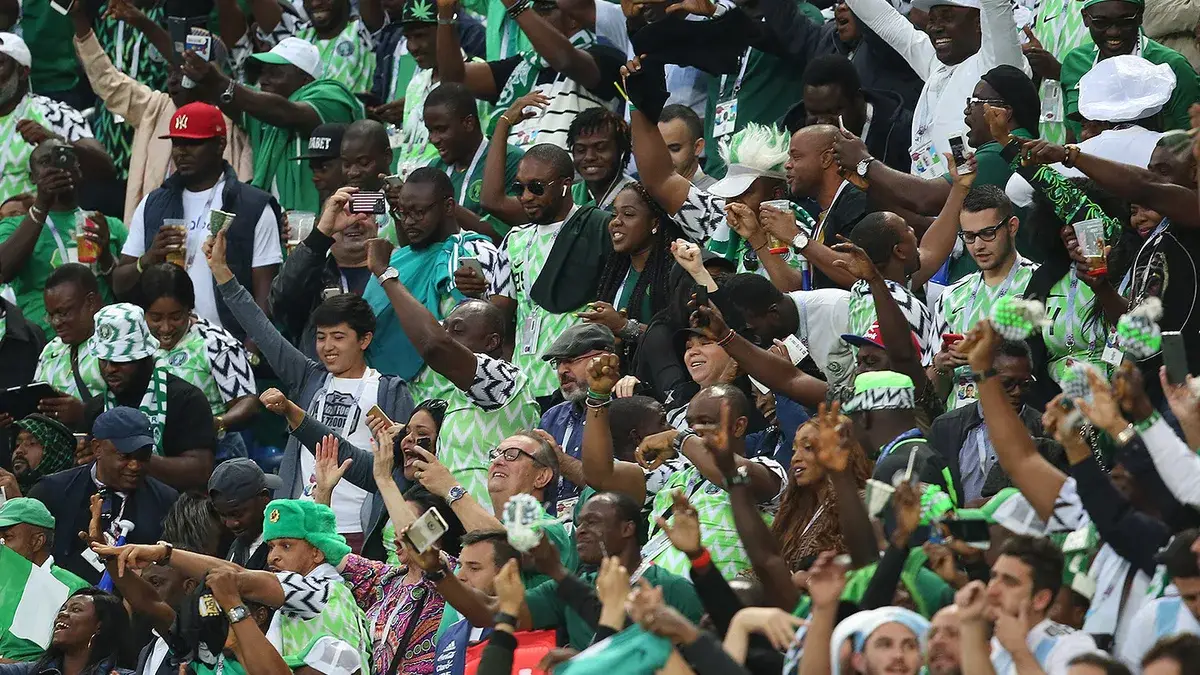
This history matters because the team means so much to Nigeria. When the Super Eagles play, the whole country watches. The green shirt is a symbol of unity, and a big win can lift the mood of millions.
There is a lesson in this history too. The Super Eagles have won three AFCON titles, yet they have lost five finals and finished third nine times. Success has never been easy, and the near misses are part of the story.
You can follow the team’s next matches on our free live scores page. See ideas for upcoming matches on our free football predictions page. To learn how betting works, visit the Betting Academy.
Frequently Asked Questions
How many AFCON titles have the Super Eagles won?
The Super Eagles have won the Africa Cup of Nations three times: 1980, 1994 and 2013. They have also been runners-up five times and finished third nine times.
When did Nigeria first play at the World Cup?
Nigeria made their World Cup debut at USA 1994. They topped their group and reached the Round of 16, where they lost 2-1 to Italy.
Who is the Super Eagles’ all-time top scorer?
Rashidi Yekini is the Super Eagles’ all-time top scorer. He was the top scorer at the 1994 AFCON and scored Nigeria’s first-ever World Cup goal.
What is the greatest achievement in super eagles history?
Many fans point to the Olympic gold medal at Atlanta 1996. Nigeria became the first African nation to win Olympic gold in football, beating Brazil and Argentina on the way.
Have the Super Eagles ever won the World Cup?
No. Nigeria have played at six World Cups and reached the Round of 16 three times, in 1994, 1998 and 2014, but they have never reached a quarter-final.
Why are they called the Super Eagles?
The team was first known as the Green Eagles before taking the Super Eagles name. The eagle is a symbol of strength, and the name has stuck ever since.
Conclusion
It is a story of three AFCON titles, six World Cups, an Olympic gold medal, and near misses that make the wins sweeter. From the Green Eagles of 1963 to the title winners of 1980, 1994 and 2013, the team has given Nigerian football its greatest moments. The legends — Yekini, Keshi, Okocha, Kanu, Odegbami and Chukwu — built a name that still carries pride across Africa. For more football stories, visit our Sports News page.
For the full story of one of the team’s greatest players, read our Jay-Jay Okocha Career: Nigeria’s Most Gifted Playmaker.
For the full story of the tournament the Super Eagles play in, read our History of the World Cup: From Uruguay 1930 to Spain 2026.