
Every punter has been there. You see a booking code on Twitter or in a Telegram channel with 12 selections and odds of 800.00. The screenshot looks beautiful. You imagine what ₦5,000 stake would turn into. You load the code, place the bet, and then watch helplessly as the third match ends in a 1-1 draw and your dream dies before the weekend even starts.
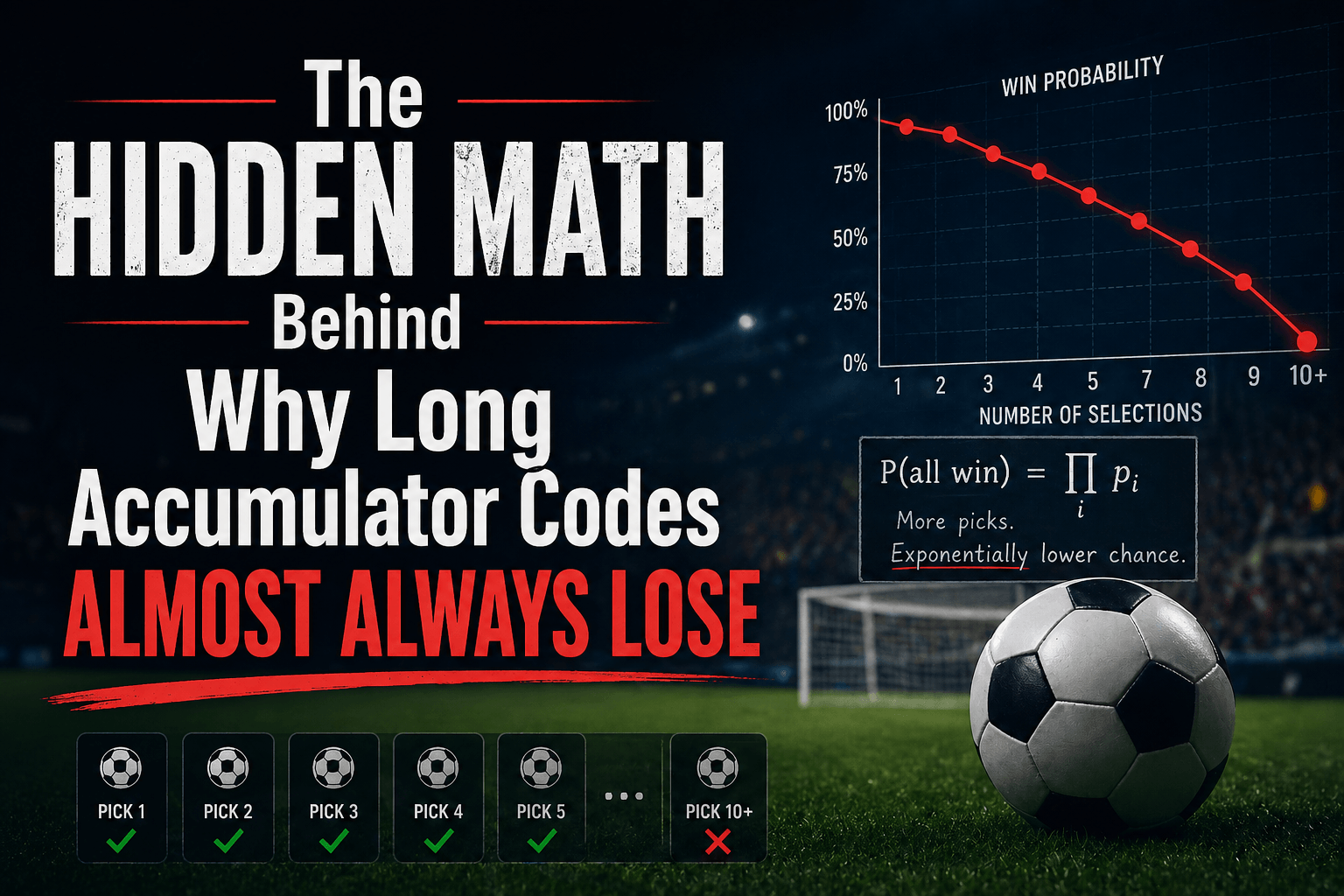
This isn’t bad luck. It’s math.
If you’ve been chasing long-accumulator codes hoping that this one will be the one that lands, this article is for you. We’re going to look at why these bets fail so consistently — not with vague advice, but with the actual numbers that govern your slip. By the end, you’ll understand why the smartest punters stay away from 10-leg slips and what they play instead.
The Quiet Truth About Accumulators
A friend of mine put it perfectly once. He said: “When you bet on two matches, you’re not really betting on two matches. You’re betting on two referees, 44 players, two managers, the weather, the pitch, injuries, red cards, VAR decisions, and a thousand other things going exactly the way you predicted.”
Let that sit for a moment.
Now ask yourself what happens when your booking code has ten matches on it. Suddenly you’re not betting on ten games. You’re betting on ten referees, 220 players, ten managers, ten different weather conditions, ten injury reports, and every single one of those moving parts cooperating with your prediction.
The picture changes when you frame it that way. A 10-leg accumulator isn’t ten chances to win. It’s one chance — and that one chance requires every single uncontrollable variable across ten different events to line up in your favor.
The Math Most Punters Never Run
Here’s where it gets uncomfortable.
When you combine selections in an accumulator, the probabilities don’t add — they multiply. That’s the whole reason the odds get big. But it’s also the reason your winning chances collapse.
Let’s use simple, generous numbers. Say each of your selections has a 70% chance of landing. That’s a confident pick — most tipsters would be thrilled with a 70% strike rate.
Watch what happens as you stack them:
- 2 selections at 70% each → 49% chance of winning
- 3 selections at 70% each → 34% chance
- 5 selections at 70% each → 17% chance
- 8 selections at 70% each → 6% chance
- 10 selections at 70% each → just over 2% chance
Read that last line again. Even when you’re right 7 times out of 10 on every individual pick, a 10-leg accumulator wins about 2 times out of 100.
And that’s with a 70% hit rate per selection — which almost no punter actually maintains over time. Drop the per-leg accuracy to a more realistic 60%, and a 10-leg slip wins roughly 6 times out of 1,000.
This is the math behind the disappointment. The bookmakers know it. The odds you see (800.00, 1,200.00, 5,000.00) are calculated precisely because the slip almost certainly will not cash. The big payout is the bait.
Why Long Slips Feel Tempting Anyway
If the math is this brutal, why do millions of punters keep loading 10+ leg codes?
Three reasons:
The screenshot effect. Every time someone hits a long acca, they post it. You see ten winning slips a week and assume it’s common. You don’t see the 10,000 losing slips that didn’t get screenshotted.
Loss aversion in disguise. When you’ve already lost ₦5,000 chasing accas, the ₦200,000 payout from a 12-leg slip feels like the only way to “recover.” The math says otherwise — chasing losses with longer slips just speeds up the bleed.
The lottery feeling. Long accas aren’t really sports betting. They’re closer to lottery tickets. A small stake, a tiny chance, a life-changing payout if it hits. That’s fine if you treat it as entertainment. It’s destructive if you treat it as a strategy.
What Smart Punters Actually Do
Punters who stay profitable (or at least break even) over the long term understand something simple: shorter slips with smaller odds win more often, and consistency beats the lottery every time.
Here’s what that looks like in practice:
Stick to 2-3 selection slips. A 3-leg accumulator with three solid 70% picks gives you a 34% win rate. That’s nine times the win rate of a 10-leg slip. Yes, the odds are smaller. Yes, the payout is less exciting. But you’ll cash slips far more often, which keeps your bankroll alive long enough to actually make money.
Hunt for value, not big odds. A “sure” 1.80 selection backed by good research is worth far more than a 50.00 long shot you found on Twitter. If your average odds per pick are between 1.50 and 2.50 and your accuracy is decent, you’re in the zone where math starts working with you instead of against you.
Use bankroll management. Whatever you bet, treat it like a budget. Most professional punters never stake more than 1-3% of their total bankroll on a single slip. That keeps a losing streak from wiping you out and lets you stay in the game long enough for skill to show.
Verify your sources. A booking code is only as good as the analysis behind it. If you’re loading codes from anonymous Telegram groups, you’re trusting strangers with your money. Look for sources that show their reasoning, track their results, and stick to shorter, well-analyzed slips. Sites like SureCodes24 publish daily booking codes across SportyBet, 1xBet, Bet9ja, and others, with a focus on verified sources rather than dream-chasing accumulators.
The Honest Trade-Off
If you walk away from long accumulator codes entirely, you give up the dream of a 5,000.00-odd slip turning ₦1,000 into ₦5 million. That dream is real — it does happen — but it happens to a tiny fraction of punters, and even they don’t repeat it.
What you gain is something more valuable: a betting habit that doesn’t drain your bankroll month after month. You’ll lose less. You’ll cash more often. You’ll stop riding emotional rollercoasters every weekend. And over time, the small, steady wins from 2-3 leg slips with verified picks add up to far more than the long-shot dream ever paid out.
Final Thoughts
Long accumulator codes aren’t evil. They’re just badly priced for the punter and exquisitely priced for the bookmaker. The big odds aren’t a gift — they’re a warning sign that the slip almost certainly won’t cash.
Next time you see a 12-leg booking code with 1,200.00 odds, remember: you’re not looking at a winning slip. You’re looking at twelve referees, 264 players, twelve weather forecasts, and twelve managers all needing to cooperate with your prediction. The math doesn’t care how confident you feel.
Bet smaller. Bet shorter. Verify your codes. Your bankroll will thank you.