
Few midfielders have ever controlled a football match the way Toni Kroos did. He didn’t rely on blistering pace or bone-crunching tackles. Instead, he built an 18-year career on something rarer: the ability to see a pass before anyone else on the pitch did and the technique to deliver it perfectly. From a small academy in East Germany to lifting six Champions League trophies, Toni Kroos became one of the most decorated and respected midfielders of his generation.
This article walks through his journey, his early life, his rise at Bayern Munich, his decade at Real Madrid, his World Cup triumph with Germany and the numbers and records that explain why he’s remembered as a genuine great of the modern game.
Early Life and Youth Career

Toni Kroos was born on January 4, 1990, in Greifswald, in what was then East Germany, only weeks after the fall of the Berlin Wall. Football ran in the family, his father worked as a coach and Kroos grew up around the game from an early age.
He started out at local side Greifswalder SC before moving to Hansa Rostock’s youth system in 2002. His talent was obvious even then and in 2006, at just 16, he joined the academy at Bayern Munich, one of the biggest clubs in Europe.
The international youth stage is where Kroos first turned heads. He was named the standout player of the 2006 UEFA European Under-17 Championship, then went a step further at the 2007 FIFA U-17 World Cup, winning the Golden Ball as the tournament’s best player and the Bronze Shoe after scoring five goals. It was already clear that Bayern had found something special.
Bayern Munich Years
Kroos made his senior debut for Bayern Munich on September 26, 2007, against Energie Cottbus, aged just 17 years and 265 days. At the time, that made him the youngest player ever to appear for the club, a record only later broken by David Alaba.
Despite the promising start, first-team opportunities were limited under a stacked Bayern squad, so the club sent him on loan to Bayer Leverkusen in January 2009. That loan spell proved crucial. Over 18 months, Kroos became a genuine first-choice player, sharpening the passing range and game intelligence that would define his career.
He returned to Bayern in 2010 and quickly established himself in the first team. The following seasons brought heartbreak and triumph in equal measure. Bayern lost the 2012 Champions League final on home soil, but bounced back to complete a historic treble in 2012–13, winning the Bundesliga, DFB-Pokal and Champions League, although a mid-season injury kept Kroos out of that final itself.
By the time he left, Kroos had collected three Bundesliga titles, two DFB-Pokal trophies, a Champions League winner’s medal and the 2013 FIFA Club World Cup with Bayern, along with three appearances in the Bundesliga Team of the Season.
Move to Real Madrid
Kroos’s breakout at the 2014 World Cup changed everything. Reports at the time suggested he’d been on the verge of joining Manchester United, but that deal fell apart after David Moyes was sacked as manager. Real Madrid moved instead, signing him for around €25–30 million in the summer of 2014, a fee that now looks like an outright bargain.
He made his Real Madrid debut in the 2014 UEFA Super Cup win over Sevilla and never really looked back. Alongside Luka Modrić and Casemiro, Kroos formed part of a midfield trio widely regarded as one of the best in modern football history, a unit built on control, balance and understanding rather than individual flair.
Real Madrid Career: A Decade of Dominance
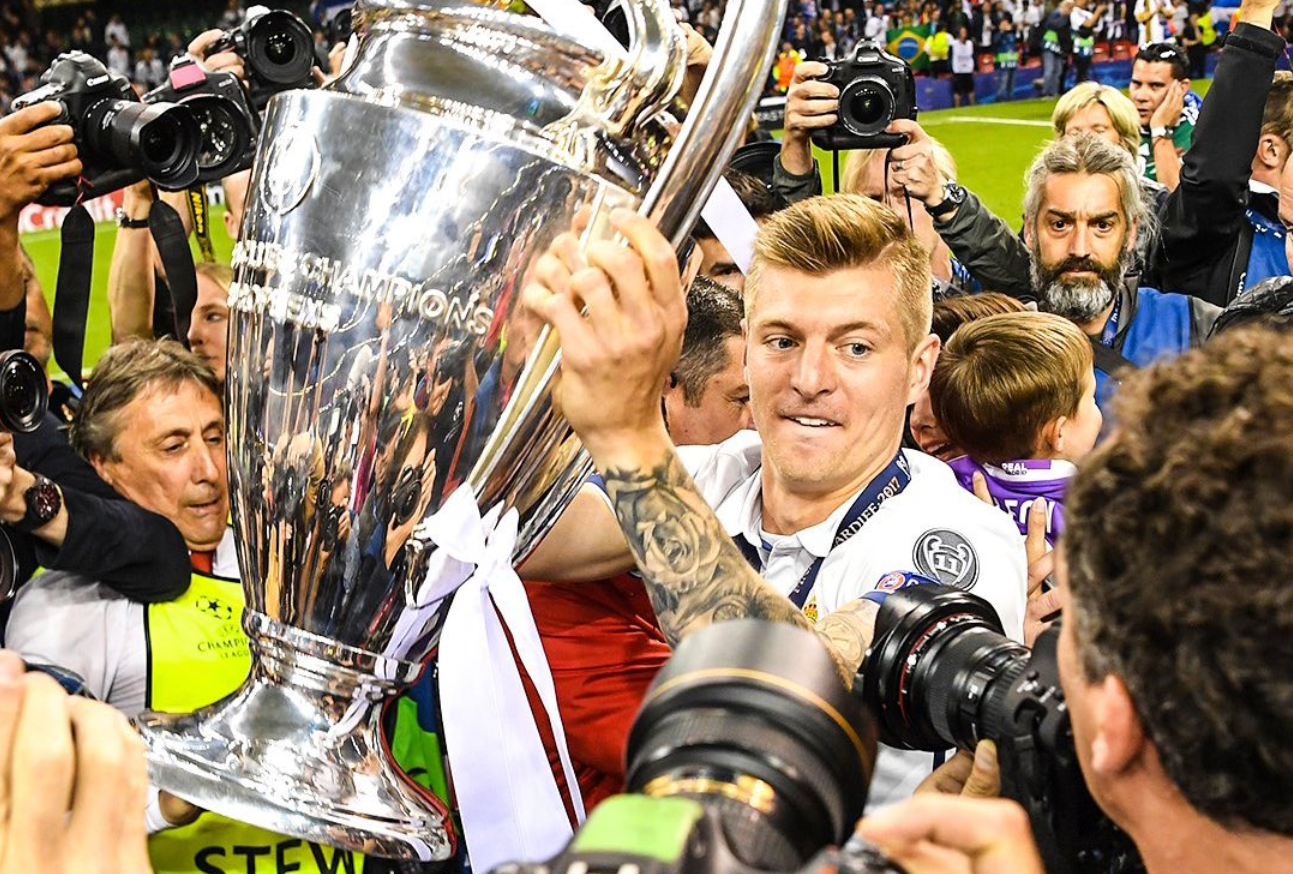
Over ten seasons in Madrid, Kroos made 465 appearances and scored 28 goals. But appearances and goals only tell part of the story. He collected 23 trophies at the club, including:
-
- 5 UEFA Champions League titles
- 5 FIFA Club World Cup titles
- 4 UEFA Super Cups
- 4 La Liga titles
- 1 Copa del Rey
- 4 Spanish Super Cups
Kroos started in all five Champions League finals he played for Real Madrid , and won every one of them. That kind of consistency in the biggest games in club football is almost unheard of. At one stretch of his career, he maintained passing accuracy above 90% across 250 consecutive Real Madrid matches, a statistic often cited as proof of just how reliable he was on the ball.
His final club match came on June 1, 2024, in the Champions League final, which Real Madrid won , meaning Kroos retired from club football as a champion, in as fitting an ending as any player could ask for.
Germany National Team Career
Kroos made his senior debut for Germany on March 3, 2010, against Argentina. He featured in the squad that reached the semifinals of the 2010 World Cup and later played at Euro 2012, gradually becoming a fixture in the national side.
His international peak came at the 2014 World Cup in Brazil, where he was one of the standout performers of the entire tournament.
FIFA World Cup Victory (2014)
Germany’s 2014 World Cup campaign is remembered for many things, but one match stands above the rest: the 7–1 semifinal demolition of host nation Brazil. Kroos was at the heart of it, scoring twice in the space of two minutes (in the 24th and 26th) and setting up a third goal, earning FIFA’s Man of the Match award for his performance.
Across the tournament, he finished as Germany’s top assist provider, was named to the World Cup All-Star Team and made the ten-man shortlist for the Golden Ball, eventually won by Lionel Messi. Brazilian media nicknamed him “Garçom” , Portuguese for “waiter”, a nod to how precisely he served the ball to his teammates. Germany went on to beat Argentina in the final and Kroos lifted the World Cup at just 24 years old.
He stepped away from international football in 2021 after Germany’s exit from Euro 2020, but returned in 2024 at the request of new head coach Julian Nagelsmann for the home European Championship. He played his final match in Germany’s quarter-final exit to eventual champions Spain, closing out an international career of 114 caps and 17 goals.
Playing Style
Toni Kroos was the definition of a deep-lying playmaker. Operating mostly as a central midfielder and occasionally dropping into a defensive-midfield role, he dictated the tempo of matches rather than chasing the ball around the pitch.
His signature qualities included:
-
- Passing range and precision, comfortable threading short combinations or switching play with a 40-yard diagonal, often first time.
- Vision and game reading, he consistently spotted teammates in space before defenders could react.
- Set-piece delivery, free kicks and corners were a genuine weapon, directly contributing to numerous goals across his career.
- Composure under pressure, rarely rushed, even in the tightest matches or biggest finals.
Strengths and Weaknesses
Like any player, Kroos wasn’t flawless. His game was built around efficiency rather than physical dominance, which shaped both his biggest strengths and the criticisms he faced.
Strengths:
-
- Elite technical passing, both short and long
- Outstanding tactical intelligence and positioning
- Reliability in big matches and finals
- Leadership and composure in midfield
Weaknesses:
-
- Limited top-end pace compared to more athletic midfielders
- Modest defensive work rate and ground coverage
- Not physically dominant in aerial or one-on-one duels
These trade-offs were exactly why he thrived at Real Madrid, where he was surrounded by more physical or pacey teammates who could cover ground he didn’t need to.
Major Statistics
-
- Real Madrid: 465 appearances, 28 goals (2014–2024)
- Germany: 114 caps, 17 goals (2010–2024)
- UEFA club competitions: over 140 appearances with double-digit goal contributions
- Passing accuracy consistently among the highest of any midfielder in Europe throughout his prime
Records
-
- Second most decorated German footballer in history, with 34 trophies overall, behind only Thomas Müller.
- Holds the record for most FIFA Club World Cup titles by a player, six in total, one with Bayern Munich and five with Real Madrid.
- Named IFFHS World’s Best Playmaker in 2014.
- Voted German Footballer of the Year twice, in 2018 and again in 2024.
- Started and won all five Champions League finals he appeared in for Real Madrid.
Major Trophies (Career Overview)
Bayern Munich: 3 Bundesliga titles, 2 DFB-Pokal, 1 UEFA Champions League, 1 FIFA Club World Cup, UEFA Super Cup
Real Madrid: 5 Champions League titles, 5 FIFA Club World Cups, 4 UEFA Super Cups, 4 La Liga titles, 1 Copa del Rey, 4 Spanish Super Cups
Germany: 2014 FIFA World Cup
Retirement
Kroos announced on May 21, 2024, that he would retire from both club and international football after UEFA Euro 2024. He explained the decision as wanting to leave the game on his own terms, prioritizing time with his family after nearly two decades at the top level. His last competitive act as a professional was helping Real Madrid win the 2024 Champions League final, followed weeks later by Germany’s quarter-final exit at the home Euros , a bittersweet but fitting way to close out a career defined by big occasions.
Legacy in Football
Toni Kroos leaves the game as one of the finest passers and midfield controllers of his generation. He never relied on flashy dribbling or highlight-reel moments; instead, his legacy is built on substance , trophies won, finals started and matches quietly controlled from midfield. Coaches and teammates consistently praised his football intelligence and the fact that he started every Champions League final he played for Real Madrid says everything about how much the club trusted him in the biggest moments.
For young midfielders, Kroos represents a blueprint: that vision, positioning and technique can be just as valuable as speed or strength. For Real Madrid and Germany fans, he’ll be remembered as a serial winner and a calming presence in a midfield built for pressure. And for football historians, his name will sit comfortably among the great deep-lying playmakers the sport has produced.
