Wrexham AFC’s transformation reached a defining moment as Apollo Sports Capital confirmed a minority investment, underlining the club’s evolution from lower league revival story into a serious institutional asset with Premier League ambition.
The deal, struck with an affiliate of global asset manager Apollo, goes beyond fresh funding. It represents validation of a strategy that blends celebrity ownership, global storytelling, and commercial scale, a model now being viewed as a replicable blueprint for investors across football’s lower tiers.
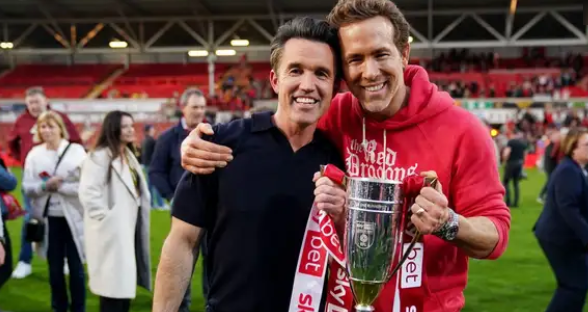
Behind the headlines sits a remarkable financial journey. Purchased for around £2 million in 2021 by Ryan Reynolds and Rob McElhenney, Wrexham has seen its valuation surge. A minority sale in 2024 reportedly placed the club between £100 million and £136 million, while recent discussions have pointed toward a £350 million valuation target by the end of 2025.
That figure places Wrexham in rare territory. It positions the Welsh club just below established Premier League sides in financial terms and confirms it as a credible top tier asset rather than a novelty project driven by fame.
The context matters. On the pitch, Wrexham have surged through the divisions with three consecutive promotions since the 2022 23 season. Off it, the club has leveraged global exposure from the Disney+ series Welcome to Wrexham to build a commercial machine that operates far beyond its league status.
The setting at the Racecourse Ground reflects that shift. Attendances have climbed, global interest has intensified, and the club’s owners have already committed around £32 million over five years to accelerate progress. Yet the leap toward Premier League football demands more than momentum. It requires infrastructure, scale, and patient capital.
That is where Apollo’s role becomes central. The investment is designed to fund long term projects, most notably the redevelopment of the STōK Cae Ras and the construction of the new Kop Stand as part of the wider Wrexham Gateway regeneration plan. These are foundational moves aimed at bridging the gap between rapid sporting success and sustainable top flight readiness.
Commercially, Wrexham continue to defy convention. Turnover rose 155 percent to £26.7 million in the year ending June 2024 while the club was still competing in the fourth tier. Commercial revenue alone reached approximately £13.2 million, a figure reported to exceed that of several Premier League clubs.
Global brands have followed. United Airlines, HP, Gatorade, and MetaQuest have all aligned with Wrexham, drawn by its international profile and strong American fanbase. More than half of the club’s revenue in the 2023 24 season was generated outside the UK, highlighting a deliberate push into the US market.
That expansion underpins Apollo’s rationale. With football interest in the United States continuing to rise, Wrexham is positioned as a gateway club for American audiences. The upside is clear. Even a brief stay in the Premier League guarantees significant broadcast revenue, while sustained presence would unlock a level of financial return few lower league projects can realistically target.
As the final stages of this chapter unfold, the significance of the deal is clear. Wrexham have moved from celebrity experiment to institutional proof point, demonstrating how storytelling, commercial intelligence, and patient capital can reshape a football club’s trajectory.
The focus now turns to execution. With Apollo on board and infrastructure plans advancing, Wrexham’s ambition is no longer theoretical. The challenge is to convert financial momentum into lasting sporting success, and to take the final steps toward becoming a Premier League club backed by a global audience.