- Quick answer: how VAR works in short
- How VAR works: the simple idea
- A short history of VAR
- Who is in the video operation room?
- How VAR works: the four decisions it can review
- How VAR works step by step: check, review, decision
- Step 1: the check
- Step 2: the review
- Step 3: the decision
- On-field review and VAR-only review
- How VAR works for offside
- How VAR works: worked scenarios
- How VAR works: what VAR cannot do
- How VAR works: common myths
- FAQ
- What does VAR stand for?
- What is a clear and obvious error?
- What is an on-field review?
- Can VAR review a second yellow card?
- How does semi-automated offside work?
- Conclusion
Learning how VAR works helps any football fan follow a match with less confusion. In fact, VAR stands for video assistant referee. It is a match official who watches the match on screens and helps the referee on the pitch. However, the system checks a small number of decisions, and only in a small number of situations. For instance, it does not watch every tackle or every pass. It does not decide the match. Above all, the referee on the pitch still makes the final call.
Last updated: November 2026
Quick answer: how VAR works in short
- VAR is a match official who watches the match on screens in a video operation room.
- In particular, it can only help with four kinds of decision: goals, penalties, direct red cards, and mistaken identity.
- However, it steps in only for a clear and obvious error or a serious missed incident.
- For example, every goal, penalty incident, possible direct red card, and possible mistaken identity is checked, often without stopping play.
- Finally, the referee always makes the final decision, after an on-field review or a VAR-only review.
How VAR works: the simple idea
The guiding idea behind VAR is “minimal interference, maximum benefit”. In other words, VAR corrects clear mistakes. Moreover, it does not re-referee the match. As a result, most decisions stay as the referee first gave them.
In fact, a check is not a review. Meanwhile, the VAR checks incidents in the background while play goes on. For example, it checks every goal, and play often carries on with no delay. However, a review is different: it happens only when the VAR thinks a clear and obvious error took place.
In short, that is how VAR works in outline: a silent check first, a review only for a clear mistake, and a final call from the referee.
A short history of VAR
IFAB writes the Laws of the Game. On 3 March 2018, IFAB approved VAR for the 2018/19 Laws. After that, FIFA’s Council decided on 16 March 2018 to use VAR at that year’s World Cup in Russia, and the system spread to many leagues.
Indeed, the idea was simple. For example, cameras already covered the pitch, and replays already showed clear errors to viewers at home. As a result, VAR gave the referee the same pictures.
Who is in the video operation room?
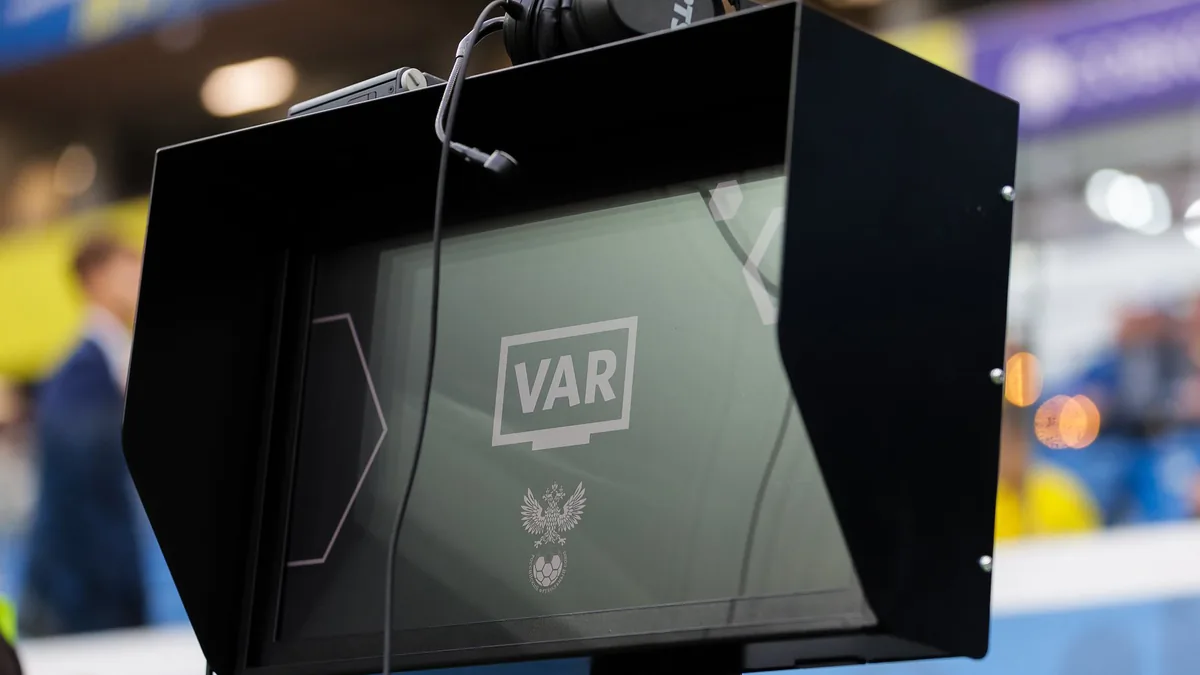
The VAR works in a video operation room, often called the VOR. In addition, inside are the VAR, assistant VARs (AVARs), and replay operators, with independent access to broadcast footage and free choice of camera angles.
Indeed, each person has a clear role. The VAR watches the match live on screens, AVARs track incidents the VAR may need, and replay operators find the right pictures fast. Finally, only the VAR speaks to the referee about a possible error.
How VAR works: the four decisions it can review
VAR can only help with four categories of decision, and nothing else is open to review. For example, a free kick in midfield, a corner, and a throw-in are not reviewed. The four categories are fixed in the Laws of the Game.
| Decision | What VAR checks | Plain example |
|---|---|---|
| Goal or no goal | Offside, foul, or handball in the build-up | A goal ruled out for offside |
| Penalty or no penalty | A foul or handball inside the area | A penalty given after a trip |
| Direct red card only | A challenge that may deserve a straight red card | A high tackle judged a sending-off offence |
| Mistaken identity | The wrong player cautioned or sent off | A yellow card moved to the right player |
However, a second yellow card cannot be reviewed, so a player sent off for two yellows stays off the pitch even if the second card looks harsh.
How VAR works step by step: check, review, decision
Fans who ask how VAR works often want the flow in order. The process has three steps: check, review, decision.
Step 1: the check
The VAR checks every goal, penalty incident, possible direct red card, and possible mistaken identity. The check starts as the incident happens. As a result, most checks end with no action, and the referee hears nothing, because a check is silent by design.
Step 2: the review
A review starts only when the VAR sees a clear and obvious error or a serious missed incident. The VAR tells the referee what the video shows, and only the referee can start a review. Moreover, coaches, players, and the crowd cannot ask for one, and there is no time limit on a review, because accuracy matters more than speed.
Step 3: the decision
The final decision is always the referee’s. The referee can keep the first decision or change it. After a review, the referee signals the outcome with a TV-screen shape, and play restarts in line with the new decision.
On-field review and VAR-only review
There are two kinds of review. The first is the on-field review, often called an OFR: the referee walks to a pitchside monitor and watches replays. It suits judgement calls, such as how hard a challenge was or a handball.
The second kind is the VAR-only review. Meanwhile, the referee stays on the pitch and accepts the VAR’s information without watching the monitor. It suits facts, such as an offside position or where a foul took place.
Finally, both kinds end the same way: the referee makes the final call, and the VAR advises.
How VAR works for offside
Offside is the most common VAR check in goals. When a goal is scored, the VAR checks the build-up: the moment a team-mate played the ball and the attacker’s position. If the attacker was offside and took part in active play, the goal is ruled out. This is how VAR works for most goals that are checked.
In addition, semi-automated offside helps with this check. Cameras and tracking follow the ball and the players to draw the line faster than a manual check. As of November 2026, it is used in major competitions, the law is unchanged, and the final call still rests with the match officials.
For the law itself, read our offside rule explained guide.
How VAR works: worked scenarios
Each case starts from the moment the incident happens.
| Situation | VAR involved? | Why |
|---|---|---|
| A goal is scored from a cross | Yes, a check | Every goal is checked for offside, foul, or handball |
| A player is tripped inside the area and no penalty is given | Yes, a check | Every penalty incident is checked |
| A defender makes a high tackle with studs up | Yes, a check | A possible direct red card is checked |
| The referee cautions the wrong player | Yes, a check | Mistaken identity is reviewable |
| A free kick is given in midfield | No | Free kicks cannot be reviewed |
How VAR works: what VAR cannot do
VAR cannot review a corner, a throw-in, a free kick in midfield, a second yellow card, or a goal kick. Many small errors therefore stay as first given. The system aims to fix clear mistakes on big calls, not every call.
Fans who ask how VAR works often wonder why a clear foul in midfield is left alone. The answer is the same limit. VAR covers four kinds of decision and nothing else.
However, VAR cannot judge intent with certainty. It shows what happened, but not what a player meant to do. A handball call still needs a judgement about the arm, and a foul call still needs one about the challenge.
VAR cannot stop debate. In fact, fans still disagree about handball and soft penalties, so a review can still leave people unhappy.
How VAR works: common myths
Myth 1: VAR decides the match. In fact, this is false. The VAR advises, and the referee on the pitch always makes the final call.
Myth 2: VAR checks everything. This is false. VAR checks only four kinds of decision, and a check is silent most of the time.
Myth 3: Players and coaches can ask for a review. In fact, this is false. Only the referee can start a review, on the VAR’s recommendation.
Myth 4: VAR always gets it right. This is false. Video can be unclear, and a judgement call can still go either way.
Myth 5: A long review means a wrong decision. In fact, this is false. Indeed, there is no time limit on a review.
Follow matches and see how reviews play out with our free live scores, and visit our Sports News section for more guides.
FAQ
What does VAR stand for?
VAR stands for video assistant referee: a match official who watches the match on screens and helps the referee with a small number of decisions.
What is a clear and obvious error?
A clear and obvious error is a mistake the video plainly shows. The first decision stands unless the video clearly shows such an error.
What is an on-field review?
An on-field review, or OFR, is when the referee watches replays on a pitchside monitor. It suits judgement calls such as a hard challenge or a handball.
Can VAR review a second yellow card?
No. VAR can review a direct red card only. A second yellow card cannot be reviewed, so a player sent off for two yellows stays off the pitch.
How does semi-automated offside work?
Semi-automated offside uses cameras and tracking to draw the offside line faster. The law is unchanged.
Conclusion
In short, how VAR works comes down to a simple flow: a silent check, a review only for a clear and obvious error, and a final call from the referee. Indeed, VAR covers four kinds of decision and nothing else: goals, penalties, direct red cards, and mistaken identity.
Above all, the system is built to fix clear mistakes on big calls, not to re-referee the match.
For more football learning, see our free football predictions page and our Betting Academy guides.
To see where each player lines up on the pitch, read our Football Positions Explained: Every Role and Number.