
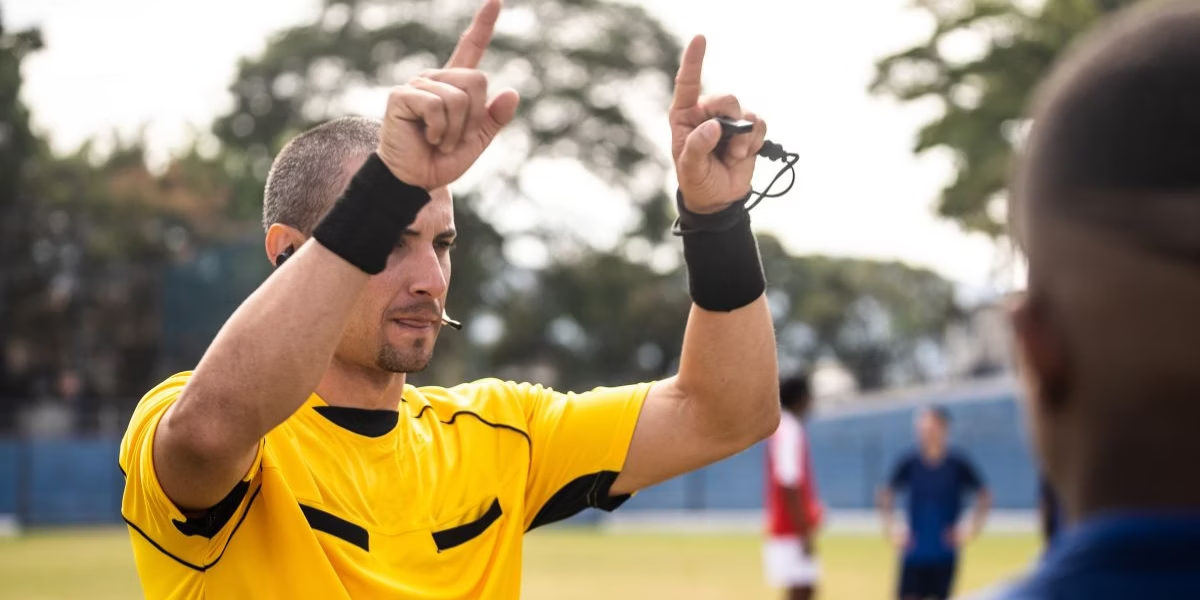
Almost every football fan can name a refereeing decision that still annoys them years later. A goal that crossed the line but was not given, an offside call that looked wrong on replay, a penalty that changed a title race. Human error has always been part of the game, and so has the search for ways to reduce it.
Technology entered football slowly. Goal-line technology arrived at the 2014 World Cup, and the Video Assistant Referee (VAR) followed at the 2018 tournament in Russia. Artificial intelligence (AI) is the next step. Below, we explain why referees make mistakes, how AI now supports them, what the latest numbers show, what tennis can teach football, and where human judgement still cannot be replaced.
Why Referees Make Mistakes
A referee has to follow 22 players and a ball that can travel at more than 100 km/h, often from a poor angle and with only a split second to decide. Some decisions are simply beyond the limits of the human eye.
Offside is the clearest example. A player is offside if they are nearer to the opponent’s goal line than both the ball and the second-last defender at the exact moment a team-mate plays the ball. That means an assistant referee must watch two things in two different places at the same instant, something no person can do with perfect accuracy.
How AI Supports Match Officials
The biggest AI tool in football refereeing is semi-automated offside technology (SAOT). At the 2022 World Cup in Qatar, FIFA used 12 tracking cameras under the stadium roof to follow the ball and up to 29 points on each player’s body, 50 times per second. A sensor inside the match ball sent data 500 times per second to identify the exact moment of the pass.
AI combines this limb and ball data and sends an automatic alert to the video officials when an attacker in an offside position receives the ball. FIFA had tested the system at the 2021 Arab Cup and 2021 Club World Cup. UEFA introduced SAOT in the Champions League group stage in 2022-23, and Serie A became the first major European league to use it in January 2023, after a stoppage-time Juventus winner had been wrongly ruled out earlier that season.
What the Numbers Say
The Premier League began using SAOT on 12 April 2025 (Matchweek 32), working with PGMOL and data company Genius Sports. The system uses up to 30 tracking cameras running at twice the frame rate of normal broadcast cameras, and it saved an average of 27 seconds per offside check in its first weeks.
Wider figures show what VAR adds to the referee on the pitch. According to the independent Key Match Incidents Panel, Premier League officials got 86% of key decisions right on the field in 2024/25. After VAR interventions, that figure rose to 97%, while VAR errors fell from 31 in 2023/24 to 18.
There is an important detail here. The Premier League itself said SAOT does not change the accuracy of offside decisions. Its main benefit is speed and consistency, because the virtual lines are placed automatically instead of by an official clicking through video frames.
Lessons From Tennis
Tennis has gone further than football. In 2025, Wimbledon replaced its line judges with electronic line calling, ending a tradition of nearly 150 years. Ball-tracking cameras now decide whether shots are in or out on every point, and the French Open is the only Grand Slam that still uses human line judges.
The change was not perfect. On 6 July 2025, during a fourth-round match between Anastasia Pavlyuchenkova and Sonay Kartal, a ball that clearly landed long was not called because the system had been accidentally switched off for three points. The All England Club blamed human error by the operators, apologised to both players and changed the system so the mistake could not happen again.
The lesson is clear for football. AI can remove some errors, but people still install, run and supervise the technology, and that creates new places where things can go wrong.
Where Human Judgement Still Matters
SAOT is called “semi-automated” for a reason. The technology cannot decide whether an attacker is actively involved in play, and the VAR must still confirm the decision. Fouls, handballs and the intensity of a tackle all depend on interpretation, not measurement.
Communication is another weak point. When Liverpool’s Luis Díaz had a goal wrongly disallowed against Tottenham in September 2023, the problem was a breakdown in communication between officials rather than a failure of the offside lines. No camera system could have fixed it.
So, Can AI Reduce Refereeing Errors?
The answer depends on the type of decision. For factual questions, such as whether the ball crossed the line, whether a player was offside or whether a tennis ball landed in, AI and tracking technology are already more precise and faster than any human. For decisions that need judgement about intent, contact and context, the referee remains essential.
The most realistic future is a partnership. Machines will handle the millimetres and milliseconds, while referees focus on reading the game. That will not end every argument in football, but it should make the arguments about genuine opinions rather than avoidable mistakes.
