- Quick Answer
- How to Play Craps for Beginners: The Table and the Dice
- How to Play Craps for Beginners: The Come-Out Roll
- How to Play Craps for Beginners: The Point Phase
- How to Play Craps for Beginners: The Four Bets to Learn First
- How to Play Craps for Beginners: Odds, Payouts and the House Edge
- Common Mistakes When You Play Craps
- Frequently Asked Questions
- What is the easiest bet in craps for a beginner?
- How long does it take to learn how to play craps for beginners?
- Can you play craps online?
- What is the difference between pass line and don't pass?
- Is craps better than roulette for beginners?
- What does sevening out mean?
- Conclusion
Learning how to play craps for beginners is easier than the table looks at first glance. Craps is a casino dice game in which one player, the shooter, rolls two dice while everyone at the table bets on the outcome. In other words, you do not need to throw the dice yourself to play.
Last updated: November 2026
Quick Answer
- Craps uses two six-sided dice, and one player rolls them.
- Firstly, the come-out roll decides the round: 7 or 11 wins the pass line, 2, 3 or 12 loses it.
- Secondly, any other total becomes the point, which must repeat before a 7.
- Thirdly, the pass line is the best first bet, with a house edge of 1.41%.
- Finally, the odds bet behind the line pays true odds and carries no house edge.
How to Play Craps for Beginners: The Table and the Dice
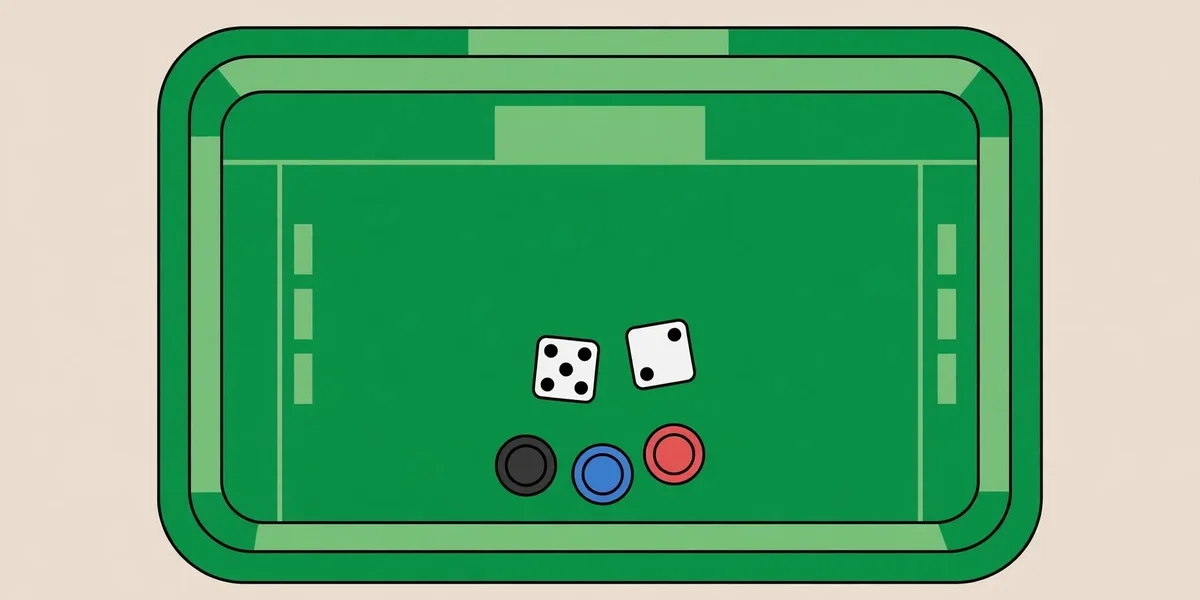
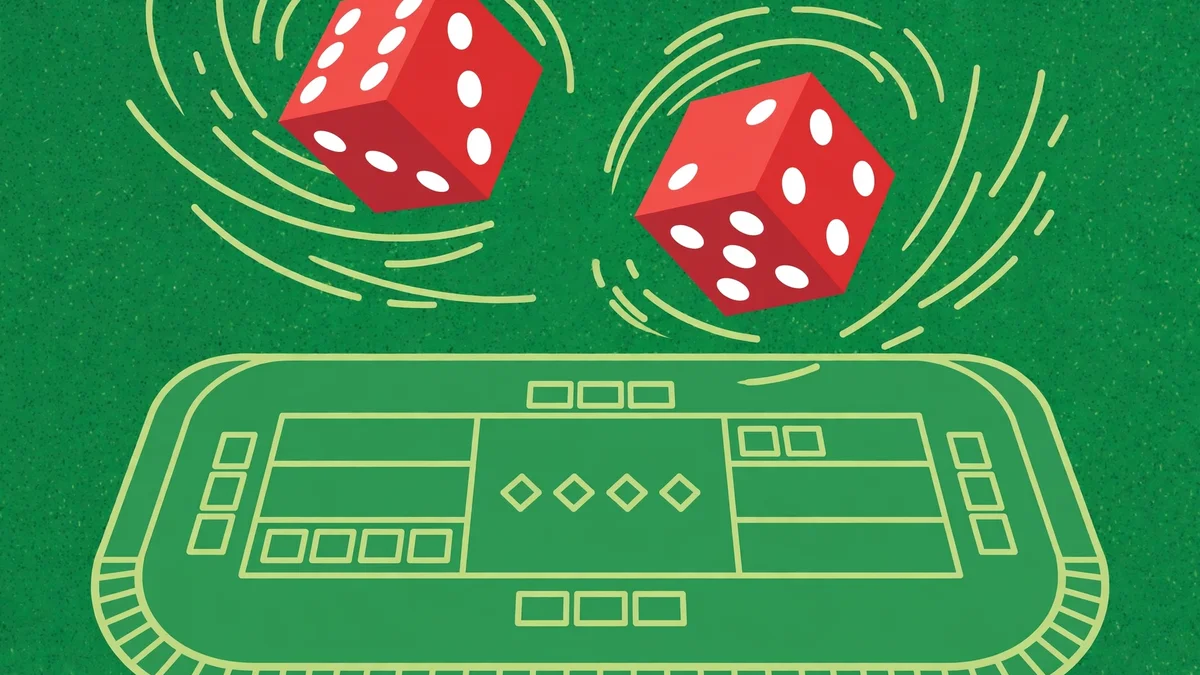
At first, a craps table looks busy, but a beginner can ignore most of the betting boxes. In fact, only a small area matters at the start: the pass line, the don’t pass line and the space behind the line for odds bets.
Two fair dice produce 36 equally likely combinations, and every probability in craps comes from counting. In particular, the total 7 can be made six ways (1-6, 2-5, 3-4, 4-3, 5-2, 6-1), more than any other total. As a result, the whole game revolves around the 7: it wins on the come-out roll and it ends the round during the point phase.
The table below shows how many ways each total can appear.
| Dice total | Ways to roll it |
|---|---|
| 2 | 1 |
| 3 | 2 |
| 4 | 3 |
| 5 | 4 |
| 6 | 5 |
| 7 | 6 |
| 8 | 5 |
| 9 | 4 |
| 10 | 3 |
| 11 | 2 |
| 12 | 1 |
How to Play Craps for Beginners: The Come-Out Roll
Firstly, every round opens with the come-out roll. Before it, players place their pass line or don’t pass bets, then the shooter picks up the dice and rolls.
In total, three things can happen. Firstly, a 7 or 11, called a natural, wins pass line bets at once and the round ends. Secondly, a 2, 3 or 12, called craps, loses pass line bets at once and the round ends. Thirdly, a 4, 5, 6, 8, 9 or 10 becomes the point, and the round moves into its second stage.
In practice, the come-out roll is the only roll where a 7 helps the pass line.
How to Play Craps for Beginners: The Point Phase
Once a point is set, the dealer marks it with a puck showing “ON” beside the number. Then the shooter keeps rolling with one question in play: will the point repeat before a 7?
If the point repeats first, pass line bets win and the same shooter starts a new round. If a 7 arrives first, pass line bets lose, which is called sevening out, and the dice pass to the next shooter. In short, every other total in between changes nothing for the pass line.
For example, if the point is 6, the shooter can roll many other totals without settling anything, so a point phase can last for several rolls.
The chance of making the point before a 7 depends on the point: 6 or 8 wins about 45.5% of the time, 5 or 9 wins 40%, and 4 or 10 wins about 33.3%. Therefore, points of 6 and 8 are the friendliest for pass line players.
How to Play Craps for Beginners: The Four Bets to Learn First
In fact, craps offers dozens of wagers, but a beginner needs only four.
Firstly, the pass line is the basic bet on the shooter succeeding, placed before the come-out roll. It wins even money on 7 or 11, loses on 2, 3 or 12, and otherwise rides on the point being made before a 7. The house edge is 1.41%.
Secondly, don’t pass is the mirror image: you bet against the shooter. On the come-out roll it wins on 2 or 3, loses on 7 or 11, and pushes on 12, so your stake comes back. Once a point is set, it wins if a 7 is rolled first. The house edge is 1.36%.
Thirdly, the come bet works exactly like a pass line bet, but you place it after a point is already set. The next roll acts as its own come-out roll: 7 or 11 wins, 2, 3 or 12 loses, and any other number becomes your own point, which must repeat before a 7. The house edge matches the pass line at 1.41%.
Finally, taking the odds is the extra bet you place behind your pass line or come bet after a point is set, and you cannot place it on its own. It pays at true odds, so the odds portion carries no house edge at all. Above all, remember that it does not remove the edge on the line bet behind it: it only dilutes the combined edge as a share of your total money wagered.
How to Play Craps for Beginners: Odds, Payouts and the House Edge
In effect, the odds bet pays according to the true chance of the point repeating before a 7: 4 or 10 pays 2 to 1, 5 or 9 pays 3 to 2, and 6 or 8 pays 6 to 5. For instance, a ₦1,000 odds bet on a point of 6 wins ₦1,200 if the 6 repeats first (ILLUSTRATIVE).
In short, the table below compares the four bets.
| Bet | Payout | House edge |
|---|---|---|
| Pass line | 1 to 1 | 1.41% |
| Don’t pass | 1 to 1 | 1.36% |
| Come | 1 to 1 | 1.41% |
| Taking the odds | True odds | 0% |
In contrast, many other bets carry a far bigger edge: a place bet on 4 or 10 carries 6.67%, while an any-seven bet carries 16.67%. As a result, beginners should stick to the four bets above.
For example, suppose you place ₦1,000 on the pass line and the point is 6. Your pass line bet wins ₦1,000 in profit if the 6 repeats first, so you receive ₦2,000 back in total (ILLUSTRATIVE). With ₦1,000 more behind the line as an odds bet, that wins ₦1,200 more, so a winning round returns ₦4,200 on ₦2,000 staked (ILLUSTRATIVE).
Common Mistakes When You Play Craps
First of all, the most common error when you are learning how to play craps for beginners is to spread chips across the middle of the table, where the one-roll proposition bets live. Their edges run from about 9% to over 16%, so they drain a bankroll fast.
In fact, another mistake is to treat past rolls as a guide to the next one. Each roll is independent of the last, so a long run without a 7 does not make a 7 more likely next time.
A third mistake is to skip the odds bet out of caution. It is the only wager with no house edge, so leaving it out means paying the full 1.41% edge on every pass line bet. That said, odds increase the amount at risk, so size them to your bankroll.
Frequently Asked Questions
What is the easiest bet in craps for a beginner?
In short, the pass line is the easiest first bet. You place it before the come-out roll: it wins on 7 or 11, loses on 2, 3 or 12, and otherwise rides on the point. Its house edge of 1.41% is among the lowest in the casino.
How long does it take to learn how to play craps for beginners?
In practice, most players follow a full round after watching a few come-out rolls and one point phase. Reading the table and placing bets smoothly takes a few sessions of practice, ideally with free or low-stakes games first.
Can you play craps online?
In short, online craps follows the same rules, with software rolling the dice through a certified random number generator. Live dealer craps streams a real table and a real shooter. Our guide to live casino games explains how live dealer tables work.
What is the difference between pass line and don’t pass?
In short, pass line backs the shooter and wins when the shooter makes the point. Don’t pass bets against the shooter and wins when a 7 arrives first. Don’t pass has a slightly lower edge at 1.36%, but most players prefer backing the shooter.
Is craps better than roulette for beginners?
Craps offers a lower house edge on its best bets: 1.41% on the pass line. However, roulette is simpler to learn, because every bet is a single spin with no phases to follow. Our guide to roulette for beginners covers that game, and our poker guide covers the other classic table game.
What does sevening out mean?
In short, sevening out means the shooter rolls a 7 during the point phase, before the point repeats. Pass line bets lose, don’t pass bets win, and the round ends. Then the dice pass to the next shooter.
Conclusion
In short, craps looks noisy, but its core is simple: a come-out roll, a point, and one question — will the point repeat before a 7? Once you can follow a full round, you know how to play craps for beginners well enough to enjoy the game. Start with the pass line, add the odds bet when a point is set, and leave the middle alone.
In Nigeria, gambling regulation is state-led: the Supreme Court nullified the National Lottery Act 2005 on 22 November 2024, and the National Lottery Regulatory Commission framework applies only in the Federal Capital Territory. For that reason, check the rules of the table or site you play on before you stake anything, and play only where you are legally allowed to do so. If you want a slower casino game to learn next, try our guide to how online slots work.
Bet Responsibly: Betting is for adults aged 18 and over only. Treat it as entertainment, not a way to make money, and only stake what you can afford to lose. If betting stops being fun, take a break and read our Responsible Gambling page.