
- How to Play Poker: Texas Hold'em Basics
- The Deal, the Button and the Blinds
- How to Play Poker: the Four Betting Rounds
- Player Actions in How to Play Poker
- Poker Hand Rankings
- How the Pot Is Won
- Pot Odds: the Maths Behind How to Play Poker
- Pot Odds Worked Example: Calling with a Flush Draw
- How to Play Poker on a Small Bankroll
- Worked Example: Bankroll at $1/$2
- Playing Poker in Nigeria
- Frequently Asked Questions
- What is the best hand in poker?
- Do suits break ties in poker?
- What do I need to start learning how to play poker?
- What are pot odds?
- Conclusion
Learning how to play poker starts with Texas Hold’em, the most popular variant of the game. In this guide, you learn the rules step by step: the deal, the betting rounds, the player actions and the hand rankings. Moreover, every rule here covers No-Limit Texas Hold’em.
Last updated: November 2026
Quick Answer:
- Texas Hold’em is the most popular poker variant, played with a 52-card deck and 2 to 10 players.
- Each player gets two private hole cards, and five community cards go face up in the middle.
- The best five-card hand wins the pot.
- Pot odds compare the price of a call with the pot, and a bankroll is money set aside only for poker.
How to Play Poker: Texas Hold’em Basics
Texas Hold’em is a community-card game played with a standard 52-card deck. In fact, a table seats 2 to 10 players. Each player receives two private hole cards. Five community cards go face up in three stages.
Each player makes the best five-card hand from their hole cards and the community cards. In other words, you may use both, one, or none of your hole cards. If the five community cards make the best hand, you “play the board”.
For a different casino game, read our guide to how online slots work. In addition, read our guide to what a live casino is.
The Deal, the Button and the Blinds
A round disc called the dealer button marks the nominal dealer. Moreover, it moves clockwise each hand. Next, the two players left of the button post forced bets, the blinds, to seed the pot.
The player left of the button posts the small blind, and the next player posts the big blind. Typically, the big blind is twice the small blind: $1 and $2 in a $1/$2 game. As a result, the big blind sets the minimum bet.
Then, the dealer gives each player two cards face down.
How to Play Poker: the Four Betting Rounds
Texas Hold’em has four betting rounds: pre-flop, flop, turn and river. The showdown has no betting.
Firstly, pre-flop is the first betting round. Action starts left of the big blind, with “under the gun”, and moves clockwise. Every player must fold, call or raise, and the big blind acts last.
Next comes the flop: three community cards face up. A new betting round begins with the first active player left of the button. Then the turn adds a fourth card. The river adds the fifth. Each brings another betting round in the same order.
In short, after the river betting, the showdown begins. Players left in reveal their hands. Acting order switches after the flop, and the button acts last. Consequently, position matters: the button decides last. Overall, a betting round ends when every player still in has matched the biggest bet, or is all-in.
Player Actions in How to Play Poker
| Action | What it means |
|---|---|
| Check | Pass; only when no bet is made |
| Bet | Put chips in first |
| Call | Match the largest bet |
| Raise | Increase the bet; others must match it or fold |
| Fold | Discard your hand and lose your chips |
| All-in | Bet every chip you have left |
Furthermore, once all-in, you cannot bet or raise again. Your hand stays live and can win up to the amount you wagered. In addition, poker uses table stakes: nobody can ask you to call for more money than you have on the table, and you cannot win more than you put in.
Meanwhile, a side pot forms when a player is all-in and others keep betting. Only the players who contributed to it can win it. In short, these six actions are the toolkit for learning how to play poker.
Poker Hand Rankings
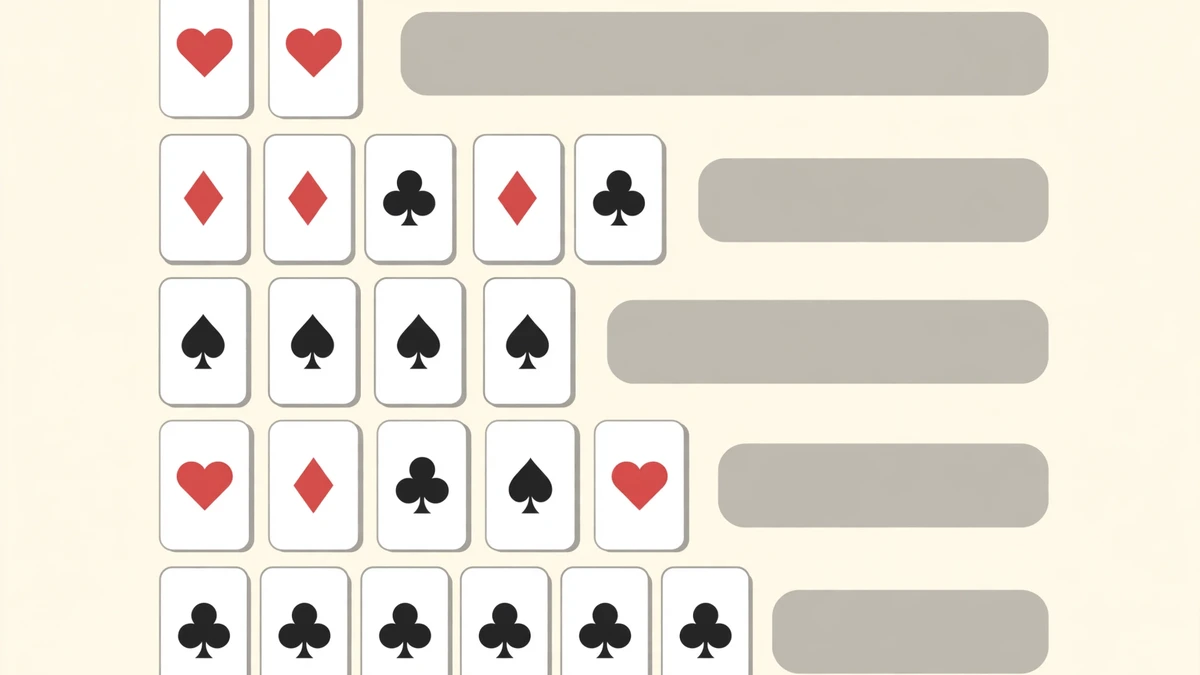
Firstly, there are ten standard poker hand categories. Moreover, a higher-ranked category always beats a lower-ranked one. In fact, the ranking mirrors how rare each hand is.
| Rank | Hand | What it is | Tie-break |
|---|---|---|---|
| 1 | Royal Flush | A-K-Q-J-10, same suit | Best hand |
| 2 | Straight Flush | Five in sequence, same suit | Highest card |
| 3 | Four of a Kind | Four of one rank | Quads first |
| 4 | Full House | Three + a pair | Trips first |
| 5 | Flush | Five of one suit | Highest card |
| 6 | Straight | Five in sequence | Highest card |
| 7 | Three of a Kind | Three of one rank | Triplet first |
| 8 | Two Pair | Two pairs + kicker | Higher pair |
| 9 | One Pair | One pair + three cards | Pair first |
| 10 | High Card | No made hand | Highest card |
In short, a royal flush is the highest straight flush. Listing it separately does not change who wins.
How the Pot Is Won
At showdown, the best five-card hand wins the pot. However, you can also win without a showdown, if everyone else folds.
Next, when hands tie, compare the hand cards, then the kickers from highest to lowest. A kicker is an unpaired side card used only to break ties. For example, with the same pair of aces, a king kicker beats a queen kicker. Similarly, with the same two pair, compare the higher pair first. Consequently, if all five cards still match, the players split the pot evenly.
In contrast, suits do not break ties: a flush in hearts does not beat an equal flush in spades. If the board makes the best hand for everyone, the players split the pot — for example, A-K-Q-J-10. Finally, house rules can vary slightly.
Pot Odds: the Maths Behind How to Play Poker
Pot odds compare the price of a call with the pot you can win. In fact, required equity is the call divided by the total pot after your call.
Worked example — pot odds: Firstly, the pot holds $100. Next, your opponent bets $50, so the pot holds $150 and you must call $50. As a ratio, $150 to $50 is 3:1. After your call, the pot is $200: $50 ÷ $200 is 25%. In other words, you need to win at least 25% of the time. That is one time in four. Consequently, call if your chance is higher, fold if lower, on pot odds alone.
Pot Odds Worked Example: Calling with a Flush Draw
“Outs” are the cards left in the deck that would improve your hand. For example, a flush draw has 9 outs: nine cards of your suit remain unseen. The rule of 4 and 2 estimates your chance of completing a draw.
With one card to come, 9 × 2 gives about 18% (exact: about 19%). In fact, 19% is below the 25% needed, so fold on pot odds alone. With two cards to come, 9 × 4 gives about 36% (exact: about 35%). As a result, 35% is above the 25% needed: call.
However, pot odds only count the money already in the pot. In contrast, implied odds add what you expect to win later, so a losing call can still pay.
How to Play Poker on a Small Bankroll
A bankroll is money set aside only for poker, separate from living costs. In fact, a standard full buy-in for a cash game is 100 big blinds. However, there is no single correct number. It depends on your game, your edge and your tolerance for risk.
| Player | Buy-ins |
|---|---|
| Recreational | 20–30 |
| Serious | 30–50 |
| Professional | 50–100 |
Worked Example: Bankroll at $1/$2
At a $1/$2 table, the big blind is $2, so one full buy-in is $200. Twenty buy-ins is $4,000. Thirty is $6,000. Fifty is $10,000.
Finally, start at the lowest stakes: $0.01/$0.02, where 20–30 buy-ins is $40–$60. In addition, tournaments need 50–100 buy-ins, or 100+ for large fields. Consequently, move down in stakes when your bankroll shrinks. Nevertheless, good bankroll management cannot turn a losing player into a winning player.
In short, treat poker as entertainment and set deposit, loss and time limits. Next, our poker strategy tips for beginners take the next step.
Playing Poker in Nigeria
Poker is for adults only: 18+, or the higher legal age where you live — 21 in regulated United States poker states, 19 in most Canadian provinces. In fact, in Nigeria, betting and gambling regulation is state-led. On 22 November 2024, the Supreme Court nullified the National Lottery Act 2005. As a result, the National Lottery Regulatory Commission’s remit covers only the Federal Capital Territory.
Frequently Asked Questions
What is the best hand in poker?
The royal flush: A, K, Q, J, 10, all the same suit.
Do suits break ties in poker?
No. Suits do not break ties. Consequently, if all five cards match, the players split the pot evenly.
What do I need to start learning how to play poker?
A bankroll set aside only for poker. Start at $0.01/$0.02, where 20–30 buy-ins is $40–$60.
What are pot odds?
Pot odds compare the price of a call with the pot. For example, with $100 in the pot and a $50 bet, you need 25% to break even.
Conclusion
Learning how to play poker comes down to hole cards, community cards, betting rounds, hand rankings and pot odds. Finally, start at the lowest stakes. In addition, for more guides, visit our Casino & iGaming section.
Bet Responsibly: Poker is for adults aged 18 and over only. Betting is entertainment, not a source of income. In short, only stake money you can afford to lose. If betting stops being fun, take a break. Learn more on our Responsible Gambling page.