- What Is a Midfielder in Football?
- The Main Types of Midfielder in Football
- The Defensive Midfielder in Football
- The Central Midfielder in Football
- The Attacking Midfielder in Football
- Wide Midfielders and Specialist Roles
- How the Midfielder Role Has Changed
- Famous Midfielders and What They Show
- Luka Modric — the No. 8
- Xavi Hernandez — the tempo-setter
- Andres Iniesta — the attacking midfielder
- Andrea Pirlo — the regista
- N'Golo Kante — the modern ball-winner
- Kevin De Bruyne — the modern creator
- Frequently Asked Questions
- What is the difference between a midfielder in football and a playmaker?
- Which type of midfielder in football is the most hardworking?
- What number does a midfielder wear?
- What is the difference between a midfielder and a striker?
- Do midfielders need to defend?
- The Bottom Line
A midfielder in football plays in the middle of the pitch, between the defence and the attack. Midfielders form the engine of a team, linking defence and attack. In short, the side that wins the midfield battle often wins the match. This guide explains the role of a midfielder in football in plain English: the main types, the shirt numbers, how it has changed, and the players who defined it.
Last updated: November 2026
Quick Answer
- A midfielder plays between the defence and the attack and links the two parts of the team.
- The classic midfield three has a holder (No. 6), a runner (No. 8) and a creator (No. 10).
- Defensive midfielders protect the back line, central midfielders cover the whole pitch, and attacking midfielders create chances.
- Wide midfielders, registas and mezzalas are specialist versions of the same job.
- Famous examples include Luka Modric, Xavi, Andres Iniesta, Andrea Pirlo, N’Golo Kante and Kevin De Bruyne.
What Is a Midfielder in Football?
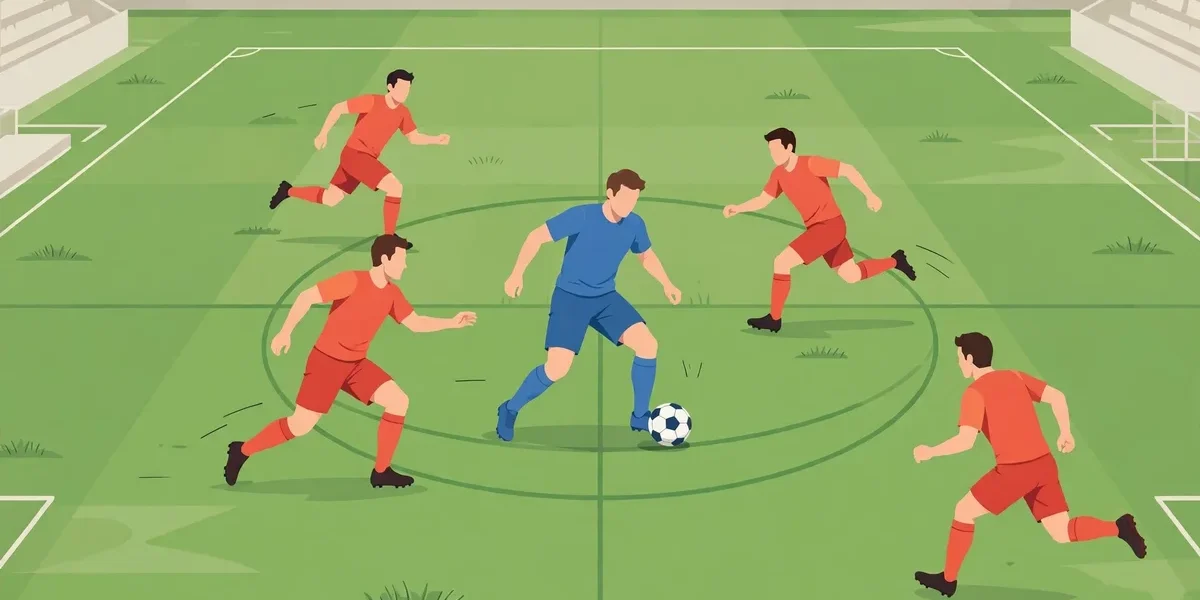
A midfielder is a player who operates in the middle third of the pitch, between the defenders behind and the forwards ahead. As a result, midfielders touch the ball more than any other outfield players in most matches. In addition, they receive passes from the defence and feed the attack.
Coaches call midfielders the engine of a team: the midfield sets the tempo and decides when a team presses or holds its shape.
Every midfielder shares the same core duties. First, they win the ball back when possession is lost. Second, they keep it with safe, accurate passing. Third, they create chances for the forwards. Finally, they cover ground in both halves.
The Main Types of Midfielder in Football
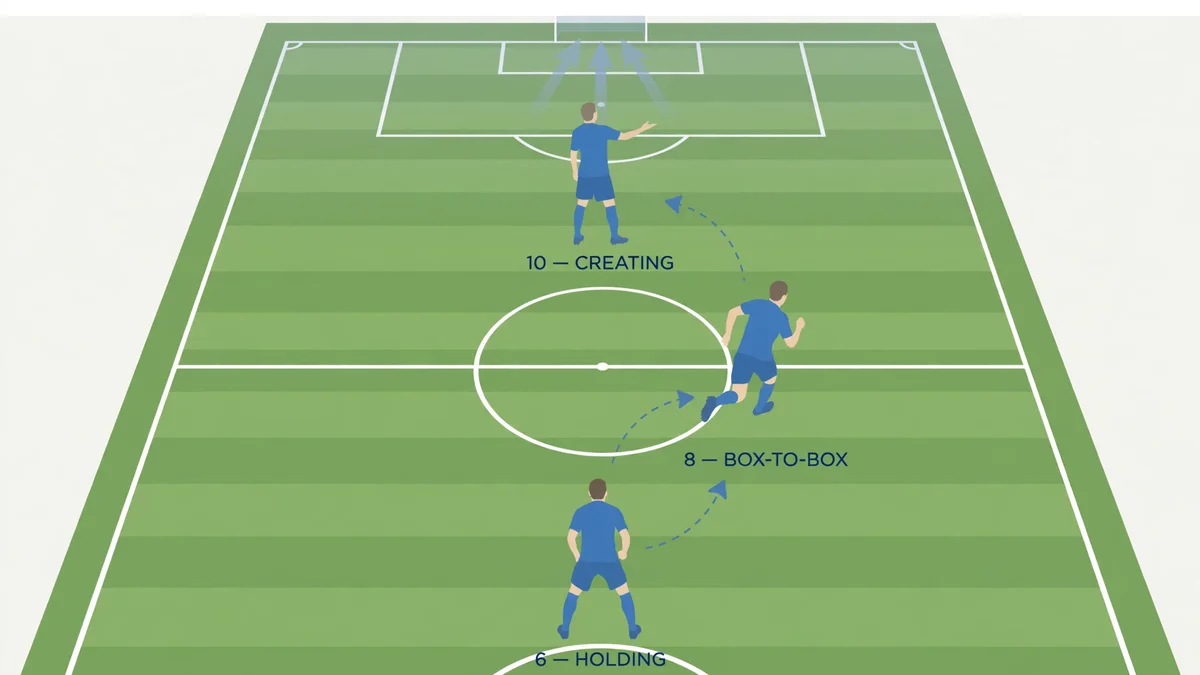
The classic midfield three has one player in each band: a holder (No. 6), a runner (No. 8) and a creator (No. 10). Each band has a different job. As a result, the three work together like parts of one machine. In addition, modern teams sometimes use a double pivot (two holders) or a rotating three.
First, the defensive midfielder. Then the all-round central midfielder. Next, the attacking midfielder. Finally, the wide and specialist roles, including the regista and the mezzala.
The Defensive Midfielder in Football
The defensive midfielder in football plays deepest, directly in front of the centre-backs. This player protects the back line, breaking up attacks and winning the ball back. After winning it, the defensive midfielder plays the first pass that starts the team’s own attack. As a result, coaches also call the role the holding midfielder or the anchor.
The player usually wears number 6, although some systems use number 4. For example, a good holder reads the game early and blocks passing lanes. In contrast, a holder who chases the ball leaves the defence exposed.
Sometimes the holder drops between the centre-backs, a job like that of a libero. Our guide to the defensive midfielder covers the role in detail.
The Central Midfielder in Football
The central midfielder is the all-round engine of the team. The role connects defence to attack, defends in its own half, and then joins attacks in the opposition half. As a result, the No. 8 covers huge ground “box to box” and earns the tag of most hardworking role on the pitch.
Above all, a box-to-box midfielder needs stamina. In addition, the role demands tackling, passing and a late run into the box. The best No. 8s do a little of everything: winning the ball, carrying it forward, and arriving late in the box. Luka Modric is the classic example.
The Attacking Midfielder in Football
The attacking midfielder is the most advanced central midfielder, working just behind the striker, between the opposition’s midfield and defence. From there, the No. 10 receives the ball between the lines, turns, and plays the final pass — or shoots.
Traditionally, the attacking midfielder wears number 10. Above all, the role needs vision, technique and an eye for space. In addition, the player must stay calm under pressure: the space between the lines is small.
The attacking midfielder is the classic playmaker of a team. However, the label covers only this subtype and the regista from deep.
Wide Midfielders and Specialist Roles
In a flat midfield, such as a 4-4-2, the wide midfielders tuck inside more than wingers do. In addition, they help the central build-up, support the full-backs, and deliver crosses or cut-backs. Traditionally, the right-sided wide midfielder wears number 7 and the left-sided one wears number 11.
The regista is a specialist deep role. The Italian word means “director”: the player directs the match from in front of the defence, dictating tempo with long, incisive passes. Andrea Pirlo is the archetype. Unlike a tackling-focused defensive midfielder, the regista’s main job is creative orchestration from deep. As a result, a regista usually needs a ball-winner alongside: Gennaro Gattuso did that job for Pirlo at AC Milan.
The mezzala is another Italian term, meaning “half-winger”. A mezzala is a central midfielder in a three-man midfield who plays wider and higher, attacking the half-spaces. The role links defenders and forwards and arrives late in the box.
How the Midfielder Role Has Changed
Overall, the midfielder in football grew from a simple link into the most varied job on the pitch. Early football used the 2-3-5 “pyramid”: two defenders, three half-backs and five forwards. The 1925 offside-law change (three to two defending players required) made the 2-3-5 vulnerable. Herbert Chapman at Arsenal answered with the WM (3-2-2-3), pulling the centre-half into defence as the first true centre-back.
The role grew out of the centre-half’s job of winning the ball back from deep. For example, Luis Monti is often cited as the first true defensive midfielder, playing just in front of Italy’s defence in Vittorio Pozzo’s 1934 World Cup-winning side.
The role changed again in 2003, when Claude Makelele joined Chelsea from Real Madrid. Under Jose Mourinho, he played as the sole protector at the base of a 4-3-3, sitting deep and shielding the back four. The position became known as the “Makelele role”. Chelsea won the 2004-05 Premier League — their first league title in 50 years — with Makelele at its base. By the 2006 World Cup, most major teams had a Makelele-type player.
Finally, the 1990s and 2000s split the pivot into two archetypes: the ball-winner (Makelele) and the deep-lying playmaker (Pirlo). In addition, the modern holder must do more than tackle and intercept.
Famous Midfielders and What They Show
Six players show how wide the role stretches, with records as of November 2026.
Luka Modric — the No. 8
Luka Modric won the 2018 Ballon d’Or, ending the ten-year Messi-Ronaldo duopoly (five wins each). In addition, he won a third successive Champions League with Real Madrid. He also captained Croatia to their first World Cup final, adding the World Cup Golden Ball.
Xavi Hernandez — the tempo-setter
Xavi won 133 caps for Spain and lifted Euro 2008, the 2010 World Cup and Euro 2012. In addition, he played 767 official matches for Barcelona, winning 8 La Liga and 4 Champions League titles (2006, 2009, 2011, 2015).
Andres Iniesta — the attacking midfielder
Iniesta won 131 caps for Spain. He scored the winner in the 116th minute of the 2010 World Cup final against the Netherlands. He also won Player of the Tournament at Euro 2012. In addition, he made 674 appearances for Barcelona, winning 9 La Liga and 4 Champions League titles.
Andrea Pirlo — the regista
Pirlo won 116 caps for Italy, the fifth-most in the country’s history. He won the 2006 World Cup, earning Man of the Match honours three times. In addition, he won two Champions Leagues with AC Milan (2003, 2007) and four Serie A titles with Juventus. He began as an attacking midfielder at Brescia before Mazzone moved him deep into the regista role.
N’Golo Kante — the modern ball-winner
Kante won the Premier League with Leicester City in 2015-16 and then with Chelsea in 2016-17. He was the first outfield player since Eric Cantona (1992, 1993) to win consecutive English league titles with different clubs. In 2016-17, he won the PFA Players’ Player of the Year award. Finally, he won the 2018 World Cup with France.
Kevin De Bruyne — the modern creator
De Bruyne was the first Manchester City player to win the PFA Players’ Player of the Year award (2019-20). He won it again in 2020-21. In 2019-20, he recorded 20 Premier League assists, equalling Thierry Henry’s record, and scored 13 league goals.
Frequently Asked Questions
What is the difference between a midfielder in football and a playmaker?
A playmaker is one subtype of midfielder: the classic playmaker is the No. 10, or the regista from deep. In contrast, a holding or box-to-box midfielder is not a playmaker in the classic sense.
Which type of midfielder in football is the most hardworking?
The box-to-box central midfielder, the No. 8, is often described as the most hardworking role on the pitch. In short, the job covers huge ground in both directions.
What number does a midfielder wear?
The classic numbers are 6 for the holder, 8 for the runner and 10 for the creator; wide midfielders wear 7 on the right and 11 on the left. However, modern squad numbers are flexible.
What is the difference between a midfielder and a striker?
A striker, usually No. 9, leads the line and lives or dies by goals. A midfielder operates behind the forwards, linking play and setting the tempo. In contrast, a defender lives by stopping goals.
Do midfielders need to defend?
Yes. In fact, every midfielder defends in some phase of play: holders protect the back line, central midfielders press, and even the No. 10 presses when possession is lost.
The Bottom Line
A midfielder in football links defence and attack: winning the ball, keeping it moving, and setting the tempo. The midfielder in football covers many jobs, from the holder to the creator playing the final pass. Midfielders are only one of the football positions on the pitch. Finally, watch the midfield in the next match: it decides how the game is played.