- The Difference Between a League and a Cup in Football: How a League Works
- The Difference Between a League and a Cup in Football: How a Cup Works
- The FA Cup: The Classic Example
- League vs Cup: The Key Differences
- The Difference Between a League and a Cup in Football: Mixed Formats
- The Difference Between a League and a Cup in Football: Why Cups Produce Upsets
- What the Difference Between a League and a Cup in Football Means for Fans
- Frequently Asked Questions
- What is the difference between a league and a cup in football?
- Can a team win a cup and be relegated in the same season?
- Does the Champions League still have a group stage?
- Why do big clubs rest players in cup matches?
- Conclusion
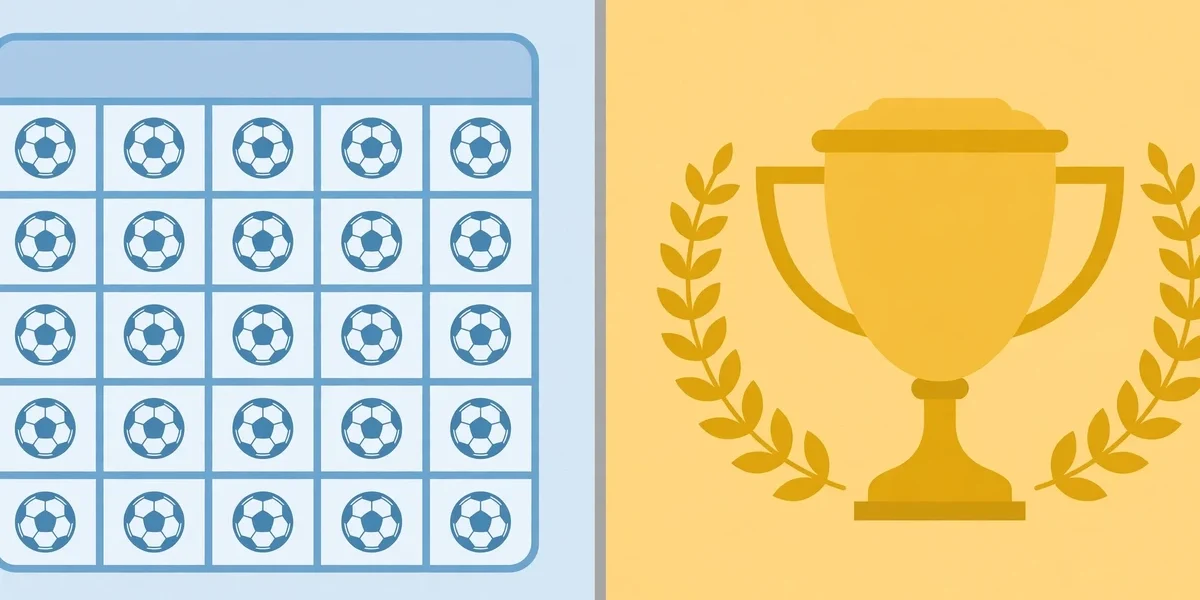
The difference between a league and a cup in football is simple to state and easy to mix up. In fact, a league is a marathon. Every team plays every other team. Points add up over a whole season. The team with the most points at the end is the champion. In contrast, a cup is a sprint through a minefield. One bad day ends a team’s whole campaign. That single difference explains almost everything else about the two formats.
Last updated: November 2026
Quick Answer:
- A league is a round-robin: every team plays every other team, home and away, and the team with the most points wins the title.
- A cup is a knockout: lose once and you are out, whatever happened before.
- A draw earns 1 point each in a league; in a cup it leads to extra time, penalties or a replay.
- A league rewards consistency over a whole season; a cup rewards survival on the day.
- Some competitions mix both formats, such as the Champions League and the World Cup.
The Difference Between a League and a Cup in Football: How a League Works
Firstly, a league runs on a round-robin format. Every team plays every other team once at home and once away. This format is a double round-robin. For the full detail, read our guide on how football leagues work.
Secondly, the points system is simple. A win earns 3 points, a draw earns 1 point, and a loss earns 0 points. Jimmy Hill proposed the system, and England adopted it in 1981.
Thirdly, the table decides the champion. Indeed, teams rank by total points. The team with the most points at the end takes the title. There is no final and no play-off in most leagues. For the columns and the maths, see our guide on how to read a league table.
In addition, the Premier League has a clear tiebreaker order: goal difference, then goals scored, then head-to-head points and head-to-head away goals, then a one-off play-off. The head-to-head steps and the play-off apply only where the title, relegation or a European place is at stake.
Meanwhile, the season is long. The Premier League has 20 clubs, each playing 38 matches, for 380 matches in total. The maximum points total is 114. For the history of the competition, read our guide on the history of the Premier League.
Finally, leagues use promotion and relegation. The bottom three from the Premier League clubs drop down. The top two from the Championship come up, plus the play-off winner. In contrast, the NPFL relegates its bottom four clubs. Four promoted clubs replace them through the NNL Super 8 play-offs. For the full story, read our guide on the history of the NPFL.
The Difference Between a League and a Cup in Football: How a Cup Works
Firstly, a cup runs on knockout, or single elimination. Teams meet in rounds. Lose once and you are out. Win and you go through to the next round. There is no table and no second chance, except for replays. The draw is random, with no seeding in the FA Cup, so a small club can draw a giant at home.
Secondly, most cup ties are a single match at one team’s ground. Some ties are two-legged, home and away. The EFL Cup semi-finals and the Champions League knockout rounds from the round of 16 onwards use two legs. In a two-legged tie, the aggregate score over both matches decides the winner. A tie level after 90 minutes, or level on aggregate, goes to extra time and then penalties. The away goals rule is gone from UEFA competitions since 2021/22.
However, replays work differently. A replay is a whole new match at the other team’s ground. In the FA Cup, replays ended from the first round proper in 2024/25. From the first round proper, ties level after 90 minutes go to extra time and then penalties. Replays still exist in the qualifying rounds.
The FA Cup: The Classic Example
Finally, the FA Cup is the classic example. The Football Association founded it in 1871, and it first played in the 1871–72 season. It is the oldest national football competition in the world. Charles W. Alcock proposed it in 1871. Wanderers beat Royal Engineers 1–0 in the first final in 1872. For the full story, read our guide on how the FA Cup works.
In the 2026–27 FA Cup, 747 teams entered. There are 14 rounds: 6 qualifying rounds, then 8 rounds of the Competition Proper. League One and League Two clubs enter in the first round proper, joining 32 qualifiers. Premier League and Championship clubs enter in the third round proper. A team entering at the very first round must win up to 13 matches. A Premier League club entering in the third round needs 6 wins. In addition, Wembley Stadium hosts the semi-finals and the final. Arsenal lead the winners list with 14 FA Cup wins. Manchester United are second with 13.
League vs Cup: The Key Differences
Indeed, the table below sets out the difference between a league and a cup in football.
| League | Cup | |
|---|---|---|
| Format | Round-robin; everyone plays everyone, home and away | Knockout; random draw, single elimination |
| Matches to win it | 38 per team | 6 wins (third-round entry); up to 13 (first-round entry) |
| What happens after a loss | Nothing final — the team keeps playing; a loss costs 0 points | The team is out (except where replays still apply) |
| What happens after a draw | 1 point each | Extra time, then penalties (or a replay) |
| How the winner is decided | Most points; tiebreakers if level | Last team standing; no table |
| Who can enter | Only the clubs in that division (20) | Open — hundreds of clubs, down to level 9 |
| Upsets | Rare over a season | Common — one bad day ends a giant’s run |
| Relegation and promotion | Yes | No |
In short, the league tests a team over months. The cup tests it on one day.
The Difference Between a League and a Cup in Football: Mixed Formats
Firstly, not every competition is purely one or the other. The Champions League is the best-known example. The old group stage is gone: 32 teams in 8 groups of 4. Since 2024/25, 36 teams play in a single league phase. Each club plays 8 matches against 8 different opponents, 4 home and 4 away. One table ranks all 36 clubs, with 3 points for a win. The top 8 go straight to the round of 16. Teams finishing 9th to 24th play two-legged knockout play-offs. Teams finishing 25th to 36th go out. From the round of 16 onwards, it is pure knockout. The final is a single match at a neutral venue.
Secondly, the World Cup mixes the formats too. It starts with a group stage, a round-robin with 3 points for a win. Then come single-elimination knockout rounds. The 2026 World Cup expanded from 32 teams to 48. FIFA confirmed the format on 14 March 2023: 12 groups of four teams, 104 matches in total, three group games each. The top two from each group plus the eight best third-placed teams advance to a new Round of 32. An earlier plan for 16 groups of three teams was reversed on 14 March 2023.
The Difference Between a League and a Cup in Football: Why Cups Produce Upsets
Firstly, a cup shock needs only one great day. A lower-league team needs one great day to knock out a giant in a cup. In a league, it would need to be better than that giant over 38 games.
For example, Hereford United beat Newcastle United 2–1 in a third-round replay on 2 February 1972. Non-league Hereford, from the fifth tier, beat top-flight Newcastle after a 2–2 draw at St James’ Park. Ronnie Radford’s 30-yard equaliser is one of the most famous FA Cup goals.
Secondly, Wigan Athletic beat Manchester City 1–0 in the FA Cup final on 11 May 2013. Ben Watson’s 91st-minute header won Wigan their first major trophy.
Thirdly, Wimbledon beat Liverpool 1–0 in the 1988 FA Cup final. The “Crazy Gang” beat the league champions.
Meanwhile, leagues reward whole seasons of consistency. In fact, Arsenal’s “Invincibles” of 2003–04 completed a 38-match Premier League season unbeaten. Manchester City’s “Centurions” of 2017–18 reached 100 Premier League points.
What the Difference Between a League and a Cup in Football Means for Fans
For fans, the difference between a league and a cup in football is really about what kind of story they want. Above all, a league title is usually seen as the truer test of the best team. Indeed, it rewards consistency over nine months. In contrast, a cup is about drama and memories. One night can make a club’s history. For bettors, league form is the steadier guide, because it rests on many matches.
Frequently Asked Questions
What is the difference between a league and a cup in football?
Indeed, a league is a round-robin. Every team plays every other team. In contrast, a cup is a knockout. One loss ends a team’s campaign. In short, a league rewards consistency over a season. A cup rewards survival on the day.
Can a team win a cup and be relegated in the same season?
Yes. In fact, Wigan Athletic won the FA Cup in 2013 and went down from the Premier League in the same season. In fact, they were the first team to do both in one season.
Does the Champions League still have a group stage?
No. In fact, since 2024/25, the Champions League has used a 36-team league phase followed by knockout rounds. The old group stage ended after the 2023/24 season.
Why do big clubs rest players in cup matches?
Because a cup tie is one game, and the league matters more over a season. Moreover, big clubs often rotate their squads in early cup rounds. However, a rotated side can still lose on one bad day. That is why cup shocks happen.
Conclusion
In short, the difference between a league and a cup in football comes down to this: a league asks who is best over a whole season, and a cup asks who survives the day. Indeed, the league crowns the most consistent team. Finally, the cup crowns the last team standing.