
- What Resistance Training for Beginners Means
- Resistance Training vs Cardio
- The Benefits of Resistance Training for Beginners
- The Best Types of Resistance Training for Beginners
- The Basic Exercises
- Sets, Reps and Rest
- How to Start Resistance Training for Beginners
- How Often to Train and Recover
- How to Progress Safely
- Warm Up and Stay Safe
- Common Mistakes in Resistance Training for Beginners
- Frequently Asked Questions
- Is resistance training for beginners safe?
- What equipment do I need for resistance training for beginners?
- How many days a week should I train?
- Can I do resistance training at home?
- Conclusion
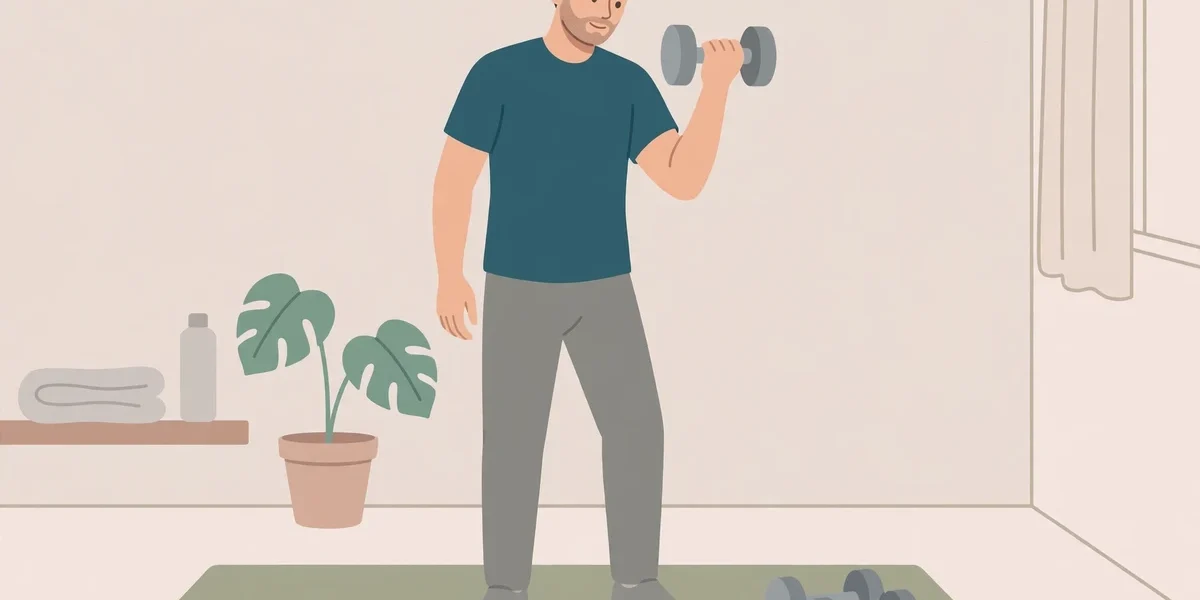
Resistance training for beginners is the simplest way to get stronger. You make your muscles work against a force, and they adapt. In other words, you lift, push or pull against something heavier than usual, and your body responds by building strength. For example, your own body weight counts as resistance.
Last updated: November 2026
Quick Answer
- Resistance training for beginners means working muscles against a force — body weight, dumbbells, machines or bands.
- Aim for 2–3 sessions a week, with 2–3 sets of 8–12 reps per exercise.
- Start light, learn the movements first, and add weight only when your form stays good.
- The World Health Organization also advises muscle-strengthening on at least 2 days a week, alongside aerobic activity.
What Resistance Training for Beginners Means
The NHS defines a strength exercise as any activity that makes your muscles work harder than usual. In other words, it is any exercise in which muscles work against an opposing force. Body weight, free weights, machines or bands all count. Above all, the goal is simple: challenge the muscles a little more than they are used to, then let them recover.
In addition, the work covers all the major muscle groups: legs, hips, back, abdomen, chest, shoulders and arms. If you want the wider picture of how strength fits into overall fitness, read our guide to health vs fitness.
Resistance Training vs Cardio
Cardio, or aerobic exercise, raises your heart rate for a sustained period. Brisk walking, running, cycling and swimming all count. Its main job is heart and lung fitness and stamina. In contrast, resistance training works muscles against a force in short bouts of effort. Its main job is stronger muscles, more muscle and stronger bones.
Cardio typically burns more calories per session than resistance training. However, cardio does not build muscle the way resistance training does. For example, a Duke trial found lifters gained more lean mass than the aerobic-only group. As a result, the guidelines ask for both: aerobic activity plus muscle-strengthening on 2 or more days a week. In short, neither one replaces the other.
The Benefits of Resistance Training for Beginners
Strength exercises increase muscle strength, size, power and endurance. Above all, everyday movements get easier when the muscles behind them are stronger. For example, carrying shopping and climbing stairs rely on the same strength.
Resistance training also helps maintain bone density, because muscles pull on bones under load. In addition, exercises that improve leg strength, balance and coordination help you avoid falls as you get older. Meanwhile, strengthening activities slow the rate of bone and muscle loss that comes with ageing. Finally, the NHS lists “reduce joint pain” among the benefits of strength exercise.
The Best Types of Resistance Training for Beginners
Bodyweight: Uses your own mass as the resistance — for example push-ups, squats, lunges and planks. Above all, it needs no equipment. However, it gets harder to make the work heavier as you get stronger.
Free weights: Dumbbells, barbells and kettlebells are the most versatile option. Moreover, they allow a full range of motion and engage the stabilising muscles. In addition, the load is easy to increase in small steps.
Weight machines: Guided, fixed-path equipment such as the leg press or the chest press machine. As a result, they are easy to learn and a common starting point for beginners.
Resistance bands: Elastic bands in different thicknesses. Also, they are cheap, portable and joint-friendly, and they work well for beginners, warm-ups and home training.
The Basic Exercises
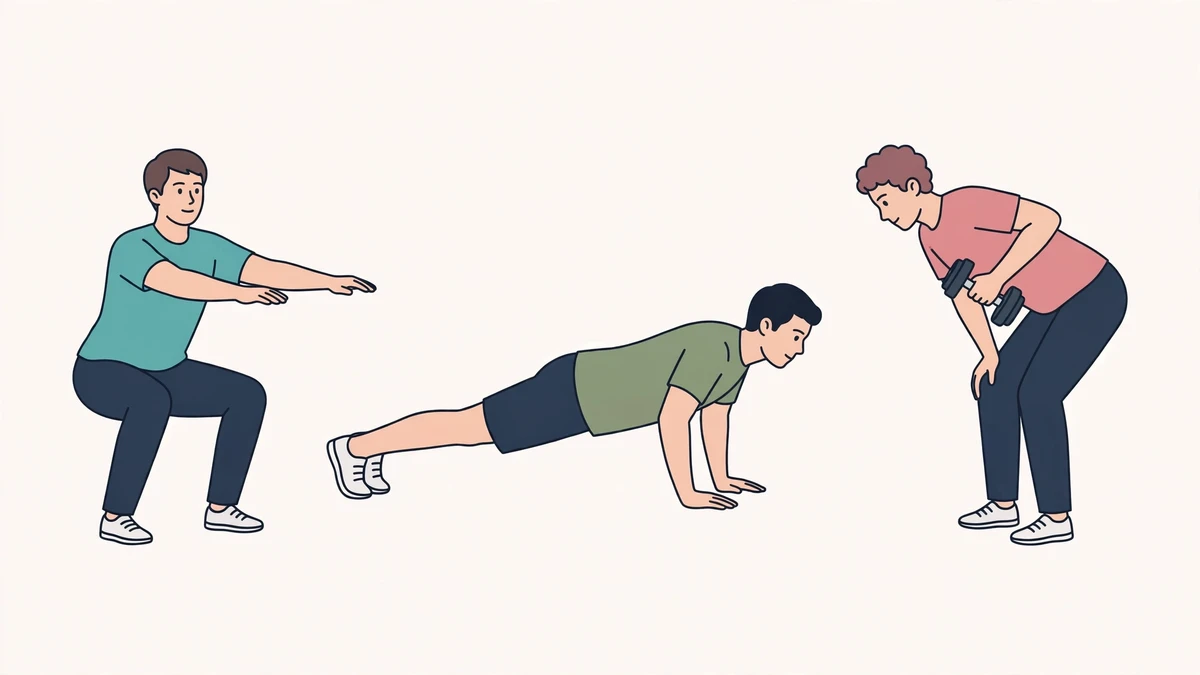
Most beginner guides build a programme around five fundamental patterns.
Squat: Firstly, bend at the knees and hips to lower the body, then stand back up. It works the quadriceps, glutes and core.
Hinge: Next, bend mainly at the hips, with only a small knee bend — the movement of picking something up from the floor. It works the glutes, hamstrings and lower back.
Push: Then push away from the body. It works the chest, shoulders and triceps. It splits into a horizontal push and a vertical push.
Pull: Afterwards, pull towards the body. It works the back, biceps and rear shoulders. It splits into a horizontal pull and a vertical pull. For example, start with a one-arm dumbbell row.
Overhead press: Finally, press dumbbells from shoulder height straight overhead. It works the shoulders, triceps and upper chest.
Sets, Reps and Rest
In general, the guidance for beginners is 2–3 sets of 8–12 repetitions per exercise. The American College of Sports Medicine (ACSM) gives this range in its 2009 and 2019 guides. The National Institutes of Health gives the same 8–12 reps. In addition, a session should include 8–10 multi-joint exercises that cover the major muscle groups.
Firstly, stop each set with 2–3 repetitions still “in the tank”. In other words, do not train to failure as a beginner. The ACSM 2026 position stand reviewed 137 systematic reviews covering more than 30,000 participants. It found that sets stopped 2–3 reps short of failure give the same gains. As a result, there is no need to push every set to the limit.
Rest for 1–2 minutes between sets. Meanwhile, keep the tempo slow and controlled, and do not use momentum, bouncing or jerking to move the weight. Another way to arrange the same exercises is circuit training — our guide to the benefits of circuit training for athletes covers that format.
How to Start Resistance Training for Beginners
Firstly, a simple beginner week has two full-body sessions on non-consecutive days — for example Tuesday and Saturday. This is an example layout, not a prescription.
- Session A: goblet squat, push-up, one-arm dumbbell row, glute bridge, plank.
- Session B: Romanian deadlift, dumbbell overhead press, lat pulldown or band pulldown, bodyweight squat, farmer’s carry.
How Often to Train and Recover
Firstly, train 2–3 days a week. The ACSM gives the same range in its 2009 and 2019 guidance. The NHS and WHO advise muscle-strengthening on at least 2 days a week. In addition, train each major muscle group at least twice a week.
Next, rest for at least 48 hours before training the same muscles again. As a result, use non-consecutive days, such as Monday, Wednesday and Friday.
How to Progress Safely
In short, progressive overload means gradually making training harder over time so muscles keep adapting — more weight, more reps or more sets. For example, the ACSM 2-for-2 rule gives a simple way to judge when to add weight. Raise the load by 2–10% when you beat your target by 1–2 reps on two sessions in a row.
In practice, add reps first, then weight. This is called double progression: keep the same weight and add reps until every set reaches the top of the range with good form. Then move to the next weight and work back up from 8 reps. However, only progress when form stays good. If form breaks down, stay at the same weight.
Warm Up and Stay Safe
Warm up for 5–10 minutes with brisk walking, cycling or marching in place. Then do one light warm-up set of your first exercise at about half the working weight.
Firstly, learn each movement with no weight or very light weight, and master the technique before adding load. In addition, start light: choose a weight you can lift with good form for the full set.
Next, keep good posture and a neutral spine — back straight, shoulders back, core engaged. Also, breathe continuously and never hold your breath. Exhale on the hard part of the lift. Meanwhile, move slowly and with control, and do not use momentum. Finally, stop if you feel sharp pain, dizziness, chest pressure or numbness.
Check with a doctor first if, for example, you have a heart or lung condition, are pregnant, or have an active injury. This is general safety guidance, not advice for any specific condition.
Common Mistakes in Resistance Training for Beginners
Firstly, too much, too soon: starting with too many sets, too many days or too much weight. Start with fewer sets than you think you can do and build up. Secondly, lifting with poor form to move heavier weight — “ego lifting”. Poor form invites injury and slows progress, so focus on form, not weight.
Next, using momentum instead of control, and holding your breath during lifts. In addition, training the same muscles every day: muscles need at least 48 hours to recover. Similarly, skipping pulling movements is a common gap. Finally, chasing soreness or pain as proof that a workout worked. Severe pain is not normal.
Frequently Asked Questions
Is resistance training for beginners safe?
Yes, when you start light, learn the movements first and follow the safety basics in this guide. Above all, warm up, use good form, breathe continuously and stop if you feel sharp pain.
What equipment do I need for resistance training for beginners?
Very little. Your own body weight is enough to start, and a pair of light dumbbells or a set of resistance bands adds options.
How many days a week should I train?
Firstly, train two to three days a week, on non-consecutive days, so each muscle group gets at least 48 hours to recover.
Can I do resistance training at home?
Yes — bodyweight exercises need no equipment. In addition, dumbbells or resistance bands are cheap and portable. Start with the same rules: learn the movements, start light and keep your form good.
Conclusion
In short, resistance training for beginners is simple. Work your muscles against a force, 2–3 times a week, with good form and enough rest. Start light, learn the five patterns, and add weight only when your form stays good. For more guides like this one, visit our Health & Fitness section.
Health disclaimer: This article is general information only and is not medical advice. Finally, check with a doctor before starting a new exercise programme, especially if you have a health condition.