- How to Bet on Darts for Beginners: How 501 Works
- Checkouts: How a Leg Ends
- The 180 and the Nine-Darter
- The Main Tournaments
- How to Bet on Darts for Beginners: The Main Markets
- How Darts Odds Work: Decimal Odds and Implied Probability
- How to Bet on Darts for Beginners: Worked Examples
- How to Bet on Darts for Beginners: What to Check First
- How to Bet on Darts for Beginners: Common Mistakes
- Betting on Darts in Nigeria
- Frequently Asked Questions
- What is the best way to learn how to bet on darts for beginners?
- What is the difference between a leg and a set in darts?
- What is a 180 in darts?
- Can you draw in darts betting?
- What does −2.5 mean in a darts handicap?
- Conclusion
How to bet on darts for beginners is simpler than it looks, once you know how a leg works. Darts is a two-way betting sport: there is no draw, so every match has a winner. This guide explains 501, checkouts, the main tournaments and the main markets.
Last updated: November 2026
Quick Answer:
- Darts is played as 501: first to exactly zero, finishing on a double.
- A match is decided by legs or by sets – never mix the two up.
- There is no draw in darts, so match-winner bets are two-way.
- Decimal odds of 2.50 mean a ₦1,000 stake returns ₦2,500 if the bet wins.
How to Bet on Darts for Beginners: How 501 Works
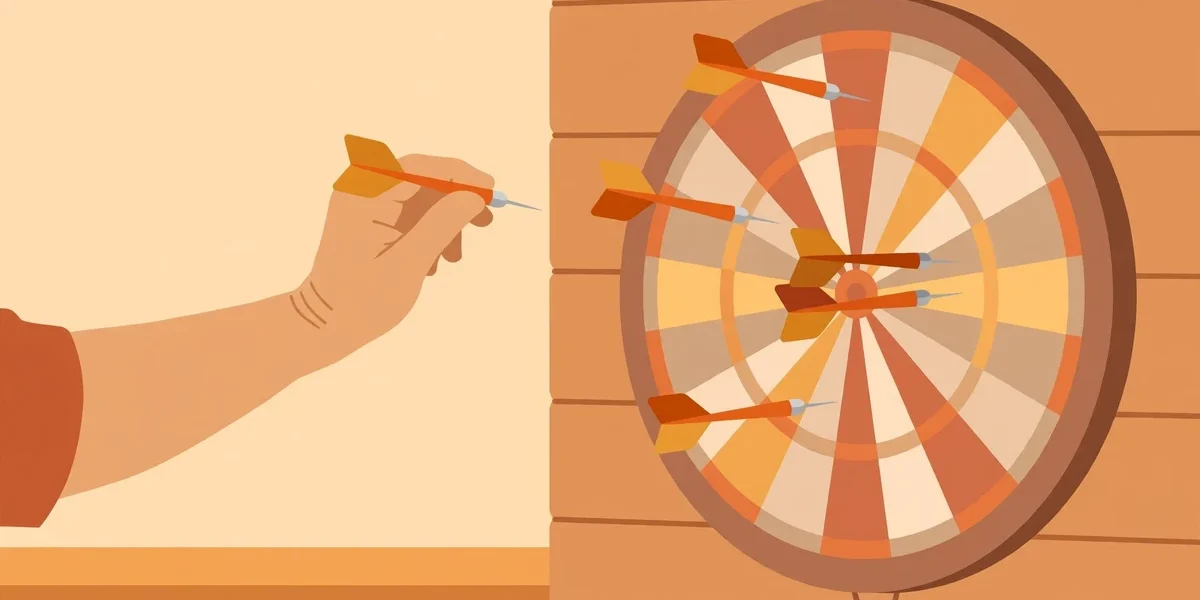
To begin with, professionals almost always play 501: each player starts on 501 points, throws three darts per visit, and subtracts the score. The first to reach exactly zero wins the leg.
Secondly, no double is needed to start: straight in, double out. The final dart must land in a double or the inner bullseye (double 25). Go below zero, reach exactly 1, or reach zero without a double, and you bust: the turn is void and the score resets.
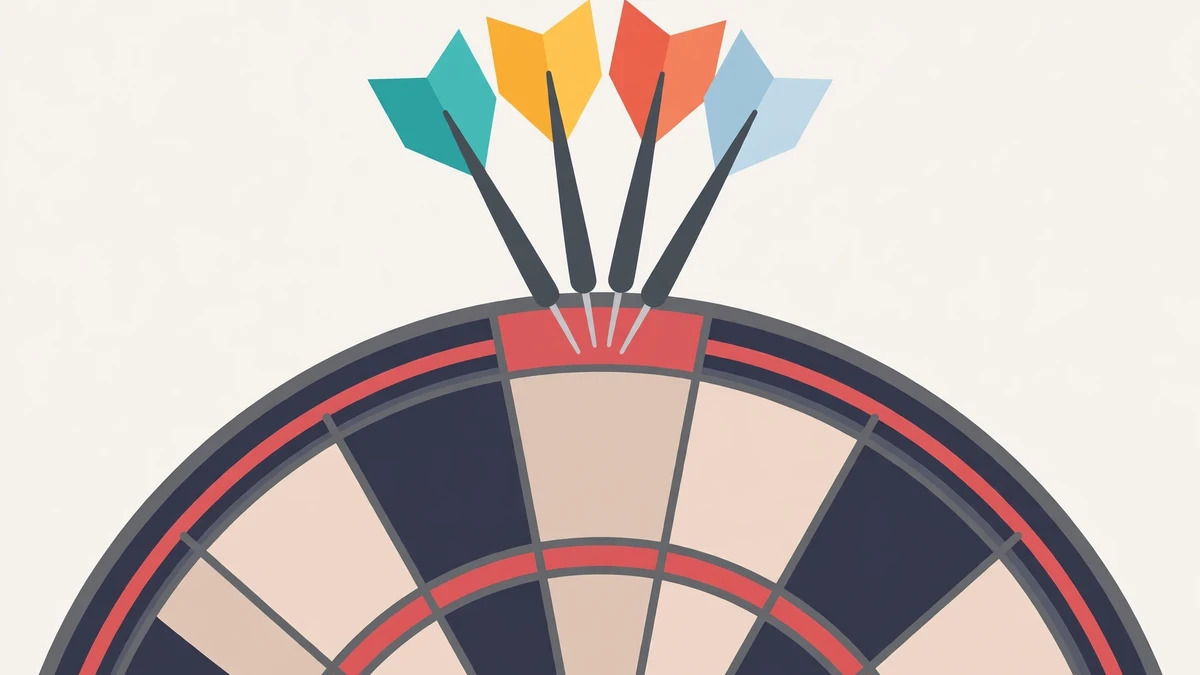
Thirdly, each segment scores its face value from 1 to 20. The thin outer ring doubles the value (double 20 = 40) and the thin inner ring trebles it (treble 20 = 60). The outer bull is 25 and the inner bullseye is 50.
Finally, three treble 20s score 180. The throw line is the oche (pronounced “ockey”), 2.37 m from the board, and the bullseye sits 1.73 m above the floor.
In short, a leg is one race from 501 to zero and a set is a group of legs, usually first to 3.
Checkouts: How a Leg Ends
A checkout is the combination that finishes a leg. Above all, the highest possible checkout is 170: treble 20, treble 20, bullseye (60 + 60 + 50), nicknamed “the big fish”.
For example, the common routes: 32 on double 16, 40 on double 20, 50 on the bullseye, and 141 on treble 20, treble 19, double 12 (60 + 57 + 24). In contrast, some totals cannot be finished in one visit: the bogey numbers 169, 168, 166, 165, 163, 162 and 159.
Meanwhile, checkout percentage is the share of double attempts a player converts: the best check out roughly 40 to 45%, and James Wade topped the PDC form guide at 44.88% as of November 2026. In addition, the three-dart average is total points divided by darts thrown, multiplied by three. Elite professionals average 95 to 100 or more: Luke Littler averaged 106.02 in the 2026 World Championship final and a record 111.04 to win the 2026 World Matchplay, per the PDC.
The 180 and the Nine-Darter
Firstly, a 180 is three treble 20s in one visit (60 + 60 + 60), the maximum from three darts.
Secondly, a nine-dart finish, or nine-darter, is a leg of 501 won in nine darts. The standard route is 180, 180, 141: two maximums, then treble 20, treble 19, double 12. In other words, 180 + 180 + 141 = 501.
Finally, John Lowe hit the first televised nine-darter in 1984. At the World Grand Prix, legs must start on a double, so a nine-darter usually finishes on the bullseye. Brendan Dolan hit the first one in that format, starting on double 20 and finishing on the bull.
The Main Tournaments
Four events matter most to bettors.
| Tournament | Where and when | Format |
|---|---|---|
| PDC World Darts Championship | Alexandra Palace, London; December to early January | Sets. 128 players. Final first to 7 (best of 13). Deciding set: two clear legs or sudden-death at 5–5. As of November 2026: £5m fund, £1m winner |
| Premier League Darts | Thursday nights, February to May | Legs. 8 invited players. Nights best of 11 (first to 6). Points: 5–3–2–0. Invitational, non-ranking |
| World Matchplay | Winter Gardens, Blackpool; July | Legs only. First to 10, then 18 in the final. Two clear legs |
| World Grand Prix | Leicester Arena; late September to early October | Sets. Double-in, double-out only. Sets first to 3 legs. 32 players |
Luke Littler won his first world title in January 2025 and retained it on 3 January 2026, beating Gian van Veen 7–6. He was the first £1m world champion. Phil Taylor holds the record of 16 world titles.
How to Bet on Darts for Beginners: The Main Markets
These are the markets to learn first. Darts has no draw, so match-winner bets are always two-way. The same approach works in our guide on how to bet on rugby for beginners.
| Market | What it means | Beginner notes |
|---|---|---|
| Match winner | Pick the match winner | No draw |
| Set betting / correct score | Exact score in sets or legs | Longer odds |
| Leg / set handicap | One player starts with a virtual deficit (−2.5) | Must cover the handicap |
| Total 180s (over/under) | Combined 180s over/under a line | Line 8.5: over needs 9+ |
| Most 180s | Which player hits more 180s | Rewards high-180 players |
| Highest checkout | Highest checkout, or over/under (line 121.5) | Maximum is 170 |
| Nine-dart finish (yes/no) | Whether a nine-dart leg happens | Very long odds |
| Outrights / tournament winner | Winner of a tournament | Odds shorten |
| Live / in-play | Bet during the match | Odds swing fast |
For example, start with match winner or a handicap, then try total 180s once the patterns feel familiar. A live bet lets you stake during the match.
How Darts Odds Work: Decimal Odds and Implied Probability
In general, darts odds work like odds in other sports. Decimal odds show the total return for every ₦1 staked, stake included: odds of 2.50 mean a ₦1,000 stake returns ₦2,500 if the bet wins.
Implied probability is what the bookmaker thinks the chance is: 1 ÷ decimal odds × 100. Odds of 2.50 imply a 40% chance (1 ÷ 2.50 = 0.40); odds of 1.50 imply about 67%.
However, the bookmaker’s margin means the implied probabilities add up to more than 100%. The maths works the same way as in our guide on how to bet on cricket for beginners. Reading the odds correctly is the first step in how to bet on darts for beginners. There is no draw in darts, so the 1X2 market does not apply.
How to Bet on Darts for Beginners: Worked Examples
Firstly, take a match-winner bet: you stake ₦1,000 at decimal odds of 2.50.
- Return if the bet wins: ₦1,000 × 2.50 = ₦2,500
- Profit: ₦2,500 − ₦1,000 = ₦1,500
- Implied probability: 1 ÷ 2.50 × 100 = 40%
Secondly, take a leg handicap at −2.5 legs in a best-of-11 match (first to 6). At 6–2, the adjusted score is 6 − 2.5 = 3.5, which beats 2, so the bet wins. At 6–4, the adjusted score is 3.5, which loses to 4, so the bet loses, though the favourite won the match.
Thirdly, take a set handicap at −2.5 sets in a first-to-3 match. A 3–0 win covers it (3 − 2.5 = 0.5, which beats 0), but a 3–1 win does not. Only a 3–0 win covers −2.5 sets.
Finally, take total 180s with the line at 8.5: over needs 9 or more 180s, and under needs 8 or fewer.
How to Bet on Darts for Beginners: What to Check First
Firstly, check recent form: the three-dart average and the checkout percentage. Heavy scorers who miss doubles still lose legs.
Secondly, check the head-to-head record.
Thirdly, check the match length: longer formats favour the better player.
Fourthly, check the crowd: the Alexandra Palace crowd is famously loud and partisan.
Finally, check the format: sets play differently from legs, and the World Grand Prix’s double-in rule changes everything. That is how to bet on darts for beginners with a plan, not a guess.
How to Bet on Darts for Beginners: Common Mistakes
Avoid these seven mistakes.
- Confusing legs and sets: a “correct score” of 3–1 means sets, not legs.
- Betting on the World Grand Prix like normal 501: legs must start on a double.
- Chasing the nine-dart finish market: a fun bet, not a plan.
- Overvaluing a short price in a short format: one bad spell on the doubles ends it.
- Ignoring checkout percentage: heavy scorers who miss doubles still lose legs.
- Betting on total 180s without checking the match length: short matches give few 180s.
- Staking money you cannot afford to lose, or chasing losses.
Betting on Darts in Nigeria
In Nigeria, sports betting regulation is state-led: the Supreme Court nullified the National Lottery Act 2005 on 22 November 2024, and the National Lottery Regulatory Commission framework applies only in the Federal Capital Territory. Betting is for adults 18 and over only.
Frequently Asked Questions
What is the best way to learn how to bet on darts for beginners?
Start with match-winner bets, then try handicaps and total 180s once the 501 rules feel familiar.
What is the difference between a leg and a set in darts?
A leg is one race from 501 to zero; a set is a group of legs, usually first to 3. The World Championship uses sets, the Premier League uses legs.
What is a 180 in darts?
Three treble 20s in one visit (60 + 60 + 60), the maximum from three darts.
Can you draw in darts betting?
No. Every darts match is played to a decisive number of legs or sets.
What does −2.5 mean in a darts handicap?
The favourite starts 2.5 legs (or sets) down and must win by 3 or more.
Conclusion
In short, darts betting rewards the bettor who knows the game first and the odds second. Learn the difference between legs and sets, check the format, and start small. That is how to bet on darts for beginners: learn the 501 rules, learn the markets, and stake only what you can afford to lose.
Bet Responsibly: betting is for adults aged 18 and over only. Treat it as entertainment, not income, and only stake money you can afford to lose. For help, visit our Responsible Gambling page.