
- How to Bet on Cricket for Beginners: How Cricket Works
- How to Bet on Cricket for Beginners: The Three Formats
- How to Bet on Cricket for Beginners: The Main Markets
- How to Bet on Cricket for Beginners: How Odds Work
- How to Bet on Cricket for Beginners: The Toss, the Pitch and the Weather
- Dead Heats, Tied Matches and Rain
- How to Bet on Cricket for Beginners: Mistakes to Avoid
- Betting on Cricket in Nigeria
- Frequently Asked Questions About How to Bet on Cricket for Beginners
- How to bet on cricket for beginners: which format should I start with?
- What happens if rain stops a cricket match?
- Can a cricket match end in a draw?
- What is a Super Over in cricket betting?
- Conclusion
How to bet on cricket for beginners starts with three things: the formats, the main markets and how the odds work. Cricket is a bat-and-ball sport between two teams of 11 players each. The team with more runs wins. One team bats while the other bowls and fields. Every cricket bet depends on the format and your bookmaker’s rules.
Last updated: November 2026
Quick Answer:
- Cricket has three formats: Test, ODI and T20.
- The main markets are match winner, top batsman, top bowler, total runs and most sixes.
- A Test can end in a draw, while a tied match goes to a Super Over.
- Odds are a price, not a prediction.
How to Bet on Cricket for Beginners: How Cricket Works
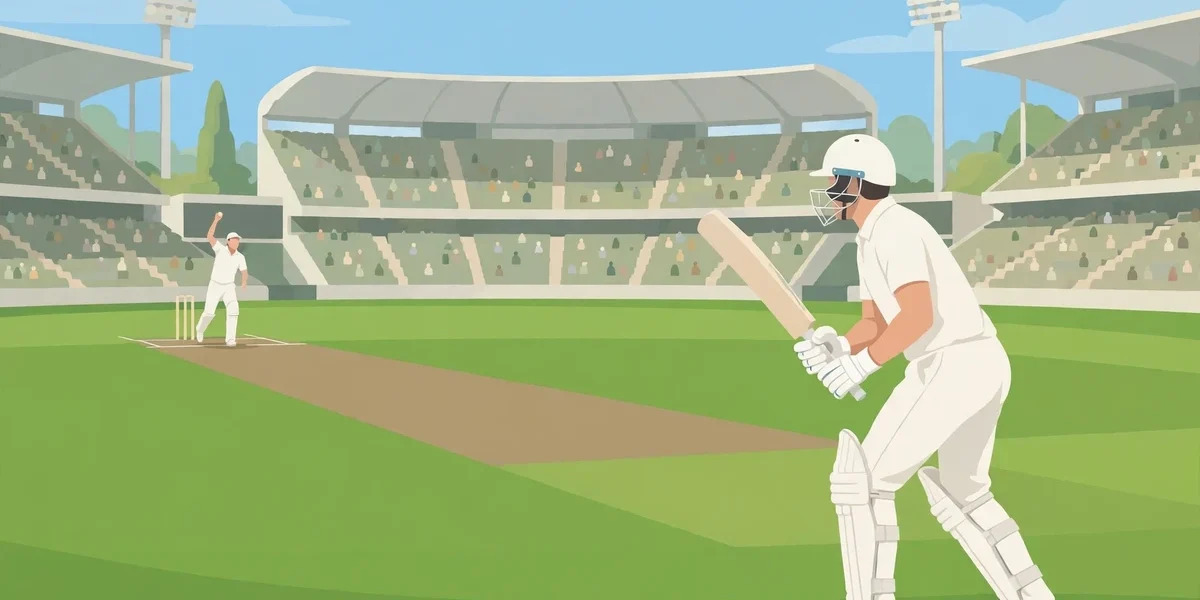
To begin with, a cricket match has two teams of 11 players each. One team bats and scores runs, while the other bowls and fields and tries to take wickets. An innings ends when 10 batters are dismissed.
An over is six legal deliveries from one bowler. However, wides and no-balls do not count among the six. Each one costs a run, and the bowler bowls it again. In addition, a no-ball gives the batter a free hit in limited-overs cricket.
Batters score by running between the wickets. For example, a boundary earns four runs if the ball touches the ground first. It earns six runs if it clears the boundary without bouncing.
The common dismissals are bowled, caught, LBW, run out and stumped. For example, bowled means the ball hits the stumps. Finally, run out and stumped both involve a broken wicket.
How to Bet on Cricket for Beginners: The Three Formats
The ICC recognises three formats: Test, ODI and T20I.
| Format | Length | Innings | Overs | Balls | Max per bowler | Powerplay | Ball |
|---|---|---|---|---|---|---|---|
| Test | Up to 5 days | 2 | No fixed limit | No fixed limit | No limit | None | Red or pink |
| ODI | 1 day | 1 | 50 | 300 | 10 | Overs 1–10 | White |
| T20I | 3 hours | 1 | 20 | 120 | 4 | Overs 1–6 | White |
In a Test, the side with more runs wins, if it also takes all 20 wickets before time runs out. However, if the five days run out first, the match is a draw. In an ODI or a T20I, the side with more runs wins. If the scores are level, the match is a tie.
In short, draw, tie and no result are three different things. A draw happens only in Tests, when time runs out before a result. When rain stops a match before an official result, it is a no result.
In a Super Over, each team bats for one over of six balls, and the team that scores more runs wins. Meanwhile, wickets lost do not matter; only runs decide it. Finally, bookmakers settle match-winner bets on the Super Over winner.
How to Bet on Cricket for Beginners: The Main Markets
The match-winner market is three-way in Tests. By contrast, ODIs and T20Is are effectively two-way. In other words, it works like a 1X2 bet in football.
Top batsman (top batter) asks which player scores the most runs. As a result, openers face more balls and usually have the shortest odds. In contrast, lower-order batters rarely win it. Similarly, top bowler asks which player takes the most wickets.
Total runs is an over/under market. For example, a line of 165.5 runs means over wins at 166 or more. Under wins at 165 or fewer. The .5 means the line can never be hit exactly. In addition, most sixes asks which team hits the most sixes. Similarly, method of dismissal asks how a named batter gets out. Finally, player performance covers combined statistics.
Meanwhile, live betting lets you bet while the match is in progress, and the odds move ball by ball. A live bet in a T20 moves fastest, because one over can swing a total.
Finally, outrights ask which team wins a whole tournament, such as the Cricket World Cup.
How to Bet on Cricket for Beginners: How Odds Work
This guide uses decimal odds. Multiply your stake by the odds to find the return. For the implied probability, divide one by the decimal odds.
For example, you stake ₦1,000 on a team at 2.50. Your return is 1,000 × 2.50 = ₦2,500. Your profit is 2,500 − 1,000 = ₦1,500. The implied probability is 1 ÷ 2.50 = 0.40, or 40%.
For example, you stake ₦1,000 at 5.00 on a batter to top-score for his team. He ties with one other batter. Under dead-heat rules, bookmakers split the stake in half. The winning ₦500 returns ₦2,500 at 5.00. The net result is +₦1,500, not +₦4,000.
Above all, odds are a price, not a prediction. They contain an estimate of probability plus the bookmaker’s margin.
How to Bet on Cricket for Beginners: The Toss, the Pitch and the Weather
The two captains toss a coin; the winner chooses whether to bat or bowl first. The toss itself is 50/50 chance. However, the choice matters.
For example, evening dew can make the ball wet and slippery in the second innings. As a result, spinners cannot grip it. In addition, the ball skids onto the bat, helping the team batting second. Captains who win the toss often bowl first.
For example, a green pitch helps fast bowlers early on. In contrast, dry pitches grip and turn, helping spinners later on. Finally, flat pitches offer true bounce and high totals.
For instance, overcast skies help fast bowlers generate swing. Finally, rain can shorten or cancel a match and triggers the DLS method.
DLS stands for Duckworth-Lewis-Stern. In short, it sets a revised target when rain shortens a limited-overs match. A batting innings has two resources: overs remaining and wickets in hand. DLS compares each side’s resources, then adjusts the target. For example, cutting a chase from 50 to 25 overs does not simply halve the target.
For a rain-hit match to have an official result, each side must have batted. That means 20 overs in an ODI and five in a T20I. Otherwise, the match is a no result.
Finally, if an official result is declared, bookmakers settle match-winner bets on it. Otherwise, if there is no official result, bets are normally void and stakes are returned.
Dead Heats, Tied Matches and Rain
To begin with, a dead heat happens when two or more selections tie for first place in a market. Under the common rule, bookmakers divide the stake by the number of tied selections. They pay the divided stake at full odds. Two tied means half the stake wins.
However, rules vary by bookmaker. Some use a fewer-balls-faced tiebreaker instead. Others void the market entirely. Similarly, if a player you backed does not bat or bowl, some void the bet. Others count it as a loser.
Firstly, if the competition’s rules determine a winner, bookmakers settle match bets on the official result. Secondly, if the official result is a tie, dead-heat rules apply. The stake is split between the two teams. Thirdly, in a Test, a tie means a dead heat between both teams. Bets on the draw count as losers.
In addition, if there is no official result, all bets are void. Finally, if a Test ends in a draw, bookmakers settle bets on the draw where they offer it. Rules vary by bookmaker, so check before you bet.
How to Bet on Cricket for Beginners: Mistakes to Avoid
- Firstly, do not bet on a Test like a T20: it can end in a draw.
- Secondly, do not back a low-order top batsman.
- In addition, do not forget the toss and the dew.
- Moreover, read the dead-heat and tie rules before you bet.
- Above all, never bet on the toss as if it were skill.
- Similarly, do not chase losses with in-play bets.
- Finally, do not treat odds as predictions.
Betting on Cricket in Nigeria
Betting is for adults aged 18 and over only. In Nigeria, sports betting regulation is state-led. The Supreme Court nullified the National Lottery Act 2005 on 22 November 2024. The NLRC framework applies only in the Federal Capital Territory.
Frequently Asked Questions About How to Bet on Cricket for Beginners
How to bet on cricket for beginners: which format should I start with?
Start with T20. Each side bats once for 20 overs.
What happens if rain stops a cricket match?
Firstly, if enough play has taken place, the DLS method sets a revised target. Each side must have batted 20 overs in an ODI and five in a T20I.
Can a cricket match end in a draw?
In short, yes, but only in Tests. If the five days run out first, the match is a draw. If the scores are level, the match is a tie.
What is a Super Over in cricket betting?
In short, a Super Over is a one-over tie-breaker. Each team bats for six balls, and the team that scores more runs wins.
Conclusion
In conclusion, learning how to bet on cricket for beginners is mostly about learning the formats. Once you know how a Test differs from a T20, the rest falls into place. Finally, start small. A free bet can be a low-risk way to try a market. For more guides, visit the Betting Academy.
Bet Responsibly
Above all, betting is entertainment, not income. Only stake money you can afford to lose. In short, if betting stops being fun, stop. You must be 18 or over to bet. For support and safer gambling tools, visit our Responsible Gambling page.