- How to Bet on Horse Racing for Beginners: The Basics
- The Main Markets: How to Bet on Horse Racing for Beginners
- Fixed Odds or Pari-Mutuel: How to Bet on Horse Racing for Beginners
- How to Bet on Horse Racing for Beginners: Reading a Racecard
- How to Bet on Horse Racing for Beginners: Famous Races to Know
- Worked Examples
- Dead Heats, Non-Runners and Rule 4
- Betting on Horse Racing in Nigeria
- Frequently Asked Questions
- What is the easiest bet when you learn how to bet on horse racing for beginners?
- How does an each-way bet work?
- What is the difference between fixed odds and pari-mutuel betting?
- What is the simplest way to learn how to bet on horse racing for beginners?
- Conclusion
Learning how to bet on horse racing for beginners starts with one simple idea: pick a horse, choose a bet type, and stake an amount you can afford to lose. Horse racing looks complicated at first glance. In practice, the basics are simple. For example, this guide explains how a race works, the main markets, and how to read a racecard.
Last updated: November 2026
Quick Answer
- Two codes: flat racing (no obstacles) and jump racing (hurdles and fences).
- Simplest bets: win and each-way (two equal bets).
- Fixed odds lock in your price; pari-mutuel odds stay final only at the close.
- A racecard shows form, weight, jockey, trainer and going.
- Check each-way terms and Rule 4 on the bet slip.
How to Bet on Horse Racing for Beginners: The Basics
A horse race is a contest over a set distance on a track. Firstly, races split into two codes: flat racing and jump racing. Flat racing has no obstacles: horses run on turf, dirt or a synthetic surface. Flat races usually run between 5 furlongs and 2 miles.
Secondly, jump racing — National Hunt in Britain and Ireland — asks horses to clear hurdles or fences.
Race types form a second axis, based on eligibility, weight and class. A maiden race is for horses that have yet to win under the applicable rules or code. Next, novice races are for horses with limited wins, and conditions races set weight by age, sex and wins. In a handicap, horses carry different weights by ability. As a result, horses of different ability can compete closely. The handicapper rates each horse, one point per pound of weight.
Group races (flat) and graded races (jumps) mark the top level. Finally, our guide to compare horse-racing betting platforms explains what to look for.
The Main Markets: How to Bet on Horse Racing for Beginners
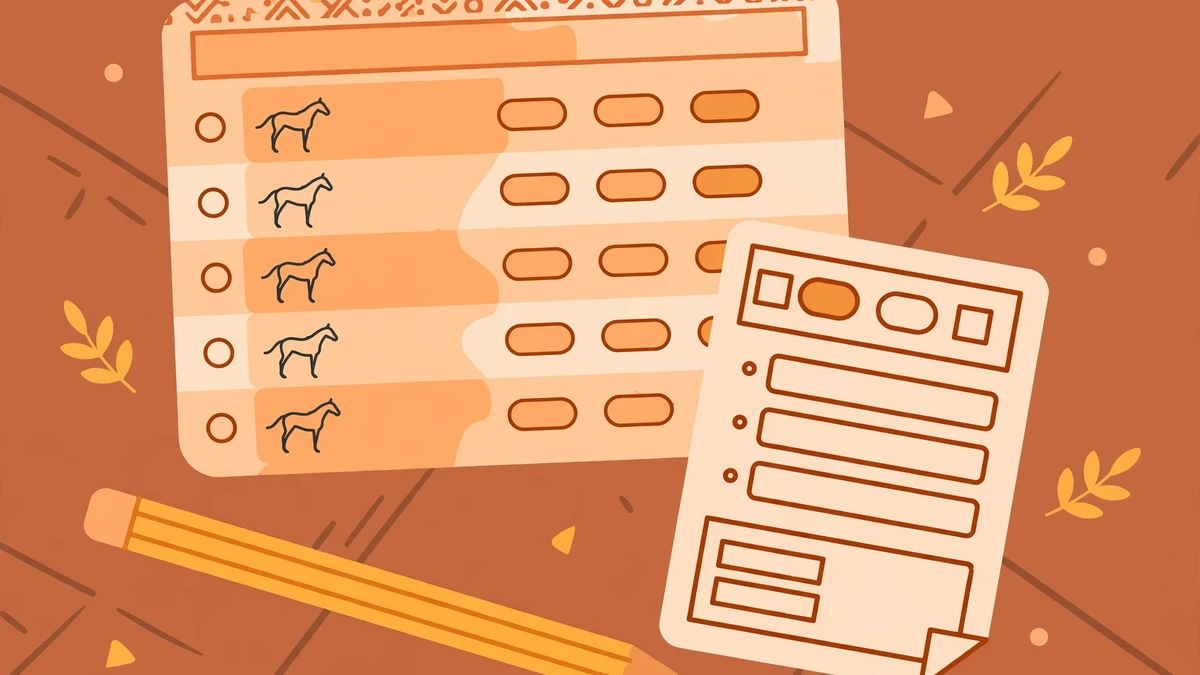
Firstly, a win bet is the simplest bet of all: pick one horse to win. If it finishes second or worse, you lose the stake. Secondly, a place bet backs a horse to finish in the paid places. Unlike a 1X2 bet on football, a win bet on a horse has only one winning outcome.
| Market | What it means | When it pays |
|---|---|---|
| Win | Your horse must finish first | Only if it wins |
| Place | Your horse must finish in the paid places | If it places; lower odds |
| Each-way | Two equal bets: one to win, one to place | Win part pays on a win; place part pays 1/4 or 1/5 |
It is TWO bets of equal stake: one to win, one to place. For example, a ₦1,000 each-way bet costs ₦2,000 in total. If the horse wins, both parts pay. A place without a win pays only the place part. Next, forecasts and tricasts pick the first two or three horses in order, settled at a dividend rather than at fixed odds.
Standard terms pay 1/4 of the win odds for two places (5–7 runners). Bigger fields pay 1/5 for three places, or 1/4 for three or four places. Therefore, always check the terms on the bet slip.
Fixed Odds or Pari-Mutuel: How to Bet on Horse Racing for Beginners
Firstly, with fixed odds, the price you take when you place the bet stays fixed. If you take a horse at 2.50 and it wins, the bookmaker pays you at 2.50.
Secondly, pari-mutuel betting, also called the tote or totalisator, works differently. All wagers on the same outcome go into a shared pool. The operator takes a fixed percentage (the takeout) off the top and divides the rest among winners. In other words, you bet against the other punters in the pool, not against the house. The final payout (the dividend) stays hidden until betting closes. The odds shown before the race only estimate the final price. In the United States, takeout runs about 16% on win pools and above 20% on exotic pools. Our NYRA Bets guide shows how one American platform works.
With fixed odds you know your payout before the race starts. With pari-mutuel you learn your price only after the race. In contrast, fixed odds suit a bettor who likes a price early, while pari-mutuel can pay more on longshots. Finally, starting price (SP) is the odds at the moment the race starts.
How to Bet on Horse Racing for Beginners: Reading a Racecard
A racecard lists every runner’s name, age, weight, jockey, trainer and form. Firstly, form figures show recent finishing positions, read left to right, oldest first. Numbers 1–9 are positions, and 0 means 10th or worse. Letters add detail: P means pulled up, F means fell, U means unseated rider. For example, form 4321 means the horse improved every time and won last time out.
C means a win at this course, D a win over this distance, and CD both. Next, cards show age in years. Meanwhile, weight appears in stones and pounds: 11-2 means 11 stone 2 pounds. In handicaps the weight follows the official rating, one point per pound. A number in brackets after the jockey’s name is a claim.
Meanwhile, OR (official rating) rates ability in pounds. Going, the ground condition, runs from fastest to slowest on turf: firm, good to firm, good, good to soft, soft, heavy. Going changes how a race runs. In addition, cards show distance in miles and furlongs (1m2f). For a deeper walk-through, see our guide on how to read a racing form. Finally, pundits start with the big four: going, distance, class and form.
How to Bet on Horse Racing for Beginners: Famous Races to Know
Firstly, the Derby at Epsom Downs first ran in 1780 and runs about a mile and a half for three-year-olds. Secondly, the Grand National at Aintree first ran in 1839: a handicap steeplechase over about four and a quarter miles with 30 fences, its field cut from 40 runners to 34 from 2024. Thirdly, the Cheltenham Gold Cup first ran in 1924: a Grade 1 steeplechase over about three and a quarter miles with 22 fences, the most prestigious race in jump racing.
Worked Examples
These examples show how to bet on horse racing for beginners with real numbers.
Firstly, take a win bet at decimal odds of 2.50, staking ₦1,000. If your horse wins, your total return is ₦1,000 × 2.50 = ₦2,500. Your profit is ₦2,500 − ₦1,000 = ₦1,500. The implied probability is 1 ÷ 2.50 = 0.40, or 40%. If the horse loses, you lose the full ₦1,000.
Secondly, take an each-way bet on a horse at 5.00 (4/1), with terms of 3 places at 1/4 of the odds. A ₦1,000 each-way bet costs ₦2,000 in total. In addition, the place odds are 1/4 of 4/1, which is 1/1 (evens), or 2.00. If the horse wins, the win part pays ₦1,000 × 5.00 = ₦5,000. The place part pays ₦1,000 × 2.00 = ₦2,000. That gives a total return of ₦7,000 and a profit of ₦5,000. A place without a win pays only the place part: ₦2,000 back, so the bet breaks even. An unplaced finish loses the full ₦2,000.
Thirdly, a dead heat: stake ₦1,000 on a horse at 5.00, and it dead-heats for the win with one other horse. Half your stake (₦500) wins at full odds, so ₦500 × 5.00 = ₦2,500 comes back.
Dead Heats, Non-Runners and Rule 4
Exact rules vary by bookmaker. The framework below is the standard Tattersalls framework. Firstly, if your horse does not run on the day you bet, the bookmaker refunds your stake. In a multiple bet, the bet drops that leg: a fourfold becomes a treble.
Next, if another horse drops out, Rule 4 applies. With one horse out, every remaining runner gains. Rule 4 deducts from your WINNINGS, never your stake, scaled to the withdrawn horse’s price when it came out. The shorter its price, the bigger the deduction.
| Price of withdrawn horse | Deduction from winnings |
|---|---|
| 1/9 or shorter | 90p in the pound (90%) |
| 16/5 to 4/1 | 20p in the pound (20%) |
| 10/1 to 14/1 | 5p in the pound (5%) |
| Over 14/1 | No deduction |
If more than one horse drops out, deductions add together and cap at 90p in the pound. For example, take a ₦1,000 win bet at 2.50, where the profit if it wins is ₦1,500. If a rival drops out at 4/1, a 20p Rule 4 deduction applies. The deduction is 20% of ₦1,500 = ₦300. Your winnings become ₦1,200, and your total return is ₦2,200 (odds 2.20).
Finally, ante-post bets settle all-in, run or not: no Rule 4 deduction, but no stake back if your horse never runs. In addition, a dead heat is when two or more horses finish exactly level. The standard settlement divides your stake by the number of dead-heaters.
Betting on Horse Racing in Nigeria
In Nigeria, sports betting regulation is state-led: the Supreme Court nullified the National Lottery Act 2005 on 22 November 2024, and the National Lottery Regulatory Commission framework applies only in the Federal Capital Territory. Betting is for adults aged 18 and over only.
Frequently Asked Questions
What is the easiest bet when you learn how to bet on horse racing for beginners?
In short, a win bet is the easiest place to start: pick one horse, and it must finish first.
How does an each-way bet work?
An each-way bet is two equal bets: one to win, one to place. In other words, a ₦1,000 each-way bet costs ₦2,000.
What is the difference between fixed odds and pari-mutuel betting?
With fixed odds, your price stays fixed and you know your payout in advance. With pari-mutuel betting, wagers go into a shared pool and the payout stays hidden until betting closes.
What is the simplest way to learn how to bet on horse racing for beginners?
Start with win bets on races you have studied. Finally, learn one market at a time — win first, then place, then each-way.
Conclusion
In short, horse racing betting rewards patience, and that is how to bet on horse racing for beginners: learn the two codes, start with win bets, and check the maths.
Bet Responsibly: betting is for adults aged 18 and over only. Treat it as entertainment, not income, and only stake money you can afford to lose. For help, visit our Responsible Gambling page.