- How to Bet on Greyhound Racing for Beginners: How a Race Works
- The Traps and Their Colours
- Grades and Distances
- The Main Markets: How to Bet on Greyhound Racing for Beginners
- Greyhound Racing vs Horse Racing
- How to Bet on Greyhound Racing for Beginners: Reading a Racecard
- How to Bet on Greyhound Racing for Beginners: The Trap Draw
- How to Bet on Greyhound Racing for Beginners: Worked Examples
- Dead Heats, Non-Runners and Rule 4(c)
- Famous Races to Know
- Betting on Greyhound Racing in Nigeria
- Frequently Asked Questions
- What is the simplest way to learn how to bet on greyhound racing for beginners?
- How many dogs run in a greyhound race?
- What does each-way mean in greyhound racing?
- Which trap wins most often in greyhound racing?
- How long does a greyhound race last?
- Conclusion
Learning how to bet on greyhound racing for beginners starts with one simple idea: six dogs chase a mechanical lure, and the first one home wins. In fact, a race lasts about 30 seconds from traps to line. This guide explains how a race works, the main markets, and how to read a racecard.
Last updated: November 2026
Quick Answer:
- Six dogs run in each race, from traps 1 to 6.
- Simplest bets: win and each-way (two equal bets).
- With six runners, each-way pays 1/4 of the win odds for first and second.
- Check trap history and running style.
How to Bet on Greyhound Racing for Beginners: How a Race Works
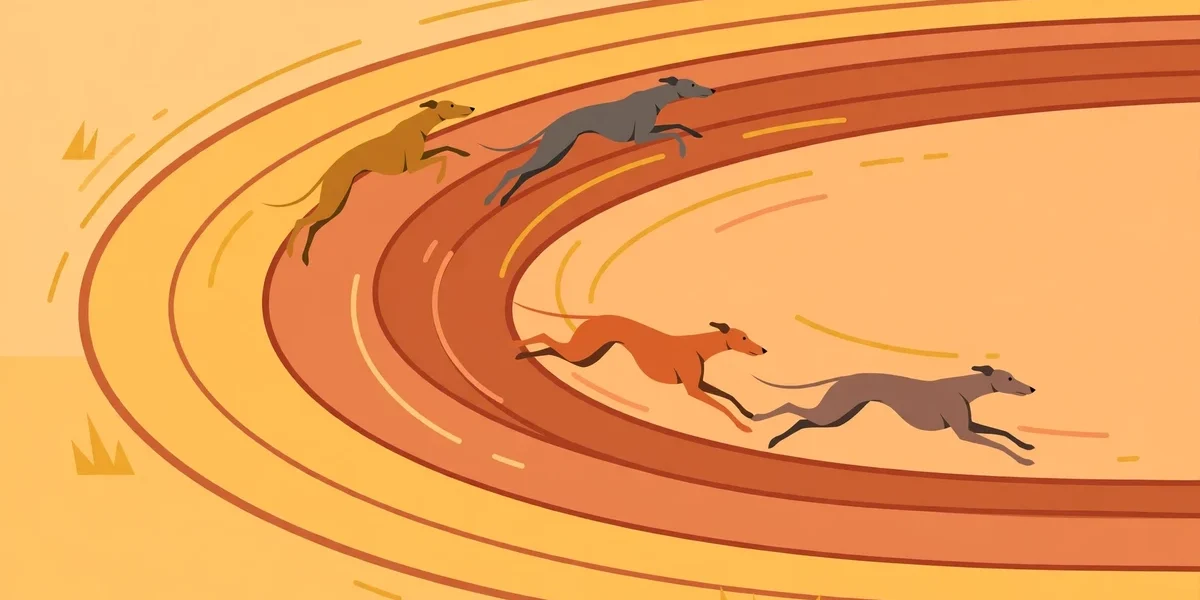
Firstly, six greyhounds run in each race in UK and Irish graded racing. The dogs load into numbered starting traps, 1 to 6. A mechanical lure, an artificial hare on a rail, starts moving before the traps open, and the dogs chase it around a sand oval.
Secondly, a race lasts around 30 seconds. Indeed, most tracks are roughly 400 metres round, with four bends and two straights. In Britain, 18 tracks hold a licence from the Greyhound Board of Great Britain. In addition, a card has 10 to 13 races, run about every 15 minutes.
Finally, the modern sport began at Belle Vue, Manchester, in 1926.
The Traps and Their Colours
Each dog wears a coloured racing jacket matching its trap number. Indeed, the colours are standard across British and Irish tracks.
| Trap | Colour | Position |
|---|---|---|
| 1 | Red | Inside |
| 2 | Blue | Inside-middle |
| 3 | White | Middle-inside |
| 4 | Black | Middle-outside |
| 5 | Orange | Outside-middle |
| 6 | Black and white stripes | Widest |
In fact, trap 1 is closest to the inner rail, the shortest route round the track. Above all, the draw matters because of the first bend: the dog that leads there wins most often.
Grades and Distances
Every graded race has a letter and number code, for example A1. The letter is the race type; the number is the ability level. Grade 1 is the top level.
| Grade | Distance | Type |
|---|---|---|
| A1 | 380–500 m | Standard |
| D1 | 240–350 m | Sprint |
| H1 | 380–500 m | Hurdles |
| M1 | 640 m+ | Marathon |
A means standard distance (380 to 500 metres); D sprint; M marathon; H hurdles; OR open race; N novice; P puppy. In fact, the bottom of the scale varies by track, so there is no single lowest grade.
Moreover, a dog must pass qualifying trials before its first graded race, and the racing manager sets the grade from trial times and recent form.
Indeed, standard races mostly run 450 to 500 metres, with 480 metres the most common. Sprints run under about 350 metres, and staying races 640 metres and beyond.
The Main Markets: How to Bet on Greyhound Racing for Beginners
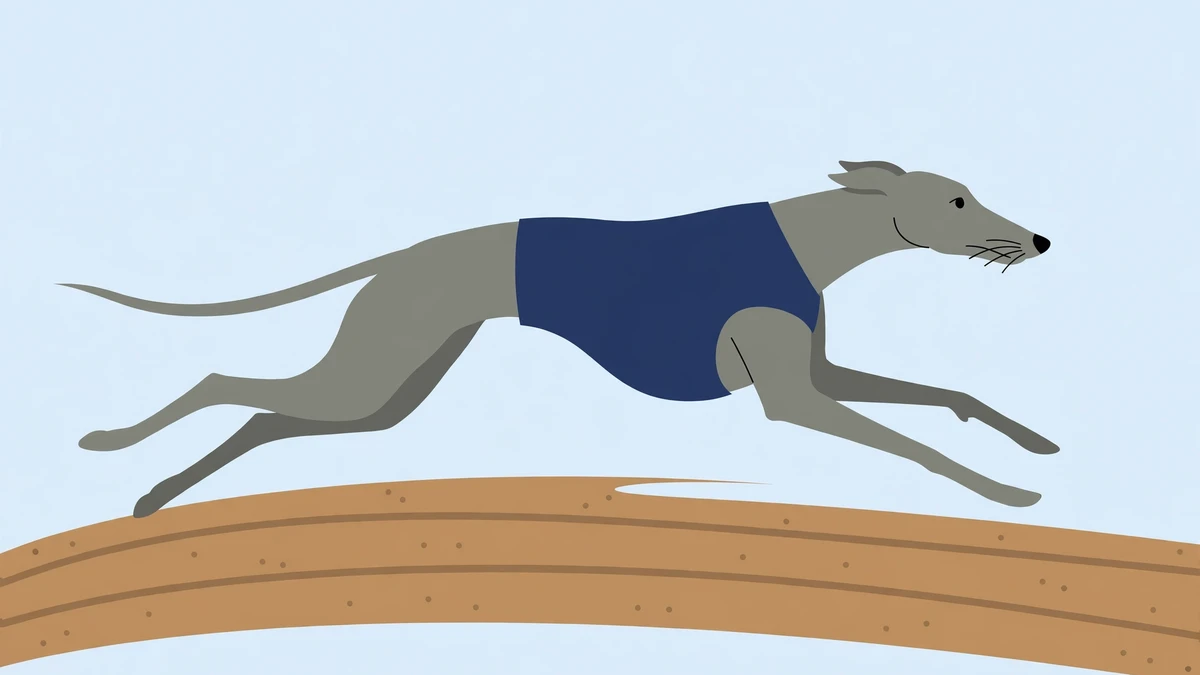
Firstly, a win bet is the simplest bet: pick one dog to finish first. Secondly, an each-way bet is two equal bets.
| Market | What it means |
|---|---|
| Win | Pick the dog to finish first |
| Place | Pick a dog to finish first or second |
| Each-way | Two equal bets: one to win, one to place |
| Straight forecast | Pick first and second in exact order |
| Tricast | Pick first, second and third in exact order |
| Accumulator | Combine win bets from different races |
The win market works like the home-win part of a 1X2 bet. With races lasting about 30 seconds, a live bet during the run itself is rare.
Place terms depend on the field size.
| Runners | Place terms |
|---|---|
| 2–4 runners | Win only |
| 5–6 runners | 1/4 the odds, first and second |
| 8 or more runners | 1/5 the odds, first, second and third |
In handicap races, 5 to 7 runners pay 1/4 the odds for first and second.
Greyhound Racing vs Horse Racing
In fact, the two sports look similar on a betting slip, but the details differ. Firstly, there are no jockeys: no rider to judge, no jockey booking, no riding tactics.
Secondly, greyhounds carry no weight cloth. The “weight” on a racecard is the dog’s own body weight at the weigh-in — not a handicap weight.
Thirdly, “going” exists on a greyhound card, but it is not horse racing’s going. It is a speed rating of the track surface for that session: Normal, Fast or Slow.
Finally, the races are shorter and the fields are smaller: six runners and about 30 seconds. For the horse racing version, read our guide on how to bet on horse racing for beginners, and see our guide to compare horse-racing betting platforms.
How to Bet on Greyhound Racing for Beginners: Reading a Racecard
A racecard row shows, for each runner: trap and jacket colour, name, trainer, form figures, best time, weight and grade.
Indeed, form figures are the finishing positions from the dog’s last six runs, read left to right with the most recent run on the right. A line of 3 2 1 1 4 1 means the dog won its latest race.
Each form line also encodes the trap drawn, the bend positions, the winning distance, the calculated time, and the going. For instance, “3-2-1-1 by 2.5 lengths, 29.43, Normal” means the dog won by two and a half lengths in 29.43 seconds.
In addition, sectional times show whether a dog is an early-pace type or a closer.
Indeed, weight is the dog’s body weight at the weigh-in. A sudden change can be a fitness signal. Comments use shorthand: SAw means slow away, EPace means showed early pace, and Crd means crowded.
How to Bet on Greyhound Racing for Beginners: The Trap Draw
Inside traps win slightly more often than the even share nationally, but the bias is track-dependent. Trap 1 typically wins around 19 to 20% of races, against an even share of 16.7%.
However, the bias varies sharply by track: Towcester’s trap 1 wins about 20%, Harlow’s trap 6 about 21%, and Oxford’s trap 5 wins 23.5%. Never call any single trap “the best”. Knowing the draw helps when you learn how to bet on greyhound racing for beginners, but running style decides whether it helps or hurts: a “railer” suits traps 1 and 2, a wide runner suits traps 5 and 6.
How to Bet on Greyhound Racing for Beginners: Worked Examples
In fact, these examples show how to bet on greyhound racing for beginners with real numbers.
Firstly, take a win bet at decimal odds of 2.50, staking ₦1,000. If your dog wins, your return is ₦1,000 × 2.50 = ₦2,500, a profit of ₦1,500. The implied probability is 1 ÷ 2.50 = 0.40, or 40%.
Secondly, take an each-way bet on a dog at 5.00 (4/1), with six-runner place terms of 1/4 the odds. In fact, a ₦1,000 each-way bet costs ₦2,000, and the place odds are 1/4 of 4/1, or 2.00. If the dog wins, the win part pays ₦5,000 and the place part pays ₦2,000: a ₦7,000 return. Second place pays only the place part: ₦2,000 back, break-even.
Thirdly, a dead heat: stake ₦1,000 on a dog at 5.00, and it dead-heats for the win with one other dog. Half your stake (₦500) wins at full odds: ₦500 × 5.00 = ₦2,500.
Finally, a Rule 4 example: take a ₦1,000 win bet at 2.50, where the profit is ₦1,500. If a rival is withdrawn at 4/1, a 20p Rule 4(c) deduction applies: 20% of ₦1,500 = ₦300, so your winnings become ₦1,200, for a ₦2,200 return.
Dead Heats, Non-Runners and Rule 4(c)
Rules vary by bookmaker. Firstly, if your dog is withdrawn, the bet is void and the stake is returned. In a multiple, the leg drops: a treble becomes a double.
Next, if a dog is withdrawn after prices are out, Rule 4(c) applies. The deduction follows the Tattersalls scale: 90p at 1/9 or shorter; 20p at 16/5 to 4/1; 5p at 10/1 to 14/1; nothing over 14/1. It comes off winnings only.
Finally, a dead heat divides the stake by the number of dead-heaters.
Famous Races to Know
Firstly, the English Greyhound Derby is the most prestigious race on the British greyhound calendar. It was first run on 15 October 1927 at White City, London, over 500 yards. Entry Badge won at 1/4 favourite in 29.01 seconds. Mick the Miller was the first dog to win it twice, in 1929 and 1930. It was not run in 1941 to 1944.
Indeed, the Derby moved between White City, Wimbledon, Towcester and Nottingham before returning to Towcester in 2021. Moreover, as of November 2026, the latest final ran on 6 June 2026 at Towcester: Lennies Eddie, a 10/1 chance, won in 28.20 seconds, the third-fastest time ever at Towcester.
Secondly, the Irish Greyhound Derby is Ireland’s premier race, held at Shelbourne Park, Dublin, over 550 yards (503 metres) since 1986. As of November 2026, the latest final ran on 12 September 2026: Bockos Gold won by four lengths in 29.05 seconds, the fastest ever winner.
Betting on Greyhound Racing in Nigeria
In Nigeria, sports betting regulation is state-led: the Supreme Court nullified the National Lottery Act 2005 on 22 November 2024, and the National Lottery Regulatory Commission framework applies only in the Federal Capital Territory. Betting is for adults aged 18 and over only.
Frequently Asked Questions
What is the simplest way to learn how to bet on greyhound racing for beginners?
In fact, start with win bets on races you have studied. Learn one market at a time.
How many dogs run in a greyhound race?
Six, from traps 1 to 6.
What does each-way mean in greyhound racing?
In fact, an each-way bet is two equal bets: one to win, one to place. With six runners, the place part pays 1/4 of the win odds for first and second.
Which trap wins most often in greyhound racing?
Indeed, no single trap wins most often everywhere. Trap 1 wins slightly more than the even share nationally, but it varies by track.
How long does a greyhound race last?
In fact, about 30 seconds from traps to line.
Conclusion
In short, greyhound racing rewards the bettor who reads the racecard first. Indeed, that is the heart of how to bet on greyhound racing for beginners: learn the traps and the racecard.
Bet Responsibly: betting is for adults aged 18 and over only. Treat it as entertainment, not income, and only stake money you can afford to lose. For help, visit our Responsible Gambling page.