
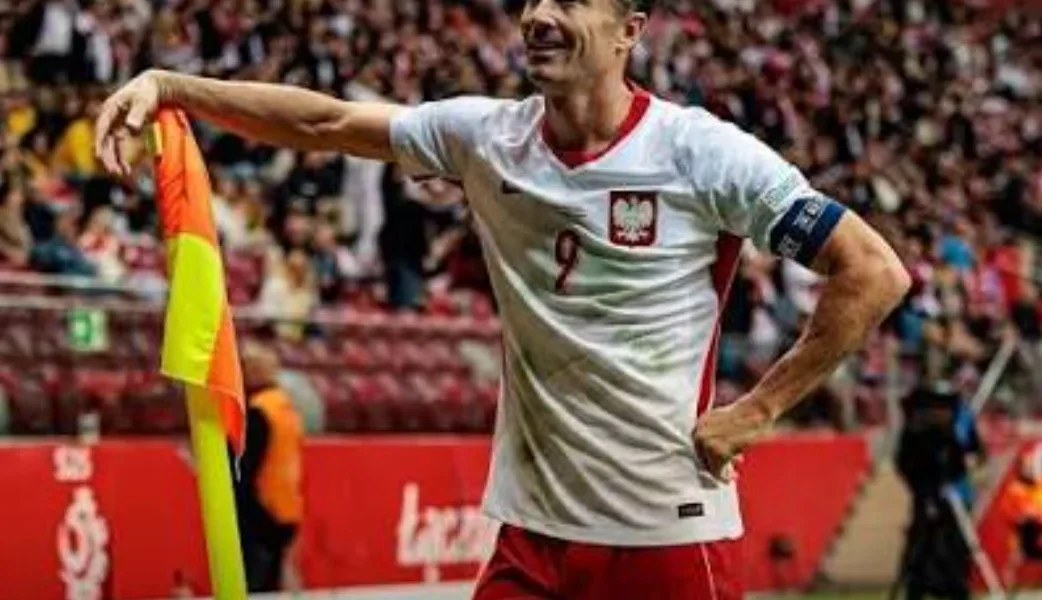
Poland has produced far more great footballers than its trophy cabinet suggests. In the 1970s and early 1980s, a golden generation won Olympic gold and finished third at two World Cups. Decades later, Robert Lewandowski became one of the best strikers in the world.
So how does Lewandowski compare to the Polish football legends who came before him? Below, we look at his records, compare him with four of Poland’s greatest players, and explain where the debate is still open.
Lewandowski’s Case in Numbers
On statistics alone, Lewandowski is in a category of his own. He is Poland’s all-time top scorer with 92 goals and the country’s most-capped player with 170 appearances, figures he reached with a hat-trick against Romania on 2 October 2026. No other Polish player has reached 50.
His club career adds even more weight. Lewandowski won the 2020 Champions League with Bayern Munich, scored more than 760 career goals for club and country, and was named FIFA’s best men’s player in 2020 and 2021. He also finished second to Lionel Messi in the 2021 Ballon d’Or, the highest finish by a Polish player.
Lewandowski vs Poland’s Golden Generation
| Player | Poland career | Caps | Goals | Signature achievement |
| Robert Lewandowski | 2008 to present | 170 | 92 | 2020 Champions League, two FIFA Best awards |
| Grzegorz Lato | 1971 to 1984 | 100 | 45 | 1974 World Cup Golden Boot |
| Włodzimierz Lubański | 1963 to 1980 | 75 | 48 | 1972 Olympic gold as captain |
| Kazimierz Deyna | 1968 to 1978 | 97 | 41 | Third in 1974 Ballon d’Or |
| Zbigniew Boniek | 1976 to 1988 | 80 | 24 | 1985 European Cup with Juventus |
Włodzimierz Lubański: The Record He Broke
Lubański was Poland’s first great striker. He made his debut at 16 in 1963, scoring in a 9-0 win over Norway, and went on to score 48 goals in 75 games. At Górnik Zabrze, he won seven league titles and scored 155 league goals. His record stood until October 2017, when Lewandowski passed it with a hat-trick against Armenia.
Lubański’s story also includes a big “what if”. A serious injury in a 1973 World Cup qualifier against England kept him out of the 1974 tournament, where Poland finished third. In 2004, the Polish federation named him its best player of the previous 50 years for UEFA’s jubilee.
Grzegorz Lato: The World Cup Hero
If the debate is about World Cups, Lato has the strongest argument. He won the Golden Boot at the 1974 World Cup with seven goals, including the winner against Brazil in the third-place match. He finished with 10 World Cup goals, still a Polish record, and won 100 caps with 45 goals.
Kazimierz Deyna: The Captain and Playmaker
Deyna was a different type of player: an elegant midfielder who controlled games rather than finishing them. He was top scorer at the 1972 Olympics, where Poland won gold, and finished third in the 1974 Ballon d’Or. He scored 41 goals in 97 internationals, mostly while playing for Legia Warsaw.
Zbigniew Boniek: The European Star
Before Lewandowski, Boniek was Poland’s biggest name abroad. He scored a hat-trick against Belgium at the 1982 World Cup, finished third in that year’s Ballon d’Or and then won the 1985 European Cup with Juventus. Pelé included him in the FIFA 100 list in 2004.
Where Lewandowski Falls Short
The main argument against Lewandowski is his record at major tournaments. He has scored eight goals across six tournaments: two at World Cups and six at European Championships. Poland’s best run in his era was the Euro 2016 quarter-final, and they failed to reach the 2026 World Cup after a play-off defeat to Sweden.
The golden generation achieved much more as a team. Lato, Deyna and their teammates won Olympic gold in 1972, silver in 1976, and finished third at the 1974 and 1982 World Cups. For many older Polish fans, those results still define the country’s footballing peak.
So, Is Lewandowski Poland’s Greatest Player?
It depends on what you value most. For individual numbers, longevity and success at the highest level of club football, Lewandowski has no Polish rival. For World Cup impact and national team medals, Lato, Deyna and Boniek can still claim more.
Many modern rankings now place Lewandowski first, ahead of Deyna and Boniek. The fairest summary may be this: the golden generation made Poland a respected team, while Lewandowski made a Polish player one of the best in the world.
