- What Is a Throw-in in Football? The Basic Idea
- When the Referee Awards a Throw-in
- What Is a Throw-in in Football? How to Take One Properly
- What Is a Throw-in in Football? The Two-Metre Rule for Opponents
- Can You Score Directly From a Throw-in?
- What Is a Throw-in in Football? No Offside From a Throw-in
- What Is a Throw-in in Football? Foul Throws and What Happens Next
- What Is a Throw-in in Football? The Long Throw: Rory Delap and the Flip Throw
- What Is a Throw-in in Football? Frequently Asked Questions
- Can you score directly from a throw-in?
- Can a player be offside from a throw-in?
- Can the goalkeeper pick up a throw-in from a team-mate?
- What happens if the thrower touches the ball again?
- What is a foul throw?
- How far must opponents stand from a throw-in?
- Conclusion
What is a throw-in in football? It is the restart that puts the ball back into play after it has crossed the touchline, the long line that runs down each side of the pitch. Every outfield player takes throw-ins at some point. This guide explains when the referee awards one and how to take one properly. It also covers foul throws and why a throw-in near the penalty area can be so dangerous.
Last updated: November 2026
Quick Answer
- What is a throw-in in football? A restart taken with both hands from behind the head after the ball crosses the touchline.
- The throw goes to the opponents of the player who last touched the ball.
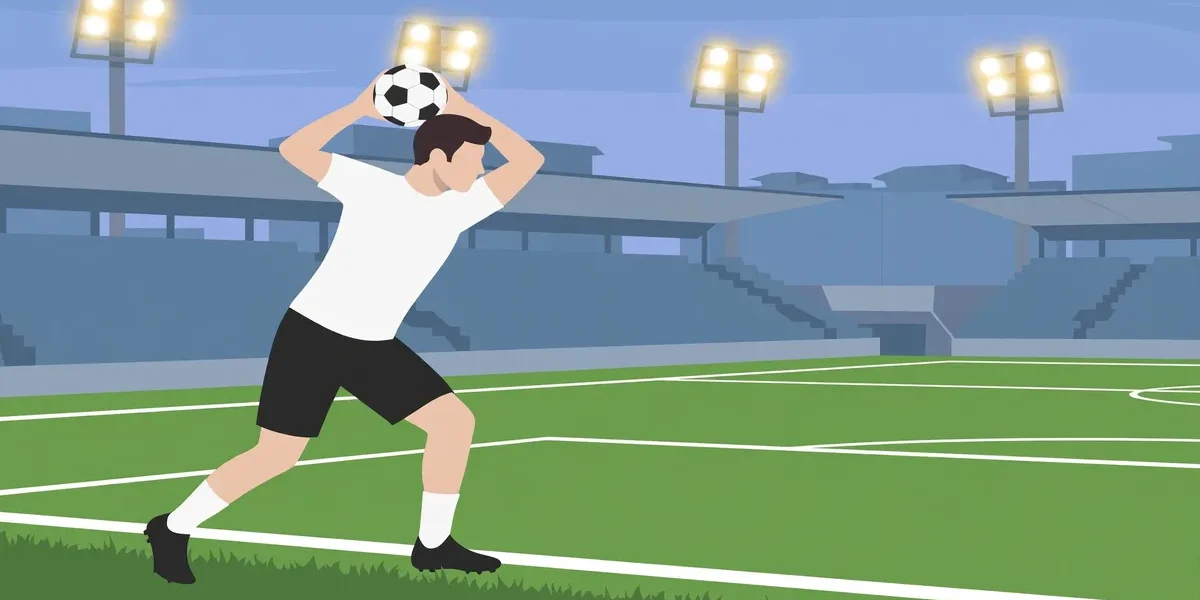
- The thrower must face the field, keep part of each foot on or behind the line, and throw with both hands from behind and over the head.
- A goal cannot be scored directly from a throw-in, and a player cannot be offside from one.
- Opponents must stand at least 2 metres from the point of the throw.
What Is a Throw-in in Football? The Basic Idea
The Laws of the Game cover the throw-in in Law 15. The throw-in restarts play after the ball has left the field of play over a touchline. In other words, the touchline runs down each side of the pitch, while the goal line sits behind each goal.
The throw-in is the only restart in football that a player takes with the hands. A free kick, a corner kick and a goal kick all use the feet. In contrast, the throw-in asks the player to pick the ball up and throw it back into play.
When the Referee Awards a Throw-in
The referee awards a throw-in when the whole of the ball passes over the touchline, on the ground or in the air. The ball must cross the line completely. If only part of the ball crosses the line, play carries on.
The throw-in goes to the opponents of the player who last touched the ball. For example, if a defender kicks it over the touchline, the attacking team takes the throw-in. After that, the thrower takes the throw from the point where the ball left the field of play. When fans ask what is a throw-in in football, they usually want to know when the referee gives one, and this is the answer.
The referee can also award a throw-in to the other team if a team delays taking its throw-in. In other words, a team cannot waste time by holding the ball.
What Is a Throw-in in Football? How to Take One Properly
The rules for a legal throw-in focus on the delivery. At the moment of delivering the ball, the thrower must meet five requirements.
First, the thrower must stand facing the field of play. Second, the thrower must have part of each foot on the touchline or on the ground outside the touchline. The Law asks only for part of each foot on or behind the line. As a result, the feet do not have to sit flat on the ground.
Third, the thrower must throw the ball with both hands. A one-handed throw is a foul throw. Fourth, the thrower must throw the ball from behind and over the head, in one smooth motion, not from the side or from the chest. Fifth, the thrower must take the throw from the point where the ball left the field of play.
The ball is in play as soon as it enters the field of play, and any player can then touch it. However, the thrower must not touch the ball again until another player has touched it. If the thrower touches it again first, the other team receives an indirect free kick.

What Is a Throw-in in Football? The Two-Metre Rule for Opponents
All opponents must stand at least 2 metres (2 yards) from the point on the touchline where the throw-in is taken. The rule gives the thrower room to deliver the ball without an opponent standing right in front of them or crowding the thrower.
The referee enforces the distance, and a player who stands too close can receive a yellow card for failing to respect the required distance. For example, a defender who steps up to the line to block a quick throw-in risks a caution.
Can You Score Directly From a Throw-in?
No, a goal cannot be scored directly from a throw-in. If the ball goes directly into the opponents’ goal from a throw-in, the referee awards a goal kick to the defending team. The goal does not count, and play restarts with a goal kick.
If the ball goes directly into the thrower’s own goal from a throw-in, the restart is a corner kick to the opponents. For example, a thrower who throws the ball backwards over their own goal line gives the other team a corner. To learn how corners work, read our guide on what is a corner kick in football.
The rule keeps the throw-in fair. It is a restart, not a shooting chance. That is a core part of what is a throw-in in football.
What Is a Throw-in in Football? No Offside From a Throw-in
A player cannot be offside when receiving the ball directly from a throw-in. The offside law does not apply to a throw-in, a corner kick or a goal kick. As a result, a team-mate can stand beyond the last defender and receive a throw-in without any offside flag.
This rule makes throw-ins near the opponents’ penalty area dangerous. A long throw into the box can reach a team-mate in a scoring position, even if that player stands behind the defence. The receiving player can then flick the ball on or shoot at goal. For that reason, teams with a strong thrower treat attacking throw-ins like set pieces.
What Is a Throw-in in Football? Foul Throws and What Happens Next
A foul throw is a throw-in that breaks one of the delivery rules. The most common foul throws come from one hand or a throw from the side. Feet inside the field of play also cause a foul throw. In addition, a throw from the wrong spot on the touchline is also a foul throw.
When the referee spots a foul throw, the throw-in passes to the other team. The opponents then take the throw-in from the same point on the touchline. In other words, the team that broke the rules loses the restart, and the other team gains it.
The thrower can also break the rules after the throw. If the thrower touches the ball again first, the other team receives an indirect free kick. The kick comes from the spot of the second touch. To learn how indirect free kicks work, read our guide on what is a free kick in football.
Foul throws are rare at the top level, but they still happen from a rushed throw under pressure.
What Is a Throw-in in Football? The Long Throw: Rory Delap and the Flip Throw
The long throw turned the throw-in into a weapon. Rory Delap’s long throws for Stoke City became famous for reaching the penalty area like a corner kick and causing chaos in the box. Stoke built attacks around his flat, hard throws. After that, other teams started to value long throwers in the same way. The long throw shows what is a throw-in in football can become in the right hands.
A long throw works because the ball arrives in the box at head height. In addition, the no-offside rule lets attackers stand in dangerous positions to meet it.
The flip throw is another way to add distance. A player runs up, plants the hands on the ground, flips forwards, and releases the ball from behind and over the head. A flip throw is legal if the thrower meets the same requirements at delivery. The thrower must face the field and use both hands. The ball must come from behind and over the head.
What Is a Throw-in in Football? Frequently Asked Questions
These are the questions fans ask most about what is a throw-in in football.
Can you score directly from a throw-in?
No. If the ball goes directly into the opponents’ goal, the restart is a goal kick. If it goes directly into the thrower’s own goal, the restart is a corner kick to the opponents.
Can a player be offside from a throw-in?
No. A player cannot be offside when receiving the ball directly from a throw-in. The same rule applies to corner kicks and goal kicks.
Can the goalkeeper pick up a throw-in from a team-mate?
No. A goalkeeper cannot handle a ball thrown directly to them by a team-mate, just as with a kicked back-pass.
What happens if the thrower touches the ball again?
The other team receives an indirect free kick. The thrower must wait until another player has touched the ball before touching it again.
What is a foul throw?
A foul throw breaks a delivery rule. Common causes are one hand, no over-the-head motion, feet inside the field, or the wrong spot. The throw-in then passes to the other team.
How far must opponents stand from a throw-in?
Opponents must stand at least 2 metres (2 yards) from the point on the touchline where the throw-in is taken.
Conclusion
So what is a throw-in in football? It is a two-handed restart from the touchline: both hands, behind the head, feet on the line, and no direct goal. The two-metre rule gives the thrower room, the no-offside rule opens up attacks, and the long throw can turn a restart into a set piece. From a quick throw to a Rory Delap launch into the box, the throw-in rewards teams that use it well. For more football stories, visit our Sports News page. You can follow the next matches on our free live scores page, and see ideas for upcoming matches on our free football predictions page.