
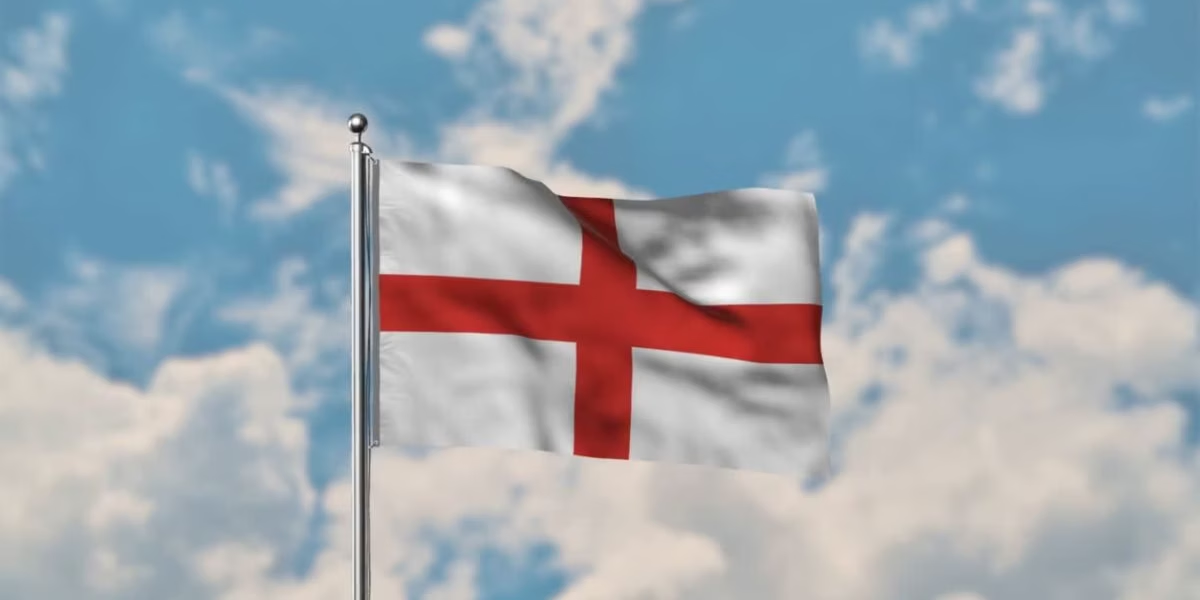
Few national teams have a history as long as England’s. The Three Lions played in the first official international match in 1872, won the World Cup on home soil in 1966 and, after decades of near misses, finished third at the 2026 World Cup in North America.
Understanding how England’s national football team has evolved means looking beyond results. Tactics, coaching, player development and England’s attitude towards the wider football world have all changed. This article follows that journey, from early isolation to the Alf Ramsey years, the long search for a second trophy, the Gareth Southgate revival and the current era under Thomas Tuchel.
The Early Years: Pioneers Who Stayed Apart
England’s first official match was a 0-0 draw against Scotland in Glasgow on 30 November 1872. The Football Association (FA), founded in 1863, had written the game’s first rules, and for decades England mostly played the other British nations in the Home Championship.
That confidence came at a cost. The FA joined FIFA in 1906, left in 1928 after disputes and only returned in 1946, so England missed the first three World Cups. There was also no manager. Until 1946, a selection committee picked the team, often with little attention to tactics.
Wake-Up Calls in the 1950s
Walter Winterbottom became England’s first manager in 1946, and the team played its first World Cup in Brazil in 1950. It brought one of the biggest shocks in the tournament’s history: a 1-0 defeat to the United States in Belo Horizonte.
A harder lesson followed. In November 1953, Hungary won 6-3 at Wembley, England’s first home defeat by a team from continental Europe. Six months later, Hungary won 7-1 in Budapest, which is still England’s heaviest defeat. The results showed that other countries had moved ahead in technique and tactical thinking.
Alf Ramsey and the 1966 World Cup
Alf Ramsey took charge in 1963 and insisted on full control of team selection. In the 1966 World Cup final at Wembley, England beat West Germany 4-2 after extra time. Geoff Hurst scored the first hat-trick in a World Cup final, and Bobby Moore lifted the trophy as captain.
Ramsey’s side was nicknamed the “Wingless Wonders” because it often played without traditional wingers, relying instead on a hard-working midfield in a shape close to 4-4-2. The approach valued organisation and balance over individual flair, and it shaped English football thinking for years.
Decades of Near Misses
Success proved hard to repeat. England failed to qualify for the 1974, 1978 and 1994 World Cups. There were highs too: Bobby Robson’s team reached the 1990 World Cup semi-finals, and Terry Venables led England to the last four at Euro 96 on home soil. Both runs ended in penalty shootout defeats to the Germans.
In 2001, the FA appointed Sven-Göran Eriksson as its first foreign manager. A so-called “golden generation” featuring David Beckham, Steven Gerrard, Frank Lampard and Wayne Rooney lost in the quarter-finals of the 2002 World Cup, Euro 2004 and the 2006 World Cup. Low points followed, including missing Euro 2008, a group-stage exit in 2014 and a 2-1 loss to Iceland at Euro 2016.
Rebuilding From the Ground Up
Behind the scenes, the FA changed how it develops players. St George’s Park, the national football centre, opened in 2012, and the “England DNA” coaching plan followed in 2014, encouraging a possession-based style across all age groups. The benefits showed in 2017, when England won both the Under-17 and Under-20 World Cups.
Gareth Southgate, promoted from the Under-21s in 2016, brought a calmer culture and turned England into regular contenders. His team reached the 2018 World Cup semi-finals, the Euro 2020 final (lost on penalties to Italy at Wembley), the 2022 World Cup quarter-finals and the Euro 2024 final, which Spain won 2-1 in Berlin. Southgate stepped down after that defeat.
The Tuchel Era and the 2026 World Cup
Thomas Tuchel, who won the Champions League with Chelsea in 2021, was named Southgate’s successor in October 2024 and started on 1 January 2025. England won their first six qualifiers without conceding a goal and booked their place at the first 48-team World Cup.
In North America, England topped a group with Croatia, Ghana and Panama. Their semi-final against Argentina in Atlanta ended in a 2-1 defeat after late goals from Enzo Fernández and Lautaro Martínez. Three days later, England beat France 6-4 in Miami, with a Bukayo Saka hat-trick, to finish third. It was their best World Cup result since 1966.
The tournament also confirmed Harry Kane’s place in history. The captain, who passed Rooney’s record of 53 England goals in March 2023, overtook Gary Lineker’s 10 World Cup goals to become the country’s top scorer at the tournament. He also passed the record of 90 matches as captain shared by Moore and Billy Wright.
What Comes Next for England
England have moved from isolation and committee selection to a professional, coach-led system built on youth development. The missing piece is still a second major men’s trophy. According to ESPN, Tuchel’s contract runs until 2028, when England co-host the European Championship with Scotland, Wales and the Republic of Ireland, giving the Three Lions another home chance to end the wait.
