- Quick Answer
- What Is a Point Spread Bet and How Does It Work?
- What Is a Point Spread Bet Payout?
- What Is the Hook in Point Spread Betting?
- What Is a Push in Point Spread Betting?
- Why Do Point Spreads Exist and Why Do Lines Move?
- Point Spread vs Moneyline
- Point Spread Betting by Sport
- How to Place a Point Spread Bet
- Point Spread Bet Under Nigerian Law
- Frequently Asked Questions
- What is a point spread bet?
- What does -6.5 mean in a point spread bet?
- What is a push on a point spread?
- Can a point spread bet push on a half-point line?
- Is a point spread the same as a moneyline bet?
- The Bottom Line
What is a point spread bet? It is a wager on the margin of victory, not just on who wins the match. For example, you back a basketball favourite to win by more than 6.5 points. The team can win the game and still lose your bet. On the other hand, the underdog can lose the game and still win your bet. In other words, the spread changes the question from “who wins?” to “by how much?” This guide explains the signs, the hook, the push and the payout, with worked examples from football, basketball and American football.
Last updated: November 2026
Quick Answer
- A wager on the margin of victory. The favourite must win by more than the spread, and the underdog must win outright or lose by less.
- The favourite carries a minus sign (-6.5) and the underdog carries a plus sign (+6.5).
- A team “covers the spread” when the bet wins once you apply the spread to the final score.
- Bookmakers call a half-point (.5) in the spread the hook. It makes a push impossible.
- A push happens only on a whole-number spread, when the final margin equals the spread exactly. The bookmaker refunds the stake.
What Is a Point Spread Bet and How Does It Work?
A point spread bet puts a margin on the final score. Firstly, the bookmaker sets a number that reflects the gap between the two teams, with a minus sign for the favourite and a plus sign for the underdog. Secondly, you pick a side. As a result, the bet settles on the adjusted score, not on the real score alone.
For example, a basketball match lists the favourite at -6.5 and the underdog at +6.5. The favourite must win by 7 points or more, because 7 is the smallest whole number above 6.5. The underdog covers by winning outright or losing by 6 or fewer. Therefore, a 112–104 final score covers the favourite: 112 – 104 = 8, and 8 is more than 6.5.
In short, the spread turns a one-sided match into a roughly even contest. A strong team must prove its strength by a set margin, and a weak team gets a head start. That is the short answer to what is a point spread bet.
What Is a Point Spread Bet Payout?
The payout is simple: stake × odds. Most spread bets carry near-even odds on both sides, often 1.91. For example, a ₦1,000 stake at 1.91 returns ₦1,910, a profit of ₦910: ₦1,000 × 1.91 = ₦1,910, and ₦1,910 – ₦1,000 = ₦910.
| Side | Line | ₦1,000 stake at 1.91 returns |
|---|---|---|
| Favourite covers | -6.5 | ₦1,910 |
| Underdog covers | +6.5 | ₦1,910 |
| Push (whole-number line only) | -7 | ₦1,000 (stake refunded) |
On the other hand, American odds show the same price as -110: risk 110 to win 100, which converts to 1.91 in decimal odds.
Above all, the payout stays fixed at the odds you took. A single bet on the spread pays out the same way: stake × odds, with the stake refunded on a push.
What Is the Hook in Point Spread Betting?
The hook is the half-point (.5) in a spread such as -6.5 or -7.5. Bookmakers add it for one reason: no game ends with half a point, so a half-point spread can never push. It forces a win or a loss on every bet.
For example, a favourite at -6.5 must win by 7 or more: a 7-point win covers, and a 6-point win loses. In contrast, a whole-number spread such as -7 leaves room for a tie on the line. Therefore, bookmakers use the hook to remove the refund outcome.
What Is a Push in Point Spread Betting?
A push happens when the final margin equals a whole-number spread exactly. Neither side covers, and the bookmaker refunds the stake. For example, a favourite at -7 wins by exactly 7 points, and the bet pushes — the bettor gets the full stake back.
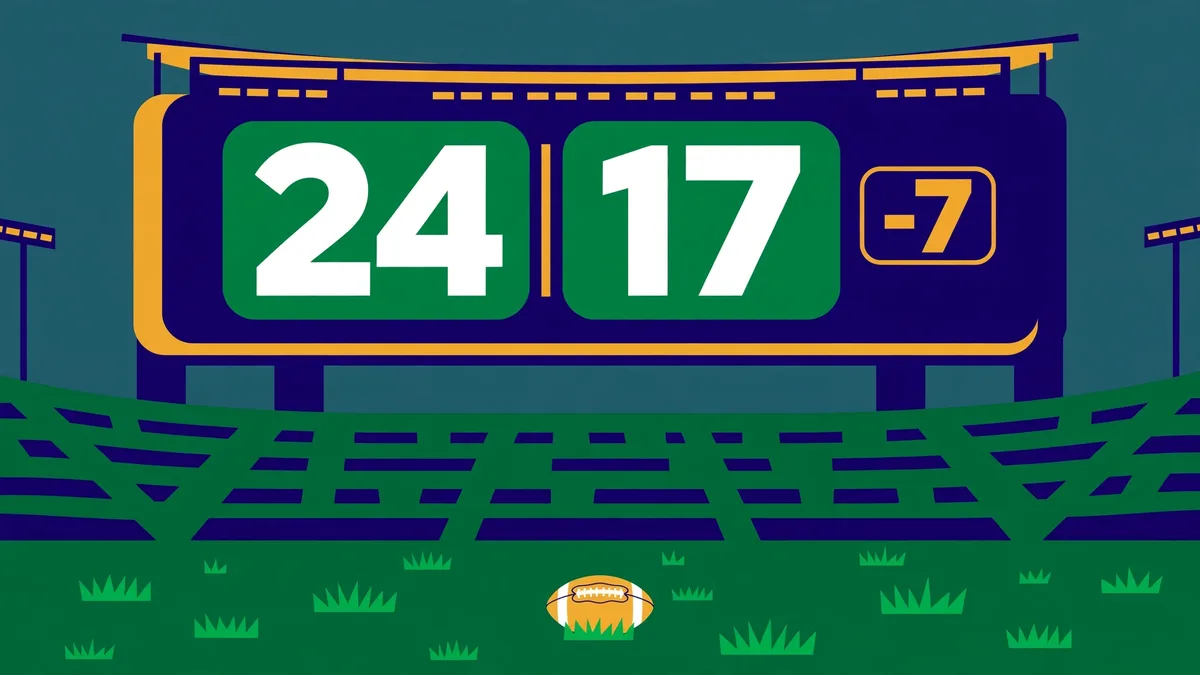
Take an American football game that ends 24–17: the margin is 24 – 17 = 7 points. At -7, that is a push, and the stake comes back. The same score covers the favourite at -6.5, because 7 is more than 6.5. At -7.5, it loses, because 7 is less than 7.5. In other words, one half-point either side of 7 changes the result completely.
Meanwhile, the push rule changes inside a parlay or accumulator. The common rule removes the pushed leg and pays the rest of the ticket on the remaining legs. However, bookmaker rules vary, so check your bookmaker’s rules first.
Why Do Point Spreads Exist and Why Do Lines Move?
Point spreads exist because bookmakers need balanced action on both sides. Without a spread, almost everyone would back the heavy favourite. In contrast, the spread turns a mismatch into a roughly even wager, with near-even odds on both sides. As a result, the bookmaker earns its margin from the price, not from guessing the result.
For example, at the standard spread price of -110, a bettor must win 52.38% of spread bets to break even: 110 ÷ 210 = 0.5238. In other words, winning half your spread bets still loses money at that price.
However, a spread can change at any time. Lines move. Firstly, injury news can shift a line by several points when a key player drops out. Secondly, heavy betting on one side pushes the number the other way. Thirdly, weather can move a line in outdoor sports. Therefore, the spread on Monday may differ from the spread on match day. Above all, the price you took stays locked in.
Point Spread vs Moneyline
The moneyline and the point spread answer different questions. On the moneyline, you pick who wins the match outright. The spread asks by how much. For example, a heavy favourite may cost a lot on the moneyline, because you risk far more than you can win. In contrast, the same favourite on the spread costs near-even odds, but must win by the spread margin. To compare the two markets, see our guide on how to read betting odds.
| Feature | Point spread | Moneyline |
|---|---|---|
| What you pick | A team to beat the adjusted score | The outright winner |
| Margin matters | Yes | No |
| Typical price | Near even, often 1.91 on each side | Varies with team strength |
| Can it push? | Yes, on whole-number spreads | Yes, a draw voids a two-way bet |
| Best for | Mismatches and heavy favourites | Close games and underdog picks |
Similarly, the moneyline suits a bettor who backs an underdog to win outright, because the underdog pays far more than the spread price. On the other hand, the spread suits a bettor who fancies the favourite at near-even odds.
Point Spread Betting by Sport
In American football, spreads often run from 3 to 14 points, because scoring comes in chunks of 3 and 7. For a guide focused only on the NFL, see our NFL point spread guide. In basketball, spreads run higher, because teams score over 100 points. In soccer, the spread runs in goals: -1.5 goals means the favourite must win by 2 goals or more.
For example, a soccer favourite at -1.5 goals covers with a 2–0 win: 2 – 0 = 2, and 2 is more than 1.5. In contrast, a 1–0 win does not cover: 1 – 0 = 1, and 1 is less than 1.5. As a result, soccer spreads are less common, because low scores leave little room for margins. In soccer, the Asian goal line is the closer equivalent: it works on the same idea of giving one side a head start.
In short, what is a point spread bet in soccer? It is a goal line: the favourite must win by more than the line, and the underdog covers by staying within it.
How to Place a Point Spread Bet
Placing the bet takes four steps. Firstly, open the match and find the spread market — bookmakers label it Spread, Point Spread or Goal Line. Secondly, choose the side: the favourite at minus, or the underdog at plus. Thirdly, add the selection to the betting slip and enter the stake. Fourthly, check the slip shows the line you want, then confirm. Therefore, always read the slip first, and check whether the line carries a half-point or a whole number. That detail decides whether a push is possible.
Point Spread Bet Under Nigerian Law
Betting in Nigeria is for adults only — 18+ only. Each state regulates betting. The Supreme Court nullified the National Lottery Act 2005 on 22 November 2024. The National Lottery Regulatory Commission framework applies only in the Federal Capital Territory. As a result, a bettor should check that a bookmaker holds a licence in the bettor’s own state. In addition, licensed bookmakers ask for identity checks before paying out winnings, usually a Bank Verification Number or National Identity Number.
Frequently Asked Questions
What is a point spread bet?
You bet on the margin of victory. The favourite must win by more than the spread, and the underdog must win outright or lose by less than the spread.
What does -6.5 mean in a point spread bet?
A favourite at -6.5 must win by 7 points or more. The underdog at +6.5 covers by winning outright or losing by 6 or fewer.
What is a push on a point spread?
It happens when a whole-number spread lands exactly on the final margin, such as a -7 favourite winning by exactly 7. The bet neither wins nor loses, and the bookmaker refunds the stake.
Can a point spread bet push on a half-point line?
No. A half-point line such as -6.5 or -7.5 can never push, because no game ends with half a point. That half-point is the hook.
Is a point spread the same as a moneyline bet?
No. A moneyline bet picks the outright winner, and the margin does not matter. A point spread bet picks a team to beat the adjusted score.
The Bottom Line
In short, what is a point spread bet? It is a wager on the margin of victory. The favourite gives up points, and the underdog gets points. For instance, a favourite at -6.5 must win by 7 or more, and a 24–17 win covers -6.5 but not -7.5. A whole-number spread can push, and a push returns the stake. Above all, the spread exists to balance the action, so both sides carry near-even odds.
Bet Responsibly: Betting is entertainment, not a way to make money. Only bet what you can afford to lose, and never chase losses. If betting stops being fun, take a break. For help and advice, see our Responsible Gambling page. 18+ only.