
- What Is a Penalty Shootout in Football? The Basic Idea
- Why Football Uses Shootouts
- What Is a Penalty Shootout in Football? The Five-Kick Format
- What Is a Penalty Shootout in Football? The Coin Toss and Choosing the Goal
- What Is a Penalty Shootout in Football? Who Can Take a Kick?
- What Is a Penalty Shootout in Football? Sudden Death
- What Is a Penalty Shootout in Football? The No-Rebound Rule
- Injuries and Delays During a Shootout
- What Is a Penalty Shootout in Football? Famous Shootouts
- What Is a Penalty Shootout in Football? Frequently Asked Questions
- How many kicks does each team take?
- Can a player score from a rebound in a shootout?
- Can a goalkeeper take a kick in a shootout?
- Does a shootout count as a draw or a win?
- What happens if a player is sent off before the shootout?
- When did shootouts start?
- Conclusion
What is a penalty shootout in football? It is the drama-filled ending that decides a knockout match when neither team can win in normal time or extra time. Two teams stand on the pitch, five players step up, and a whole stadium holds its breath. One kick can turn a hero into a villain, and one save can make a goalkeeper a legend. Shootouts have decided World Cup finals, Champions League finals and cup finals for more than 50 years. This guide explains the rules in plain English: the five-kick format, sudden death, the no-rebound rule and the famous shootouts.
Last updated: November 2026
Quick Answer
- What is a penalty shootout in football? A tie-breaker of kicks from the penalty mark that decides a knockout match still level after extra time.
- Each team takes five kicks, alternating, from 11 metres out, with only the opposing goalkeeper to beat.
- If the scores are level after five kicks each, the shootout goes to sudden death.
- The kicker touches the ball only once. There are no rebounds in a shootout.
- Only players on the field at the end of the match may take part.
What Is a Penalty Shootout in Football? The Basic Idea
The Laws of the Game call a penalty shootout “kicks from the penalty mark”, and IFAB Law 10 covers it. The shootout settles a knockout match that is still level after normal time and, in most competitions, extra time. League matches never need a shootout, because a draw stands in the league. However, a cup tie must produce a winner, so the shootout steps in when extra time fails to separate the teams.
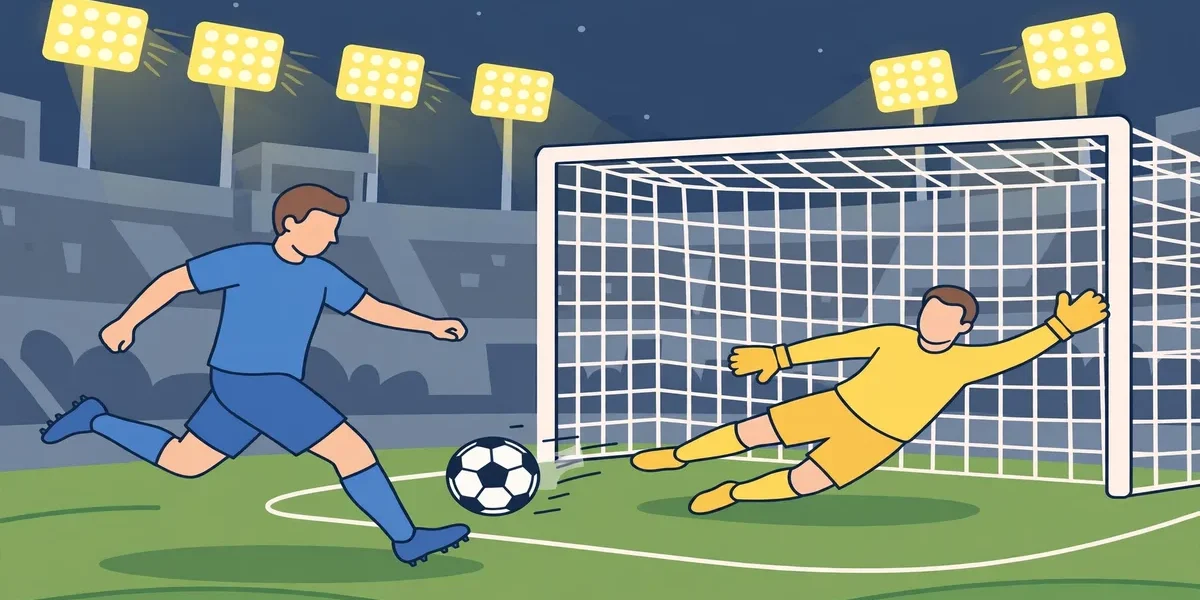
A shootout kick is not a free kick. It is a single kick from the penalty mark with only the goalkeeper to beat. The kicker places the ball on the spot, 11 metres (12 yards) from the goal line, and shoots. The goalkeeper stands on the goal line and tries to stop it. For the full rules on free kicks, read our guide on what is a free kick in football. To understand the stage before a shootout, read our guide on what is extra time in football.
Why Football Uses Shootouts
Before 1970, football had no fair way to settle a drawn knockout match. Organisers drew lots, tossed a coin, or ordered a replay. A team could lose a cup tie on pure luck, or face a second match days later. In 1970, IFAB introduced the penalty shootout as a fairer answer. The shootout tests skill under pressure and gives both teams the same number of kicks. It has settled the biggest matches in world football ever since.
What Is a Penalty Shootout in Football? The Five-Kick Format
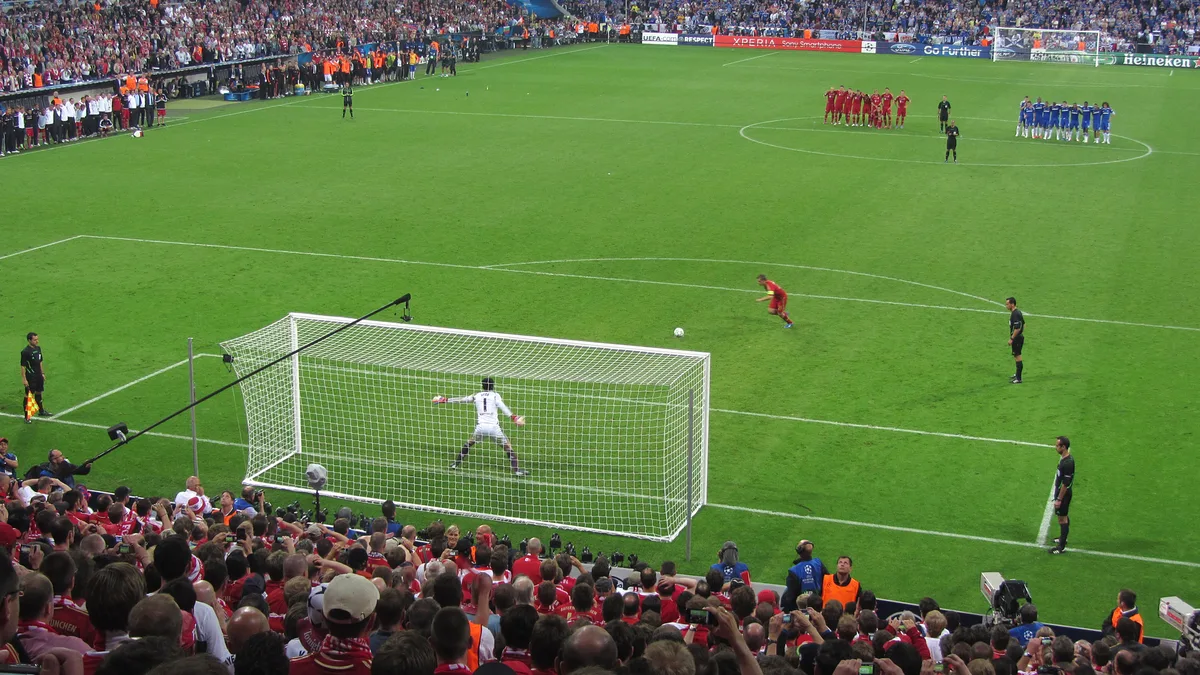
Each team takes five kicks, and the teams alternate. The teams take turns until both have taken five. Only the opposing goalkeeper defends the goal, so the kicker faces a clear shot from 11 metres.
The shootout can end before all ten kicks are taken. If one team builds a lead that the other team cannot catch with its remaining kicks, the referee ends the shootout at once. For example, if one team leads 3-0 after three kicks each, the other team has only two kicks left, so it cannot catch up. The referee then ends the shootout, and the leading team wins the tie.
What Is a Penalty Shootout in Football? The Coin Toss and Choosing the Goal
Before the shootout, the referee tosses a coin. The team that wins the toss decides whether to take the first or second kick. Most teams choose to kick first, because scoring first puts pressure on the other team. However, some teams prefer to kick second. Either way, the choice belongs to the toss winner.
The referee also chooses the goal at which the teams take the kicks. All kicks are taken at the same goal, usually the one with the biggest crowd behind it. The referee may change the goal for safety or pitch condition, but the teams still take every kick at the one chosen goal.
What Is a Penalty Shootout in Football? Who Can Take a Kick?
Only players on the field of play at the end of the match may take part in the shootout. That means the players on the pitch when extra time ends, minus any player sent off. A sent-off player cannot take a kick, and neither can a substitute who never entered the match.
If one team has more players on the field than the other, for example after a red card, the team with more players must reduce its numbers to match. The captain chooses which players drop out.
No player may take a second kick until every other eligible player on the team has taken one. That rule includes the goalkeeper, so a goalkeeper may have to step up before a star striker takes a second one.
What Is a Penalty Shootout in Football? Sudden Death
If the scores are level after five kicks each, the shootout goes to sudden death. The teams take one kick each until one scores and the other misses. After that, the team that scored wins the tie. Sudden death can end in one round, or it can run for many rounds, with defenders and goalkeepers taking kicks before a winner emerges.
Sudden death keeps the same rules as the first five kicks. The kicker still touches the ball only once, and the goalkeeper still defends alone. Every kick can win the match or lose it, so each player walks to the spot knowing the whole tie rests on one kick.
What Is a Penalty Shootout in Football? The No-Rebound Rule
The kicker may touch the ball only once in a shootout. There are no rebounds. If the goalkeeper saves the kick, or the ball hits the post or crossbar and stays out, the kick is over. The kicker cannot run in and score from the rebound. As a result, a shootout kick is a one-shot chance, and a save ends the danger at once.
However, the ball may still go in off the goalkeeper, the post or the crossbar, as long as its movement comes from the initial kick. The most famous example came in the 1986 World Cup shootout between Brazil and France. Bruno Bellone’s kick rebounded off the post, hit goalkeeper Carlos’s back and bounced into the goal. The referee allowed the goal, because the ball’s movement came from the original kick. After that, IFAB clarified the rule in 1987, so a goal counts if the ball goes in off the goalkeeper, the post or the crossbar from the first kick.
Injuries and Delays During a Shootout
A goalkeeper who is injured during the shootout may be replaced. The team can bring on a substitute goalkeeper from the bench if it still has a substitution left, or an outfield player already on the field takes the gloves.
Kicks must not be delayed for a player who leaves the field of play. If a player walks away and does not return in time, the referee forfeits that kick. As a result, teams keep their players close to the centre circle while they wait.
What Is a Penalty Shootout in Football? Famous Shootouts
The history of what is a penalty shootout in football is full of drama. West Germany beat France in the first World Cup shootout, in the 1982 semi-final. The first World Cup final decided by a shootout came in 1994, when Brazil beat Italy 3-2. Italy’s Roberto Baggio missed the final kick, and Brazil lifted the trophy.
The 2006 final also went to a shootout, and Italy beat France 5-3. In that match, France’s Zinedine Zidane had already left the field after his famous red card, so he could not take a kick. Italy held their nerve and won the trophy.
The 2022 final gave fans the most dramatic shootout of all. Argentina and France drew 3-3 after extra time, and Argentina won 4-2 on penalties. The match had a hat-trick, a comeback, and a shootout for the greatest prize in football.
What Is a Penalty Shootout in Football? Frequently Asked Questions
These are the questions fans ask most about what is a penalty shootout in football.
How many kicks does each team take?
Five kicks each, alternating. That is the heart of what is a penalty shootout in football. If the scores are level after five kicks each, the shootout goes to sudden death.
Can a player score from a rebound in a shootout?
No. The kicker touches the ball only once. If the goalkeeper saves the kick or the ball hits the woodwork and stays out, the kick is over.
Can a goalkeeper take a kick in a shootout?
Yes. Every eligible player must take a kick before anyone takes a second one, and that rule includes the goalkeeper.
Does a shootout count as a draw or a win?
The match counts as a draw for records, but the shootout decides which team goes through to the next round.
What happens if a player is sent off before the shootout?
The sent-off player cannot take a kick. In addition, the other team must reduce its numbers to match, so both teams have the same number of eligible players.
When did shootouts start?
IFAB introduced kicks from the penalty mark in 1970, as a fairer way to settle a drawn knockout match than drawing lots or replaying it.
Conclusion
So what is a penalty shootout in football? It is the final test in a knockout match: five kicks each from 11 metres, then sudden death if the scores stay level. The kicker gets one touch, there are no rebounds, and only players on the field at the end may take part. Shootouts have decided World Cup finals since 1994, and they will keep deciding the biggest matches for years to come. For more football stories, visit our Sports News page. Follow the next matches on our free live scores page, and see ideas for upcoming matches on our free football predictions page.
Related: For the rules of a single penalty kick, read our guide on What Is a Penalty Kick in Football? Rules Explained.
