
- What Is Stoppage Time in Football?
- What Is Stoppage Time in Football For?
- What Counts as Lost Time?
- How the Referee Decides What Is Stoppage Time in Football
- How the Fourth Official's Board Works
- What Is Stoppage Time in Football vs Extra Time?
- Why Matches Last Over 100 Minutes
- What Is Stoppage Time in Football for Betting?
- Frequently Asked Questions
- How much stoppage time is added in football?
- What is stoppage time in football also called?
- Can the referee add more time than the board shows?
- Does a goal in stoppage time count?
- Why do some matches have 10 or more minutes of stoppage time?
- Conclusion
What is stoppage time in football? It is the time the referee adds at the end of each half. It replaces the minutes lost while play stopped for injuries, substitutions and other delays. In other words, a 45-minute half almost never lasts exactly 45 minutes. Too much can interrupt it. This guide explains the referee’s count, the fourth official’s board, and why stoppage time matters for your bets.
Last updated: November 2026
Quick Answer
- Stoppage time is the time added at the end of each half for minutes lost during play.
- The fourth official shows the minimum amount on an electronic board, and the referee can add more.
- Stoppage time is part of the 90 minutes, so a goal in the 94th minute counts for full-time bets.
- Extra time is different: two 15-minute periods that teams play only when a knockout match is level after 90 minutes.
What Is Stoppage Time in Football?
Under Law 7 of the Laws of the Game, a football match has two halves of 45 minutes each. The half-time break lasts no more than 15 minutes. However, the referee does not simply blow the whistle at 45 and 90 minutes. Instead, the referee adds time at the end of each half for every minute lost while play stopped. The official name for stoppage time is “added time”. In other words, it means an allowance for time lost. Many fans still call it “injury time”. That is only an old nickname, because injuries are just one of several causes.
The referee keeps the official time, so the stadium clock is not the real clock. As a result, the numbers on television can differ from the referee’s count by a few seconds. In short, the referee alone decides when each half ends.
What Is Stoppage Time in Football For?
Stoppage time exists to keep the game fair. Without it, a team that is winning could waste minutes on purpose and run the clock down. For example, a goalkeeper could take a full minute over every goal kick. Players could also stay down after every small knock. Because the referee adds the lost minutes back, time-wasting brings little reward. If you want the full picture, read our guide on how long a full football match lasts.
What Counts as Lost Time?
Law 7 lists the events that cost playing time. When any of them happens, the referee notes the minutes lost. Then the referee adds them at the end of the half. Here are the main causes:
- Substitutions: each change takes time while players swap over.
- Injured players: the referee adds the time spent treating an injury on the pitch.
- Disciplinary sanctions: a yellow or red card stops play while the referee deals with the player.
- Medical stoppages: drinks breaks of up to one minute and cooling breaks of 90 seconds to three minutes.
- VAR checks and reviews: a video review can take several minutes, so the referee adds that time too. You can read how it works in our guide to how VAR works in football.
- Time-wasting: players who delay restarts on purpose lose time, because the referee adds it back.
- Goal celebrations: a long celebration after a goal also counts as lost time. At the 2022 World Cup, FIFA referees chief Pierluigi Collina said each celebration takes about one to one and a half minutes.
VAR checks often involve offside calls, so a tight review can take even longer. Learn the basics in our guide to the offside rule explained.
How the Referee Decides What Is Stoppage Time in Football
Only the referee decides how much time to add. Meanwhile, the fourth official simply shows the number on the board. First, the referee tracks the lost minutes during the half. Then, near the end of the half, the referee tells the fourth official the total. That number is a minimum, so the referee can play more time but never less.
Time lost during added time counts too. For example, a player may go down injured in the 93rd minute. The referee then adds extra minutes on top of the minutes already shown. In the same way, a penalty changes the plan. If a penalty kick has to be taken or retaken, the referee extends the half until the kick is complete. On the other hand, the referee must not fix a first-half timekeeping mistake. The referee cannot change the length of the second half to make up for it. Each half stands on its own.
How the Fourth Official’s Board Works
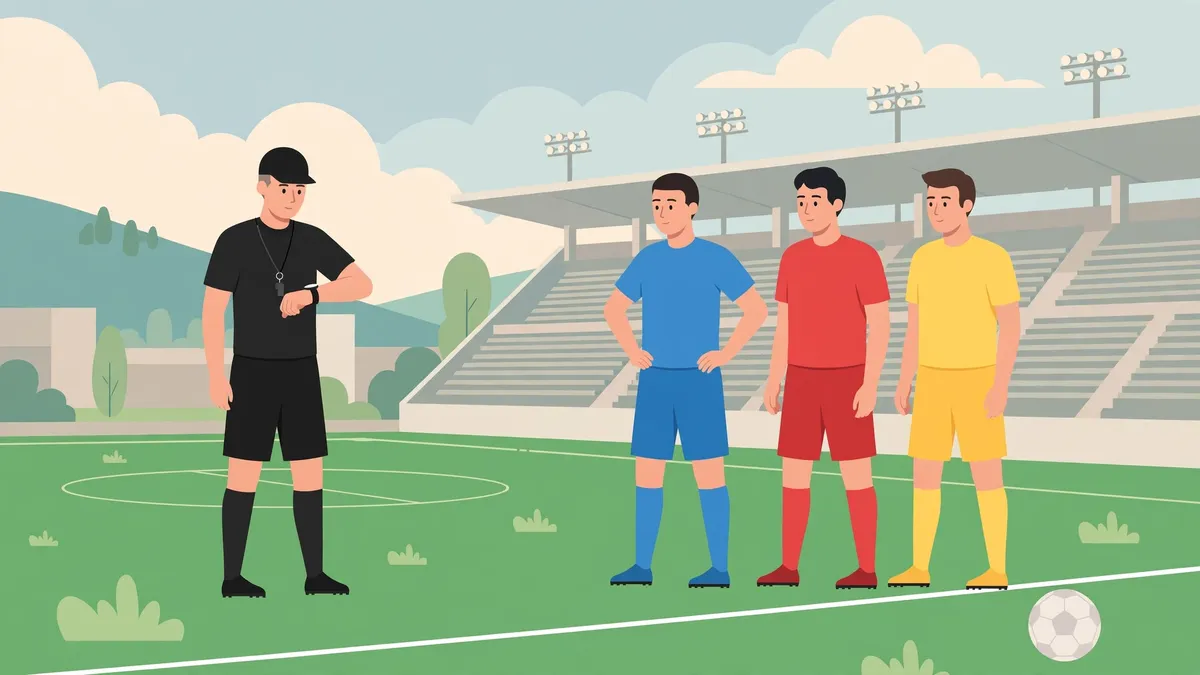
Many fans ask what is stoppage time in football when the board goes up. Near the end of each half, the fourth official holds up the board. The number tells everyone the minimum added time. If the board shows six, the referee plays at least six more minutes. Many fans, however, treat the number as an exact count. That is a mistake: the referee can, and often does, play longer.
After the minimum time, the referee usually waits for a natural break before blowing the final whistle. A free kick, a throw-in or a goal kick often provides that moment. Learn more in our guide to what a free kick is in football. The Laws do not force the referee to wait for the ball to go dead. In other words, the referee can end the half at any moment after the minimum has passed.
What Is Stoppage Time in Football vs Extra Time?
Fans often mix up stoppage time and extra time, but they are very different things. Stoppage time is part of the 90 minutes. It lasts only a few minutes at the end of each half. Extra time, by contrast, is an extra 30 minutes. Teams play it only in knockout matches when the score is level after 90 minutes. The split is simple: stoppage time counts for full-time bets. Extra time does not. Our guide to extra time in football covers the full rules.
Why Matches Last Over 100 Minutes
As of November 2026, matches in big tournaments and top leagues often pass 100 minutes. The reason is simple: referees add lost time far more accurately than before. Goal celebrations, VAR reviews and long injury checks all add up.
The clearest example came at the 2022 World Cup in Qatar. England beat Iran 6-2 on 21 November 2022. The referee added 14 minutes 8 seconds in the first half and 13 minutes 8 seconds in the second. In total, the match lasted 117 minutes 16 seconds, the longest World Cup group-stage game. Before the tournament, FIFA referees chief Pierluigi Collina told referees to count lost time accurately. He also pointed out that each goal celebration takes about one to one and a half minutes.
Since then, long added time has become normal at the highest level. Therefore, fans and bettors should expect it. A match with several goals and a VAR review can easily run past 100 minutes.
What Is Stoppage Time in Football for Betting?
If you understand what is stoppage time in football, a late goal will never surprise you. For betting, the key point is simple: stoppage time is part of the 90 minutes. A goal in the 94th minute counts. So does a goal in the 97th minute. Because of that, bookmakers settle over/under and both teams to score bets on the 90 minutes, stoppage time included. Extra time, by contrast, does not count for full-time markets.
Here is a worked example. Imagine, for example, you back over 2.5 goals at odds of 2.50 with a stake of ₦1,000. The score stands at 2-0 after 90 minutes. Then a third goal arrives in the 94th minute. Your bet wins, because the goal came inside stoppage time. Your return is ₦2,500, which is your ₦1,000 stake multiplied by odds of 2.50, and your profit is ₦1,500.
The same logic works in reverse. If you back under 2.5 goals and a late goal arrives in stoppage time, your bet loses. For that reason, never treat a bet as won until the referee blows the final whistle.
Frequently Asked Questions
How much stoppage time is added in football?
There is no fixed amount. The referee adds the minutes actually lost. A quiet half may get one or two minutes. A half with injuries and a VAR review may get six or more. In big tournaments, ten minutes or more is possible.
What is stoppage time in football also called?
The official term is “added time”. In other words, it is an allowance for time lost. Many fans still say “injury time”. That name is out of date, because injuries are only one cause.
Can the referee add more time than the board shows?
Yes. The number on the board is the minimum amount. For anything lost during added time, the referee adds even more. Less than the number shown is never allowed.
Does a goal in stoppage time count?
Yes. A goal scored in stoppage time counts as a normal goal. It also counts for full-time betting markets. A goal in extra time is different, however: it does not count for full-time bets.
Why do some matches have 10 or more minutes of stoppage time?
Long VAR reviews, serious injuries, several substitutions and long goal celebrations all add up. At the 2022 World Cup, for example, England’s 6-2 win over Iran had 14 minutes 8 seconds in the first half. The second half had 13 minutes 8 seconds.
Conclusion
In short, stoppage time keeps football fair by giving each team a full half of play. That is what is stoppage time in football. The referee counts the minutes lost, the fourth official shows the minimum, and the referee can always add more. For fans, it means late drama. For bettors, it means a match is never over until the final whistle. A goal in the 94th minute counts just as much as a goal in the 10th.
