
- What Is a Red Card in Football? The Basic Idea
- The Seven Sending-Off Offences
- Serious Foul Play and Violent Conduct
- What Is a Red Card in Football? The Double Jeopardy Rule
- What Happens After a Red Card
- How Long Is a Red Card Suspension?
- What Is a Red Card in Football? VAR and Red Cards
- Famous Red Cards: Zidane in the 2006 Final
- What Is a Red Card in Football? Frequently Asked Questions
- Can a goalkeeper get a red card?
- Does a red card mean a player misses the next match?
- What is the difference between a red card and a second yellow card?
- Can a player get a red card after the final whistle?
- Does VAR check red cards?
- Can a substitute get a red card?
- Conclusion
What is a red card in football? It is the referee’s way of sending a player off the field for a serious offence. The referee holds up a red card, and the player leaves the pitch at once. The team plays on with ten players instead of eleven. As a result, red cards change matches. A team that loses a player early faces a long battle, while a team that gains a man advantage gains a clear edge. This guide explains the rules in plain English. It covers the seven sending-off offences, the double jeopardy rule, suspensions, VAR, and the famous red cards that fans still talk about.
Last updated: November 2026
Quick Answer
- What is a red card in football? A sending-off shown by the referee for a serious offence under IFAB Law 12.
- A sent-off player leaves the field at once. The team plays the rest of the match with one fewer player.
- The seven sending-off offences include serious foul play, violent conduct, spitting, abusive language, and a second yellow card.
- A player who denies a clear goal-scoring chance inside the penalty area still faces a red card in most cases. However, the double jeopardy rule can reduce it to a yellow card.
- A red card usually brings a one-match or three-match suspension, depending on the offence.
What Is a Red Card in Football? The Basic Idea
IFAB Law 12 covers fouls and misconduct. It sets out the two cards. The yellow card communicates a caution. In contrast, the red card communicates a sending-off. Only a player, substitute, substituted player or team official can receive a red or yellow card.
When the referee shows a red card, the player must leave the vicinity of the field of play and the technical area. The team plays the rest of the match with one fewer player, and the team cannot replace the sent-off player. In other words, a red card punishes the team as well as the player.
The Seven Sending-Off Offences
The answer to what is a red card in football starts with the seven offences in Law 12. A referee sends a player off for one of these:
- Denying the opposing team a goal or an obvious goal-scoring opportunity by a handball offence. The one exception covers a goalkeeper inside the goalkeeper’s own penalty area.
- Denying a goal or an obvious goal-scoring opportunity to an opponent whose overall movement is towards the offender’s goal. The offence must be punishable by a free kick. For the full rules on that restart, read our guide on what is a free kick in football.
- Serious foul play.
- Biting or spitting at someone.
- Violent conduct.
- Using offensive, insulting or abusive language and/or actions.
- Receiving a second caution, in other words a second yellow card, in the same match.
In short, the first two offences share one idea: the player stopped a goal or a clear chance to score.
Serious Foul Play and Violent Conduct
To understand what is a red card in football, fans must learn the difference between serious foul play and violent conduct. In fact, the Laws draw a clear line between them.
Serious foul play happens during a challenge for the ball. A tackle or challenge that endangers the safety of an opponent, or uses excessive force or brutality, counts as serious foul play. For example, a player who lunges at an opponent with one or both legs, using excessive force, commits serious foul play.
Violent conduct is different. It happens when a player uses or attempts to use excessive force or brutality against an opponent when not challenging for the ball. It also covers force against a team-mate, official, spectator or any other person. Contact does not matter here. As a result, a punch thrown off the ball counts as violent conduct. A wild two-footed lunge at the ball counts as serious foul play. Both bring a red card.
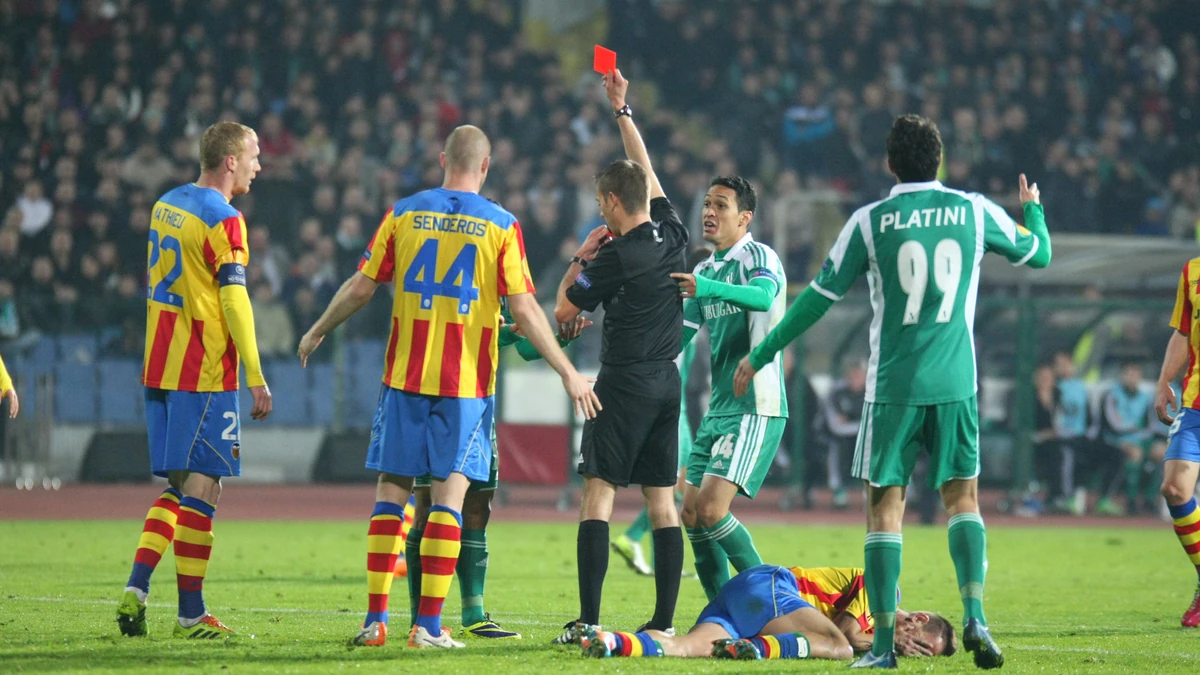
What Is a Red Card in Football? The Double Jeopardy Rule
Before 2016, a player who denied an obvious goal-scoring opportunity inside the penalty area faced three punishments at once: a penalty kick, a red card, and a suspension. Fans and coaches called this the triple punishment, and many felt it was too harsh. In 2016, the Laws changed, and the new rule is known as the double jeopardy rule.
Under the double jeopardy rule, the referee awards a penalty kick and shows only a yellow card if the offence was an attempt to play the ball or a challenge for the ball. The penalty itself is punishment enough in that case. However, the referee must still send the player off in all other circumstances. Holding, pulling, pushing, or a challenge with no possibility of playing the ball all bring a red card, even inside the penalty area.
Finally, one exception has no softening at all. A handball that denies a goal or an obvious goal-scoring opportunity is always a red card, wherever it happens. The only exception covers a goalkeeper inside the goalkeeper’s own penalty area.
What Happens After a Red Card
A red card changes the shape of a match at once. The team with ten players usually drops deeper, works harder without the ball, and looks for counter-attacks. The team with eleven players usually keeps the ball longer and pushes more players forward. After that, the balance of the game shifts, and the team a man down often tires faster.
A red card for a goalkeeper creates a special problem. The team must put an outfield player in goal or bring on a substitute goalkeeper and take off an outfield player. Either way, the team still plays with ten players.
A red card can also arrive after the final whistle. The referee has authority to take disciplinary action from the pre-match inspection until leaving the field after the match. That period includes a penalty shootout. So a player who commits a sending-off offence in that period can still receive a red card.
How Long Is a Red Card Suspension?
A red card usually brings a suspension, but the exact length depends on the competition. As a general guide, a red card for a second yellow card or for denying a goal-scoring opportunity usually brings a one-match suspension. Serious foul play and violent conduct usually bring a three-match suspension. However, these are usual lengths, not fixed rules. Different leagues and tournaments can set different bans. As of November 2026, the one-match and three-match guides above describe common practice.
What Is a Red Card in Football? VAR and Red Cards
VAR also plays a part in red-card decisions. The video assistant referee can recommend an on-field review for a possible red card. The referee can also overturn a red card after review. In other words, the referee gets a second look on the pitch-side screen before making the final call. This check helps the referee catch a serious foul missed in live play. It also helps the referee correct a red card that the pictures show was wrong.
Famous Red Cards: Zidane in the 2006 Final
The most famous red card in football history came in the 2006 World Cup final. Zinedine Zidane received a red card for headbutting Italy’s Marco Materazzi in extra time, an act of violent conduct. The referee sent off one of the greatest players of all time in the biggest match of all. France lost the final on penalties. The Zidane sending-off shows what is a red card in football at its most dramatic. It proves that no player, however great, stands above the Laws of the Game.
What Is a Red Card in Football? Frequently Asked Questions
These are the questions fans ask most about what is a red card in football.
Can a goalkeeper get a red card?
Yes. A goalkeeper faces the same sending-off offences as any other player. If the referee sends off a goalkeeper, the team must put an outfield player in goal or bring on a substitute goalkeeper.
Does a red card mean a player misses the next match?
Usually, yes. A red card normally brings a suspension. As a general guide, a second yellow card brings a one-match ban, while serious foul play and violent conduct bring a three-match ban.
What is the difference between a red card and a second yellow card?
A straight red card comes from one serious offence, such as violent conduct. A second yellow card comes from two separate cautionable offences in the same match. Both end with the player leaving the field.
Can a player get a red card after the final whistle?
Yes. The referee keeps authority from the pre-match inspection until leaving the field after the match. That period includes a penalty shootout.
Does VAR check red cards?
Yes. VAR reviews direct red-card decisions. The video assistant referee can recommend an on-field review, and the referee can also overturn a red card after review.
Can a substitute get a red card?
Yes. Only a player, substitute, substituted player or team official can receive a red or yellow card. That list includes substitutes on the bench. A substitute who commits a sending-off offence receives a red card.
Conclusion
So what is a red card in football? It is the referee’s strongest punishment. It is a sending-off for one of seven offences in Law 12, from serious foul play and violent conduct to a second yellow card. The player leaves the field, the team plays on a man short, and a suspension usually follows. The double jeopardy rule softens the punishment for a genuine attempt to play the ball inside the penalty area, and VAR gives the referee a second look at the biggest calls. Overall, from Zidane in the 2006 final to any sending-off in a local derby, the red card stays one of football’s most dramatic moments. For more football stories, visit our Sports News page. You can follow the next matches on our free live scores page, and see ideas for upcoming matches on our free football predictions page.
Related: A yellow card is the warning that comes before a red card. Read our guide on what is a yellow card in football to learn the seven cautionable offences, two yellows, suspensions and the history of the card.
