- Quick Answer
- What Is a Push in Betting and How Does It Work?
- Whole-Number Lines Push; Half-Point Lines Cannot
- Push in Betting on Point Spreads
- Push in Betting on Totals
- Push in Betting on Moneylines
- Quarter Lines: Half a Push
- Push in Betting on Accumulators
- How Much Is a Push in Betting Worth?
- Push in Betting vs Void: Not the Same Thing
- How to Place a Bet That Can Push
- Push in Betting Under Nigerian Law
- Frequently Asked Questions
- What is a push in betting?
- Can a push happen on a half-point line?
- What happens to a push in an accumulator?
- Does a push count as a win?
- Is a push the same as a void?
- Does a drawn soccer match push a moneyline bet?
- The Bottom Line
A push in betting is a result that lands exactly on the betting line, so the bet neither wins nor loses and the bookmaker gives the stake back. For example, you back a favourite at -3 and it wins by exactly 3 points. That is a push. In other words, you tied with the bookmaker — no profit, no loss, and your money comes home.
This guide gathers the push rules for every market in one place: spreads, totals, moneylines, quarter lines and accumulators.
Last updated: November 2026
Quick Answer
- A push is a tie against the line: the result lands exactly on the number you bet.
- Your full stake comes back — you make no profit and lose nothing.
- Pushes need whole-number lines; a half-point line can never push.
- In an accumulator, a pushed leg usually drops out and the ticket pays at fewer legs.
- A push is not a void: a void comes from outside the score, not from the score itself.
- Our glossary gives the short definition of a push; this guide covers every market in full.
What Is a Push in Betting and How Does It Work?
What is a push in betting in practice? The bookmaker grades every bet against a number it sets: a spread sets a margin, a total sets a combined score, and a prop sets a statistic. Most of the time the result lands on one side of that number. Occasionally it lands exactly on it. That exact landing is a push.
For example, a spread of -3 means the favourite must win by more than 3. If it wins by exactly 3, neither side has beaten the line. The book grades the bet as a push and returns the stake. Similarly, a total of 44 pushes both sides when the final combined score is exactly 44. In short, the result met the line exactly, and an exact meeting is a tie.
Meanwhile, a push is not a small win or a small loss. It is a refund. The stake reappears in your balance as if you had never placed the bet. On the slip it usually shows as “Push”, “Tie” or “Refunded”. Above all, do not count a push as a win when you track your results: it paid nothing.
Whole-Number Lines Push; Half-Point Lines Cannot
Firstly, a push needs a result that can equal the line. Similarly, whole-number lines can push, because a final score is a whole number. For example, a team can win by exactly 7, and two teams can combine for exactly 44.
Secondly, a half-point line can never push. A spread of -3.5 or a total of 44.5 has no score that lands on it, because no match finishes with half a point or half a goal. Therefore, at -3.5 a favourite that wins by 3 loses the bet, and at -2.5 the same result wins it. There is no score in between, so there is no push.
In fact, bookmakers often price spreads and totals with a half point precisely to remove the push. Bookmakers call that half point the hook. As a result, a line of -3 can push while a line of -3.5 cannot. The odds usually reflect that difference.
Push in Betting on Point Spreads
On a point spread, the favourite gives points and the underdog gets them. For example, Team A is -7 against Team B at +7. If Team A wins by 8 or more, the favourite covers. Win by 6 or less, or lose, and the underdog covers. If Team A wins by exactly 7, both sides push and both stakes come back.
Similarly, in football, the same rule applies to goal lines. For instance, a favourite at -1 wins by exactly 1 goal, so the spread bet pushes. Our guide to point spread betting covers the spread push in full, with its own worked examples. Read it for the spread detail, and use this guide for the rules across every market.
Push in Betting on Totals
On an over/under, the line is the combined score. For example, with a total of 44, a final of 24-21 (45 points) wins for the over. A final of 21-20 (41 points) wins for the under, and a final of 24-20 lands on 44 and pushes. Either way, both sides get their stakes back.
Similarly, in football, the same rule applies to goals. For instance, over 2 goals with exactly 2 goals in the match pushes in full. Over 2.5 goals with exactly 2 goals loses in full. Our over/under master guide covers totals in depth. The push rule is the same one you already know: the total landed exactly on the line.
Push in Betting on Moneylines
By contrast, a moneyline has no number to land on, so it pushes only when the game itself ends in a tie and the book offers no draw option. For example, in a sport that allows ties, a two-way moneyline on a drawn game is generally refunded.
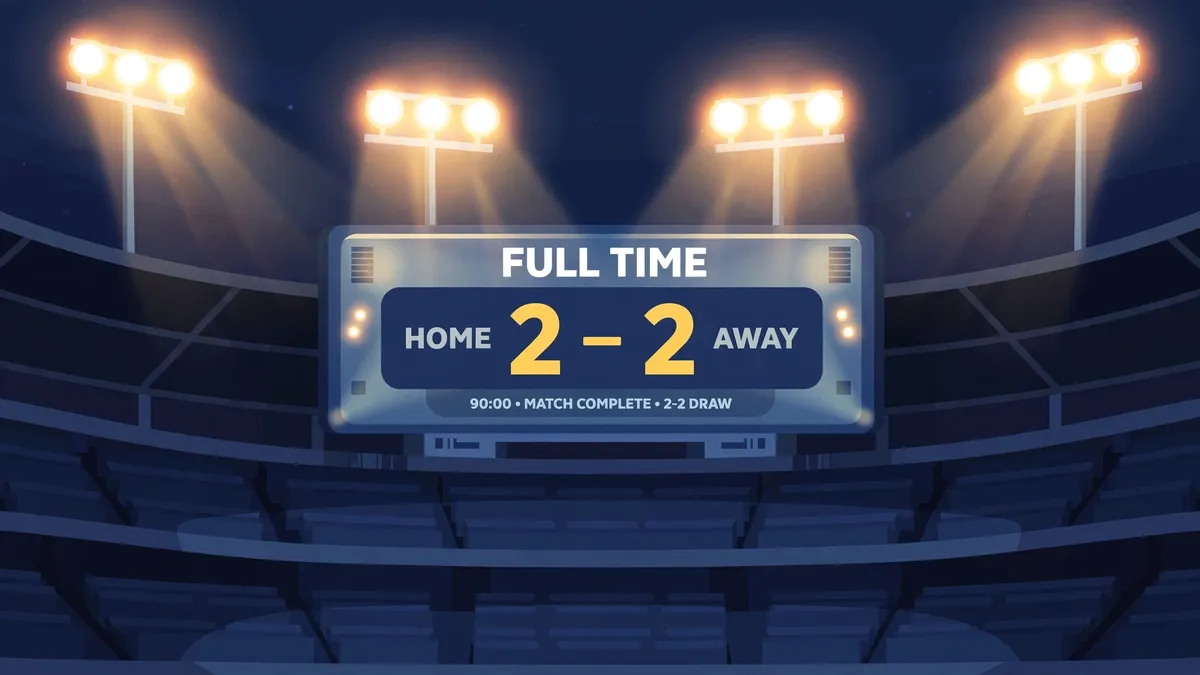
However, soccer is different. On a three-way 1X2 pick — home, draw or away — the draw is a result of its own. The draw counts after 90 minutes plus stoppage time. Therefore, a home pick on a 1-1 draw loses. It does not push, because the draw was a pick you could have taken. In short, a moneyline push needs a tie AND no draw option. Do not assume a push protects every moneyline when a game ends tied.
Quarter Lines: Half a Push
Meanwhile, quarter lines split the stake, so the whole stake never pushes on them. For example, over 2.25 goals with exactly 2 goals in the match is a half loss. The over 2 half pushes, and the over 2.5 half loses. Similarly, over 2.75 goals with exactly 3 goals is a half win. The over 2.5 half wins, and the over 3 half pushes.
Meanwhile, the Asian goal line market uses the same quarter-line maths on margins instead of totals. The rule is the same in both places: the borderline total costs or pays only half the stake. Our Asian totals guide covers the full settlement table. The one-line version is that a quarter line never refunds the whole stake.
Push in Betting on Accumulators
In an accumulator, a pushed leg usually drops out and the ticket pays at fewer legs. For example, take a four-fold with legs at 1.50, 2.00, 1.80 and 1.40. The combined odds are 7.56 (1.50 x 2.00 x 1.80 x 1.40). If the 1.80 leg pushes, the ticket pays as a three-fold at 4.20 (1.50 x 2.00 x 1.40). A ₦1,000 stake returns ₦4,200 instead of ₦7,560.
In fact, the push costs the profit on the removed leg, not the stake. The ticket stays alive on the remaining legs. However, bookmaker rules vary, so check the slip — a few books grade a pushed leg differently. Either way, a push never kills an accumulator on its own; it only shortens it.
How Much Is a Push in Betting Worth?
So what is a push worth in naira? Exactly your stake, and nothing more. For example, a pushed ₦1,000 stake returns ₦1,000, a profit of ₦0. Similarly, a pushed ₦2,000 stake at 1.91 returns ₦2,000, a profit of ₦0. In short, a push pays zero profit and costs zero.
| Market | Line | Result | Outcome |
|---|---|---|---|
| Point spread | Favourite -3 | Wins by exactly 3 | Push, stake back |
| Point spread | Favourite -3.5 | Wins by exactly 3 | Loses, no push possible |
| Total goals | Over 2 goals | Exactly 2 goals | Push, stake back |
| Total goals | Over 2.5 goals | Exactly 2 goals | Loses, no push possible |
| Moneyline (1X2) | Home win | Match ends 1-1 | Loses, draw is its own outcome |
| Moneyline (two-way) | Either team | Game ends tied | Push, stake back |
| Accumulator | One leg pushes | Other legs win | Pays at fewer legs |
Either way, the table shows the pattern: a whole-number landing refunds, a half-point landing decides, and a draw on a three-way pick loses.
Push in Betting vs Void: Not the Same Thing
Firstly, a push comes from the score landing on the line. A void comes from something outside the score — an abandoned match, a postponed match, or a player who never takes part. For example, a match called off at half-time voids the bets on it, because the match never reached a result. By contrast, a match that finishes with the total exactly on the line pushes. The match finished — the result just tied the line.
Meanwhile, both end the same way for your balance: the stake comes back. However, the reason matters when you read the slip. A push means your pick tied the line; a void means the event never settled. Do not mix the two up when you check your results.
How to Place a Bet That Can Push
Placing the bet takes four steps. Firstly, open the match and find the market — a spread, a total or a moneyline. Secondly, check the line: a whole number can push, a half point cannot. Thirdly, add the pick to your betting slip and enter your stake. Fourthly, check the slip shows the line you meant — 2 is not 2.5 — then confirm.
For example, if you want the safety of a refund on an exact landing, take the whole-number line. For instance, over 2 goals refunds on exactly 2, while over 2.5 goals loses on exactly 2. Before you confirm, read the line twice: one half point changes a refund into a loss.
Push in Betting Under Nigerian Law
Betting in Nigeria is for adults only — 18+ only. Regulation is state-led. The Supreme Court nullified the National Lottery Act 2005 on 22 November 2024, and the National Lottery Regulatory Commission framework applies only in the Federal Capital Territory. As a result, check that a bookmaker holds a licence in your own state. Expect identity checks before any payout, usually a Bank Verification Number or a National Identity Number.
Frequently Asked Questions
What is a push in betting?
It is a result that lands exactly on the betting line, so the bet neither wins nor loses and the bookmaker refunds the stake in full. People also call it a tie or “no action”.
Can a push happen on a half-point line?
No. A spread of -3.5 or a total of 44.5 can never push, because no score lands on a half point. Only whole-number lines can push.
What happens to a push in an accumulator?
The pushed leg usually drops out and the ticket pays at fewer legs. A four-fold with one pushed leg pays as a three-fold. The ticket does not lose because of the push.
Does a push count as a win?
No. A push pays zero profit. Your stake comes back, and the book grades the bet as neither a win nor a loss.
Is a push the same as a void?
No. A push comes from the score landing exactly on the line. A void comes from outside the score, such as an abandoned or postponed match. Both return the stake, but for different reasons.
Does a drawn soccer match push a moneyline bet?
No, not on a three-way 1X2 pick: the draw is a result of its own, so a home or away pick loses. A moneyline pushes on a tie only when the book offers no draw option.
The Bottom Line
In short, what is a push in betting? It is a tie against the line. The result lands exactly on the number, nobody wins, and the stake comes back in full. For instance, a favourite at -3 that wins by exactly 3 pushes. The same team at -3.5 that wins by 3 loses, because the half point removes the refund. Above all, check the line before you confirm. Whole numbers can push, half points cannot, and a pushed leg in an accumulator shortens the ticket instead of killing it.
Bet Responsibly: Betting is entertainment, not a way to make money. Only bet what you can afford to lose, and never chase losses. If betting stops being fun, take a break. For help and advice, see our Responsible Gambling page. 18+ only.