
- Quick Answer
- What Is the Fibonacci Betting System?
- How the Fibonacci Betting System Works
- Worked Example: A Five-Bet Sequence
- Losing Streaks: How Fast the Stakes Grow
- Why the Fibonacci Betting System Cannot Beat the House Edge
- Fibonacci Betting System vs Martingale
- Common Fibonacci Betting System Mistakes
- Frequently Asked Questions
- What is the Fibonacci betting system?
- How does the Fibonacci sequence work in betting?
- Does the Fibonacci betting system guarantee a profit?
- What happens after a win in the Fibonacci system?
- Is the Fibonacci system safer than Martingale?
- The Bottom Line
The Fibonacci betting system sets your stake from a famous number sequence. It runs 1, 1, 2, 3, 5, 8, 13 and so on. In fact, after a loss, you move one step forward in the sequence. After a win, you move two steps back. In short, it is a staking plan, not a way to pick winners.
This guide explains the rules. It works through a real staking chain with naira stakes, and shows why the sequence cannot beat the house edge.
Last updated: November 2026
Quick Answer
- The Fibonacci betting system is a negative progression: stakes rise after losses and fall after wins.
- Each stake is the sum of the two stakes before it. The sequence runs 1, 1, 2, 3, 5, 8, 13, 21 and so on.
- After a loss, move one step forward in the sequence. After a win, move two steps back.
- It suits even-money bets, such as red or black in roulette. Meanwhile, it does not change the odds of any bet.
- It cannot beat the house edge. As a result, a long losing run can still grow the stakes beyond your bankroll.
What Is the Fibonacci Betting System?
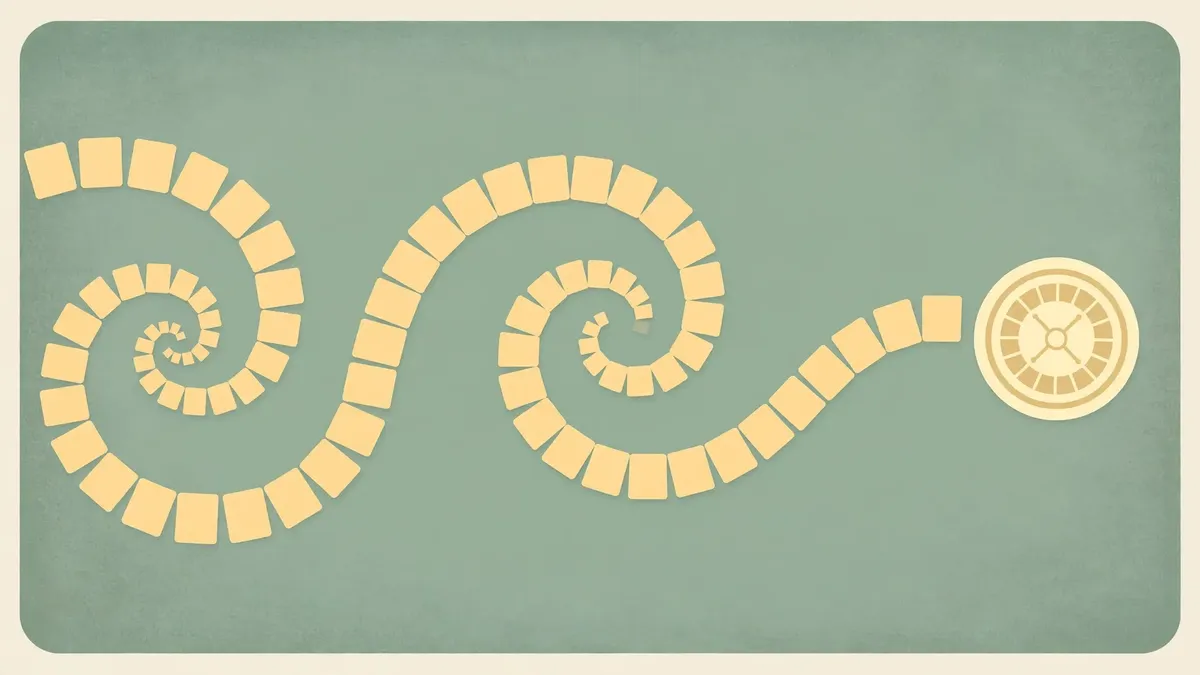
The Fibonacci betting system is a staking method built on a number sequence from medieval mathematics. In fact, the sequence is named after Leonardo of Pisa, known as Fibonacci, a 13th-century Italian mathematician. Specifically, each number in his sequence is the sum of the two numbers before it. The sequence runs 1, 1, 2, 3, 5, 8, 13, 21, 34, 55, 89 and so on.
In betting, each number in the sequence is a stake size, measured in units. To begin with, you pick a base unit, such as ₦1,000. Then the sequence tells you how many units to stake after each result. For example, a “1” means one unit (₦1,000), a “3” means three units (₦3,000), and so on.
In short, it is a negative progression system. In other words, the stake goes up after a loss and down after a win. That is the opposite of a positive progression, where you raise your stake after winning. In other words, the idea is to recover losses gradually, over several wins. You do not chase them all back with one big bet.
Crucially, the sequence only decides the size of your next stake. It does not choose what to bet on. Similarly, it does not change the probability of winning. After all, a roulette wheel has no memory of the sequence, and neither does a football match. The maths of the system is about stake sizes, nothing more.
How the Fibonacci Betting System Works
Fortunately, the rules are simple, and they fit in five steps. Firstly, choose a base unit, such as ₦1,000, and an even-money bet, such as red or black in roulette. Secondly, start at the first number in the sequence: 1 unit. Thirdly, after a loss, move one step forward and stake the next number. Fourthly, after a win, move two steps back and stake that number. Finally, if a win takes you before the start of the sequence, close the cycle and return to the first stake.
In this case, an even-money bet pays 1:1, so a win returns your stake plus the same amount again as profit. That matters, because the sequence is built for 1:1 payouts. Each number equals the sum of the two before it. As a result, a win at any point returns a profit equal to the two previous stakes combined. In other words, one win recovers the two losses before it.
Before you start, set three limits. Firstly, a base unit of 1–2% of your bankroll. Secondly, a maximum step in the sequence, such as the 8 or the 13. Thirdly, a loss limit for the session. The sequence has no built-in stop, so the limits must come from you.
Worked Example: A Five-Bet Sequence
To begin with, take a base unit of ₦1,000 and an even-money bet at odds of 2.00. Then start at the first 1 in the sequence. Here is how five bets can play out:
| Bet | Stake (units) | Stake (₦) | Result | Running total (₦) | Next stake |
|---|---|---|---|---|---|
| 1 | 1 | 1,000 | Lose | −1,000 | 1 |
| 2 | 1 | 1,000 | Lose | −2,000 | 2 |
| 3 | 2 | 2,000 | Lose | −4,000 | 3 |
| 4 | 3 | 3,000 | Win | −1,000 | 1 |
| 5 | 1 | 1,000 | Win | 0 | Cycle closed |
Next, walk through it. Firstly, bet 1 loses ₦1,000, so you move one step forward to the second 1. Secondly, bet 2 loses another ₦1,000, so you move forward to 2. Thirdly, bet 3 stakes ₦2,000 and loses, so you move forward to 3. Then bet 4 stakes ₦3,000 and wins, returning ₦6,000 (your ₦3,000 stake plus ₦3,000 profit). The running total is now −₦1,000. Then you move two steps back, from 3 to 1. Finally, bet 5 stakes ₦1,000 and wins, returning ₦2,000. In the end, the running total is now ₦0, and the cycle closes at break-even.
Losing Streaks: How Fast the Stakes Grow
In fact, the climb grows more slowly than doubling your stake, but it still grows fast. For example, after eight straight losses from a ₦1,000 unit, you have staked ₦54,000 in total. The next stake is ₦34,000. Here is the full climb:
| Consecutive losses | Stake (units) | Stake (₦) | Total staked so far (₦) |
|---|---|---|---|
| 1 | 1 | 1,000 | 1,000 |
| 2 | 1 | 1,000 | 2,000 |
| 3 | 2 | 2,000 | 4,000 |
| 4 | 3 | 3,000 | 7,000 |
| 5 | 5 | 5,000 | 12,000 |
| 6 | 8 | 8,000 | 20,000 |
| 7 | 13 | 13,000 | 33,000 |
| 8 | 21 | 21,000 | 54,000 |
Overall, the pattern is clear. After six losses you have staked ₦20,000, and the next stake is ₦13,000. After eight losses the next stake is ₦34,000, which is more than a third of a ₦100,000 bankroll on a single bet. In short, a losing run does not need to be long before the stakes become uncomfortable.
Next, compare that with doubling your stake after every loss. For example, eight straight losses at a ₦1,000 base stake cost ₦255,000 in total, and the next stake is ₦256,000. In fact, the Fibonacci climb is far gentler than that. But gentler is not the same as safe. Both systems keep raising the stake after losses. And both run into the same two walls: your bankroll and the table limit.
Why the Fibonacci Betting System Cannot Beat the House Edge
In fact, no staking system changes the odds of the game. It only changes the size of your bets. Moreover, each spin of a roulette wheel is independent. The house edge applies to every naira staked, whatever the sequence says.
On a European roulette wheel, there is one zero. In other words, the house edge is 2.70%. That means the casino keeps ₦2.70 of every ₦100 staked, on average, over the long run. On an American wheel, with two zeros, the edge is 5.26%. Unfortunately, the sequence cannot touch those numbers. It only decides how much you stake on each spin.
For example, some bettors believe the system works because a win recovers two losses. That is true, but it misses the other side of the maths. To recover, you must keep winning one bet in three, roughly, for as long as you play. The wheel does not owe you those wins. As a result, a bad run can push the stakes beyond your bankroll before the recovery arrives. Then the losses are locked in.
Similarly, the same warning applies to football betting. The sequence works the same way on any even-money bet, but the bookmaker’s margin plays the role of the house edge. If your picks lose money at flat stakes, they lose money with the sequence too. The system organises your staking; it does not improve your picks.
Fibonacci Betting System vs Martingale
Martingale is the best-known negative progression, and this system is often sold as its safer cousin. The comparison below shows why it is safer, and where the safety runs out.
| Feature | Fibonacci betting system | Martingale |
|---|---|---|
| Stake after a loss | Next number in the sequence (add the two previous stakes) | Double the previous stake |
| Stake after a win | Two steps back in the sequence | Back to the base stake |
| Recovery | One win repays the previous two losses | One win repays all previous losses |
| Total staked after 8 straight losses (₦1,000 unit) | ₦54,000 | ₦255,000 |
| Next stake after 8 straight losses | ₦34,000 | ₦256,000 |
| Risk | Stakes still grow fast in a long losing run | Stakes explode and hit limits quickly |
For a fuller look at other staking systems, see Exploring Different Betting Strategies. For the basics of progressive staking, see What Is Progressive Betting?. And for the game where this system is most often used, see How to Play Roulette for Beginners.
Common Fibonacci Betting System Mistakes
Firstly, the most common mistake is starting with too big a unit. A ₦5,000 unit looks small, but after six losses the stake is ₦40,000 and the total staked is ₦100,000. Therefore, keep the unit at 1–2% of your bankroll, so the climb has room to run.
Secondly, many bettors use the system on bets that do not pay even money. The sequence is built for 1:1 payouts, where a win repays the two previous stakes. On a bet at odds of 3.00 or 5.00, that maths breaks down. The win still pays, but the recovery logic no longer works as designed.
Thirdly, some bettors refuse to stop at their limit. They reach the 13 or the 21, feel they are due a win, and keep climbing. That is exactly how a bad run turns into a wiped-out bankroll. The sequence has no stop built in. So your stop must be decided before the first bet, not during a losing run.
Finally, do not treat a completed cycle as proof the system works. A cycle that closes at break-even feels like a win, but you risked up to ₦54,000 to finish level. The system is a way to organise stakes, not a source of profit. Judge it by your results over hundreds of bets, not by one lucky cycle.
Frequently Asked Questions
What is the Fibonacci betting system?
In short, it is a negative progression staking method. Your stakes follow the sequence 1, 1, 2, 3, 5, 8, 13 and so on. After a loss you move one step forward, and after a win you move two steps back. It is used mainly on even-money bets.
How does the Fibonacci sequence work in betting?
Each number in the sequence is the sum of the two numbers before it. Your stake is the current number multiplied by your base unit. For example, with a ₦1,000 unit, the number 5 means a ₦5,000 stake. After a loss you move to the next number, and after a win you move two numbers back.
Does the Fibonacci betting system guarantee a profit?
No. The system only changes your stake sizes; it does not change the odds of any bet. On a European roulette wheel, the house keeps 2.70% of everything staked over the long run, whatever sequence you follow. A long losing run can still grow the stakes beyond your bankroll.
What happens after a win in the Fibonacci system?
After a win, you move two steps back in the sequence. For example, if you win on the 5, your next stake is the 2. If a win takes you before the start of the sequence, the cycle closes. Then you return to the first stake of 1 unit.
Is the Fibonacci system safer than Martingale?
Yes, in one sense: the stakes grow more slowly. After eight straight losses from a ₦1,000 unit, Fibonacci has staked ₦54,000 in total, while Martingale has staked ₦255,000. However, both systems raise stakes after losses, and both can wipe out a bankroll in a long losing run.
The Bottom Line
It is an elegant way to organise your stakes. The sequence is simple, the rules are clear, and the climb is far gentler than doubling after every loss. For bettors who want structure without the violence of Martingale, it is an appealing choice.
However, structure is all it offers. It does not change the odds. It does not create an edge. And it does not protect you from a long losing run. Use it with a small unit, a fixed stop, and honest expectations. The sequence is a tool for managing stakes, not a shortcut to profit.
Bet Responsibly: Betting is entertainment, not a way to make money. Only bet what you can afford to lose, and never chase losses. If betting stops being fun, take a break. For help and advice, see our Responsible Gambling page. 18+ only.