
- What Is a Tackle in Football?
- How the Laws Judge a Tackle
- What Is a Tackle in Football? The Three Thresholds
- Types of Tackles in Football
- What Is a Tackle in Football? The Slide Tackle
- Tackles from Behind: Banned or Not?
- What Is a Tackle in Football? Winning the Ball First
- What Is a Tackle in Football? The Betting Angle
- Frequently Asked Questions
- Is a slide tackle legal?
- What is a tackle in football, and is it the same as a foul?
- Can a tackle from behind be legal?
- What happens after a reckless tackle?
- Do defenders have to win the ball to make a legal tackle?
- Conclusion
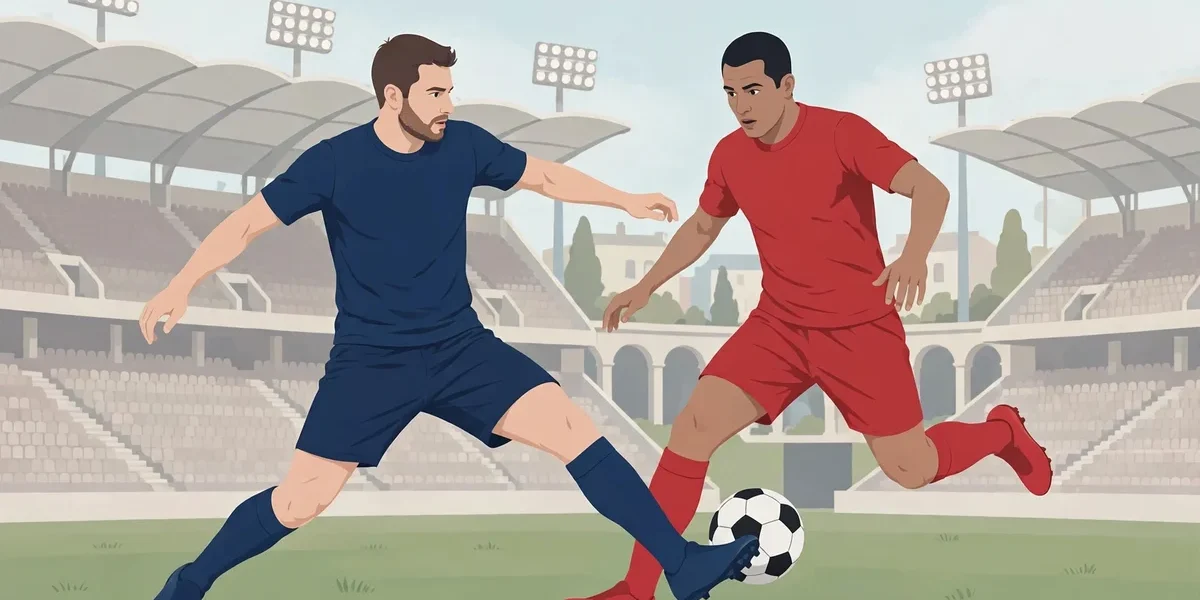
What is a tackle in football? It is a player’s effort to take the ball away from an opponent using the foot or feet. In short, tackling is the main way defenders win the ball back. In fact, fans argue about tackles more than almost any other part of the game.
Last updated: November 2026
Quick Answer
- A tackle is a player’s effort to take the ball away from an opponent with the foot or feet.
- There is no offence called “tackling” in the Laws of the Game — the offence is a tackle that is careless, reckless or uses excessive force.
- A careless tackle gives a free kick, a reckless tackle adds a yellow card, and excessive force means a red card.
- A slide tackle is not banned, and winning the ball first does not make a bad tackle legal.
- Tackles from behind are not banned either — they are judged the same way as any other tackle.
What Is a Tackle in Football?
A tackle is one of the oldest skills in football. In other words, a tackle is simply a defender’s attempt to win the ball from an opponent. For example, a defender may step in and block the ball or poke it away with a toe. A defender may also slide along the ground to take it. In each case, the aim is the same.
Above all, tackling is a core defending skill. Centre-backs, full-backs and defensive midfielders tackle more than any other players. In fact, a team that tackles well wins the ball back and starts attacks of its own. For the full picture of where tacklers play, see our guide to football positions.
How the Laws Judge a Tackle
Many fans ask what is a tackle in football under the rules, and the answer surprises them: there is no offence called “tackling” in the Laws of the Game. Instead, Law 12 names the offence as “tackles or challenges in a manner considered by the referee to be careless, reckless or using excessive force”. In other words, the tackle itself is fine — the problem is how the player makes it.
Next, the referee judges what the player does, not what the player meant to do: the Laws dropped the word “intention” in 1996/97, so a player cannot escape punishment by saying they meant to win the ball.
What Is a Tackle in Football? The Three Thresholds
Law 12 sets three levels for a bad tackle. First, a careless tackle shows “a lack of attention or consideration when making a challenge or acts without precaution”. In short, the player is sloppy rather than dangerous. As a result, the tackle gives a free kick but no card.
Second, a reckless tackle shows that the player “acts with disregard to the danger to, or consequences for, an opponent”. In other words, the player knows the risk and goes in anyway. As a result, the tackle gives a free kick plus a yellow card. For the full guide, see what a yellow card means in football.
Third, a tackle with excessive force “exceeds the necessary use of force and/or endangers the safety of an opponent”. Above all, this is the level that ends careers, so it gives a free kick plus a red card for serious foul play. For the full guide, see what a red card means in football.
The table below sums up the three levels.
| Level | What it means | Punishment |
|---|---|---|
| Careless | A lack of attention or consideration; acts without precaution | Free kick, no card |
| Reckless | Acts with disregard to the danger to, or consequences for, an opponent | Free kick plus a yellow card |
| Excessive force | Exceeds the necessary use of force and/or endangers the safety of an opponent | Free kick plus a red card (serious foul play) |
Types of Tackles in Football
There are four main types of tackles. First, the standing tackle, also called a block tackle, is the most common: the defender stays on the feet, steps in, and blocks or pokes the ball away. For example, a centre-back uses it when an attacker tries to dribble past. In fact, it is the safest type.
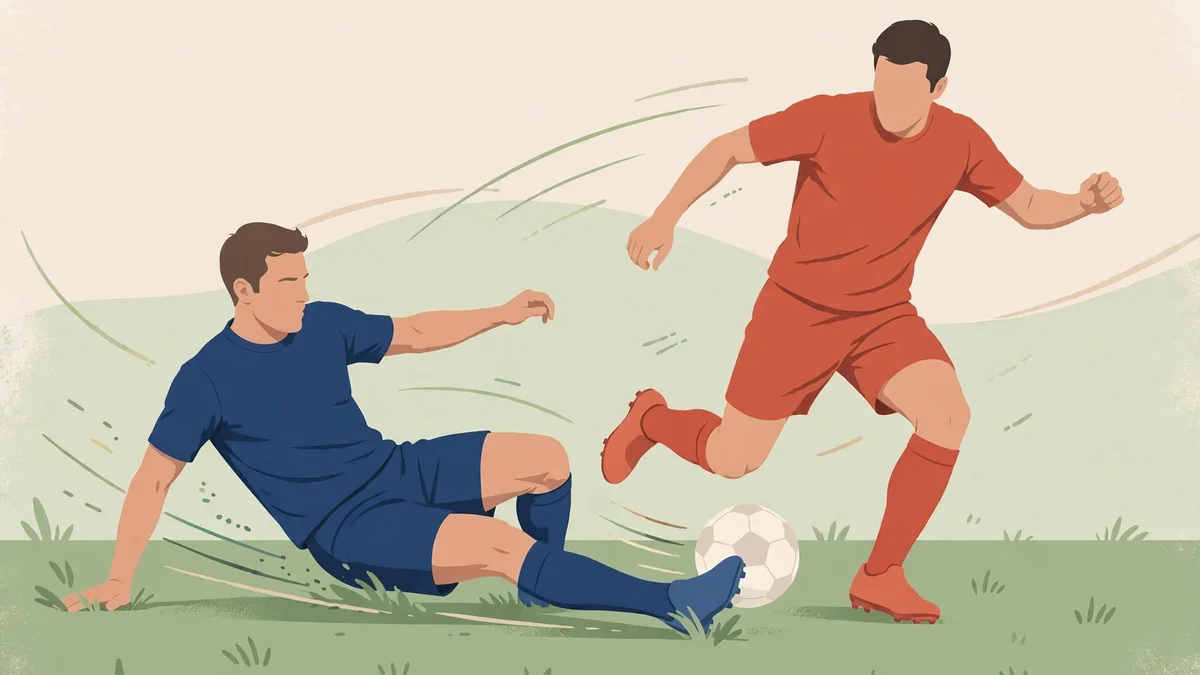
Second, the slide tackle sends the defender to the ground, foot first, to win the ball. Meanwhile, the defender must time it well, because a mistimed slide leaves the team short at the back.
Third, the poke tackle is a quick reach with the toe: a defender chasing an attacker pokes the ball away from behind, or a full-back pokes it out for a throw-in. In short, it is a small, sharp standing tackle.
Fourth, the shoulder-to-shoulder challenge is a fair charge for the ball, shoulder against shoulder. In other words, it is legal if it is not careless, reckless or with excessive force.
What Is a Tackle in Football? The Slide Tackle
The slide tackle causes more arguments than any other type. First, many fans believe it is banned. In fact, no rule in the Laws bans sliding from behind, from the side, or anywhere on the field. In short, a slide tackle is legal as long as it is not careless, reckless or with excessive force.
Next, a good slide tackle wins the ball cleanly and keeps the player in control: a defender may slide in from the side, win the ball, and spring back to the feet. Above all, the slide must be timed well — a late slide, a slide with studs showing, or a slide at speed into an opponent turns a fair tackle into a foul.
Tackles from Behind: Banned or Not?
Tackles from behind cause the same confusion. In fact, referees treated them very strictly in the 1990s, and many fans still think they are banned. However, there is no current ban. Referees judge a tackle from behind the same way as any other tackle: careless, reckless or excessive force.
In other words, a clean tackle from behind is legal: a defender may poke the ball away from behind without touching the opponent at all. On the other hand, a tackle from behind that trips the attacker, or hits the legs before the ball, is a foul. As a result, the direction matters far less than the action itself.
What Is a Tackle in Football? Winning the Ball First
One myth refuses to die: “I got the ball, so it cannot be a foul.” First, winning the ball first does not protect a player, because contact with the ball is irrelevant to the referee’s judgement. In other words, a tackle that wins the ball can still be a foul if it endangers the opponent.
Next, the order of contact matters: contact with the opponent before the ball is a foul. For example, a defender who catches the attacker’s ankle first has still fouled the attacker.
Above all, the worst tackles are lunges. A lunge is a challenge for the ball from the front, the side or behind, using one or both legs. With excessive force, or endangering the safety of an opponent, it is serious foul play and earns a red card. The Laws call out the two-footed lunge explicitly. In fact, the worst slide tackles are two feet forward, studs up, above ball height, at speed.
What Is a Tackle in Football? The Betting Angle
Tackles matter for betting too. First, “player to be booked” markets pay out when a named player gets a yellow card. Since a reckless tackle earns a yellow card, a player who tackles hard and often is a likely candidate. In other words, defenders and defensive midfielders who make many tackles face the most risk of a booking.
Frequently Asked Questions
Is a slide tackle legal?
Yes, a slide tackle is legal: no rule in the Laws of the Game bans sliding. What matters is whether the tackle is careless, reckless or uses excessive force. A clean slide tackle is fine, while a late slide with studs showing is a foul and can earn a card.
What is a tackle in football, and is it the same as a foul?
In short, a tackle in football is a player’s effort to take the ball away from an opponent with the foot or feet. No, a tackle is not the same as a foul. A tackle becomes a foul only when it is careless, reckless or uses excessive force. Most tackles are legal and win the ball cleanly.
Can a tackle from behind be legal?
Yes, a tackle from behind can be legal. There is no ban on tackles from behind, and referees judge them the same way as any other tackle. A clean poke of the ball from behind is fine. On the other hand, a trip, or a hit on the legs first, is a foul.
What happens after a reckless tackle?
A reckless tackle gives a free kick to the other team plus a yellow card. In short, the player acted with disregard to the danger to the opponent. Two yellow cards in one match mean a red card and a sending off.
Do defenders have to win the ball to make a legal tackle?
No, winning the ball is not required for a tackle to be legal. For example, a standing tackle may block the ball without winning it, and that is still fine. What matters is that the tackle is not careless, reckless or with excessive force. On the other hand, winning the ball first does not save a tackle that endangers an opponent.
Conclusion
In short, what is a tackle in football? It is a defender’s effort to win the ball with the foot or feet. Above all, most tackles are legal. In fact, the Laws do not ban tackling, sliding or tackles from behind. Instead, they punish tackles that are careless, reckless or use excessive force. Learn the three levels, watch the point of contact, and the next tackle you see will make much more sense.
