- Quick Answer
- How a Tennis Match Works
- How to Bet on Tennis for Beginners: The Main Markets
- How to Bet on Tennis for Beginners: Handicaps
- How to Bet on Tennis for Beginners: Totals and Tiebreaks
- How to Bet on Tennis for Beginners: Live Betting
- How to Bet on Tennis for Beginners: Retirements and Walkovers
- Surfaces and How They Change a Match
- The Four Grand Slams
- A Worked Example
- Conclusion
- Frequently Asked Questions
- How to Bet on Tennis for Beginners: What Is the Easiest Market to Start With?
- What Happens to My Bet If a Player Retires?
- What Is a Tiebreak in Tennis?
- How Many Sets Are Played in a Men's Grand Slam Match?
- Can a Tennis Match End in a Draw?
- Bet Responsibly
Learning how to bet on tennis for beginners starts with one simple idea: tennis has no draws, so every match has a winner. For that reason, the match-winner market is a two-way choice. In short, this guide explains the main markets, the handicaps, the totals, live betting, and what happens when a player retires.
Last updated: November 2026
Quick Answer
- Tennis is scored in points, games and sets, and every match produces a winner.
- The simplest markets are match winner, set betting, handicaps and total games.
- A tiebreak counts as one game for totals and handicaps.
- If a player retires, settlement rules vary by bookmaker, so check them first.
How a Tennis Match Works
Tennis scores in three layers: points make games, games make sets, sets make the match. Firstly, players count points as 15, 30, 40, then game, and a player needs four points and a two-point lead to take a game. At 40-40, known as deuce, play runs on until one player leads by two.
Secondly, a player wins a set by taking six games with a lead of two, so 6-0 to 6-4, or 7-5. At 6-6, a tiebreak settles the set: players count points as 1, 2, 3, and the first to 7 with a two-point lead takes it.
Thirdly, most matches are best of three sets: the ATP and WTA tours, women’s Grand Slam matches, and doubles. However, men’s singles at the four Grand Slams runs to best of five. The winner takes two sets first in a best-of-three match, and three first in a best-of-five match.
Finally, a set tied at 6-6 in the deciding set of a Grand Slam goes to a 10-point tiebreak: first to 10, win by two. The Australian Open adopted it in 2019, and the other Slams followed in 2022. There is no draw in tennis, so the match-winner market is a two-way market. In contrast, football offers a third option, the draw, which you can read about in our guide to 1X2.
How to Bet on Tennis for Beginners: The Main Markets
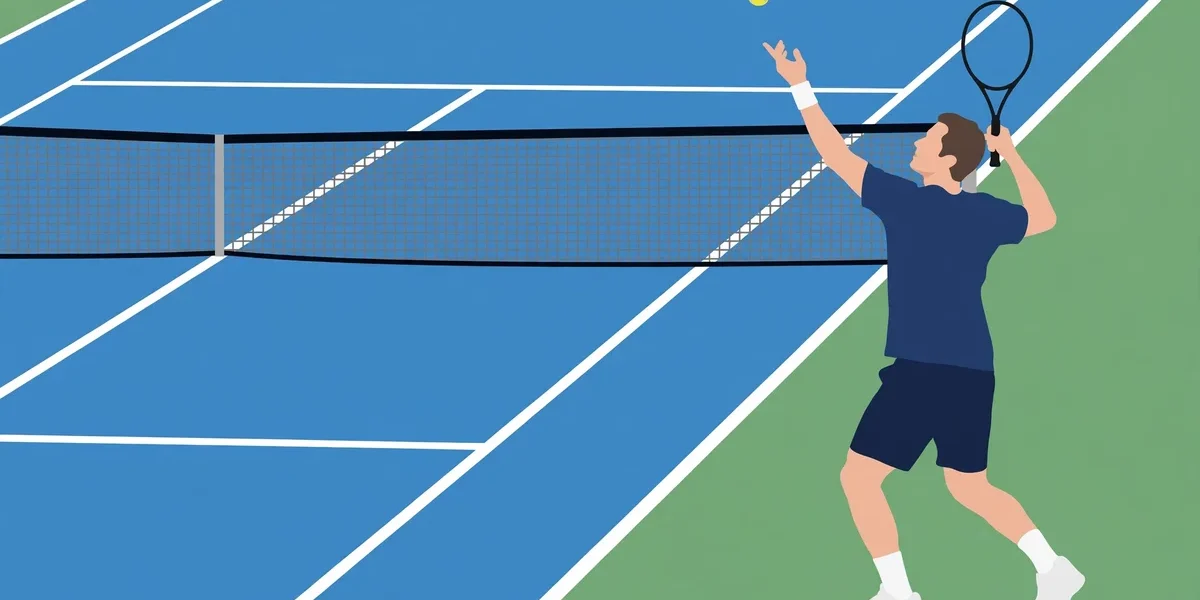
Match winner is the simplest market: pick which player wins the match. In addition, set betting asks you to predict the exact final score in sets, for example 2-0 or 2-1. As a result, it pays more than match winner, because you must get the winner and the margin right.
Furthermore, first set winner is a standalone market on who wins the opening set. Similarly, set winner covers who wins a given set, and it settles when that set ends. Total sets is another option: bet on how many sets the match lasts, for example over or under 2.5 sets.
How to Bet on Tennis for Beginners: Handicaps
Set handicap gives a player a virtual head start in sets. For example, -1.5 sets wins only if the player wins in straight sets (2-0). On the other hand, +1.5 sets wins if the player wins at least one set.
Similarly, game handicap counts games across the whole match. For example, -3.5 games means the player must win at least four more games than their opponent. In contrast, +3.5 games wins if the player wins the match or loses by three games or fewer. As a result, handicaps let you back a strong favourite at better odds, or back an underdog to keep it close.
How to Bet on Tennis for Beginners: Totals and Tiebreaks
Total games asks whether the combined games in the match go over or under a line. In practice, typical lines for a best-of-three match sit in the low 20s, for example 21.5 or 22.5. In addition, a tiebreak counts as one game for totals and handicaps, so a 7-6 set is 7 games to 6.
Furthermore, you can bet on whether any set goes to a tiebreak. In short, totals and tiebreaks reward a read on how close the match will be, not who wins it.
How to Bet on Tennis for Beginners: Live Betting
Live betting means betting after the match has started, with odds updating after every point, game and set. In particular, tennis suits it because the score changes point by point. For example, common live markets include match winner, next game winner, next set winner and next point winner.
However, live odds can move within seconds, and markets often pause briefly while a point is in play, then reopen with new odds. In practice, the server usually holds the advantage in a next-point or next-game market. Therefore, live betting is the natural next step once you know how to bet on tennis for beginners. For a fuller guide to betting during play, read our article on live bet.
How to Bet on Tennis for Beginners: Retirements and Walkovers
Retirements are the one area where tennis betting rules differ the most. There is no universal rule, so check the bookmaker’s own rules before betting.
In practice, the most common rule is the “one set” rule. If the players complete at least one set, match-winner bets settle on the player who advances. If they complete no set, all match bets are void and the bookmaker returns the stakes.
In addition, markets decided before the retirement stand. For example, a first-set bet that had already settled stays settled even if the player retires in the second set. Set betting needs every set required to win the match to be played; if a player receives the match early, all correct-set-score bets are void.
A walkover differs from a retirement: it happens when a player withdraws before the first point is played, and it voids every market with a full refund. Finally, if rain, darkness or heat suspends a match and it later resumes, bets settle normally. If officials abandon it, undecided markets are void.
Surfaces and How They Change a Match
Players play tennis on three main surfaces: hard, clay and grass. In particular, the surface changes ball speed and bounce height. Hard courts give a consistent bounce and a medium pace.
In contrast, clay is the slowest surface. It slows the ball and produces a high bounce, which extends rallies and produces more breaks of serve. Meanwhile, grass is the fastest surface. The ball stays low and skids, serving matters more, and matches feature more tiebreaks and fewer breaks of serve.
As a result, a player can be far stronger on one surface than another, and bookmakers price matches that way. Above all, surface form is only one part of judging a match. For example, Rafael Nadal won 14 French Open titles on clay with a 112-4 record at Roland Garros. In addition, the grass season lasts only a few weeks a year, so grass form rests on few matches.
The Four Grand Slams
The four Grand Slam tournaments are the biggest events in tennis: the Australian Open, the French Open (Roland Garros), Wimbledon and the US Open. Each lasts two weeks and offers the most ranking points.
| Tournament | When | Where | Surface | First held |
|---|---|---|---|---|
| Australian Open | January | Melbourne Park, Melbourne | Hard | 1905 |
| French Open (Roland Garros) | Late May to early June | Stade Roland Garros, Paris | Red clay | 1891 |
| Wimbledon | Late June to early July | All England Club, London | Grass | 1877 |
| US Open | Late August to early September | New York | Hard | 1881 |
In particular, the French Open is the only Slam played on clay. It dates to 1891 and opened to international players in 1925. Wimbledon is the oldest tournament, first played in 1877, and the only Slam on grass. Men’s singles at all four Slams is best of five sets; women’s singles is best of three.
A Worked Example
Take a match-winner bet at odds of 1.50 as an illustration only — the odds are made up, not a real price. For example, a stake of ₦1,000 returns ₦1,500, which is ₦500 profit. Similarly, the same maths applies to any market: return equals stake times odds, and profit equals return minus stake. For more guides, visit the Betting Academy.
Conclusion
Tennis betting is simpler than it looks once you know the scoring. Firstly, start with the match winner, then try handicaps and totals when you are comfortable. Secondly, always check the retirement rules before you bet. That is the short version of how to bet on tennis for beginners. Above all, treat betting as entertainment, and never stake more than you can afford to lose.
Frequently Asked Questions
How to Bet on Tennis for Beginners: What Is the Easiest Market to Start With?
In short, the match winner is the easiest market: pick the player you think will win the match. It is a two-way market, since tennis has no draws.
What Happens to My Bet If a Player Retires?
It depends on the bookmaker. Under the most common rule, bets settle if at least one set was completed, and they are void if no set was completed. Decided markets stand.
What Is a Tiebreak in Tennis?
A tiebreak settles a set tied at 6-6. Players count points as 1, 2, 3, and the first to 7 with a two-point lead takes it 7-6. In a Grand Slam deciding set, officials use a 10-point tiebreak instead.
How Many Sets Are Played in a Men’s Grand Slam Match?
Men’s singles at the four Slams is best of five sets, so the winner takes three first. Everywhere else, matches are best of three sets.
Can a Tennis Match End in a Draw?
No. Every tennis match produces a winner, so the match-winner market is a two-way market with no draw option.
Bet Responsibly
Betting is for adults aged 18 and over only. Betting is entertainment, not a way to make money. Only stake what you can afford to lose. If betting stops being fun, take a break and seek help. For support, visit our Responsible Gambling page.